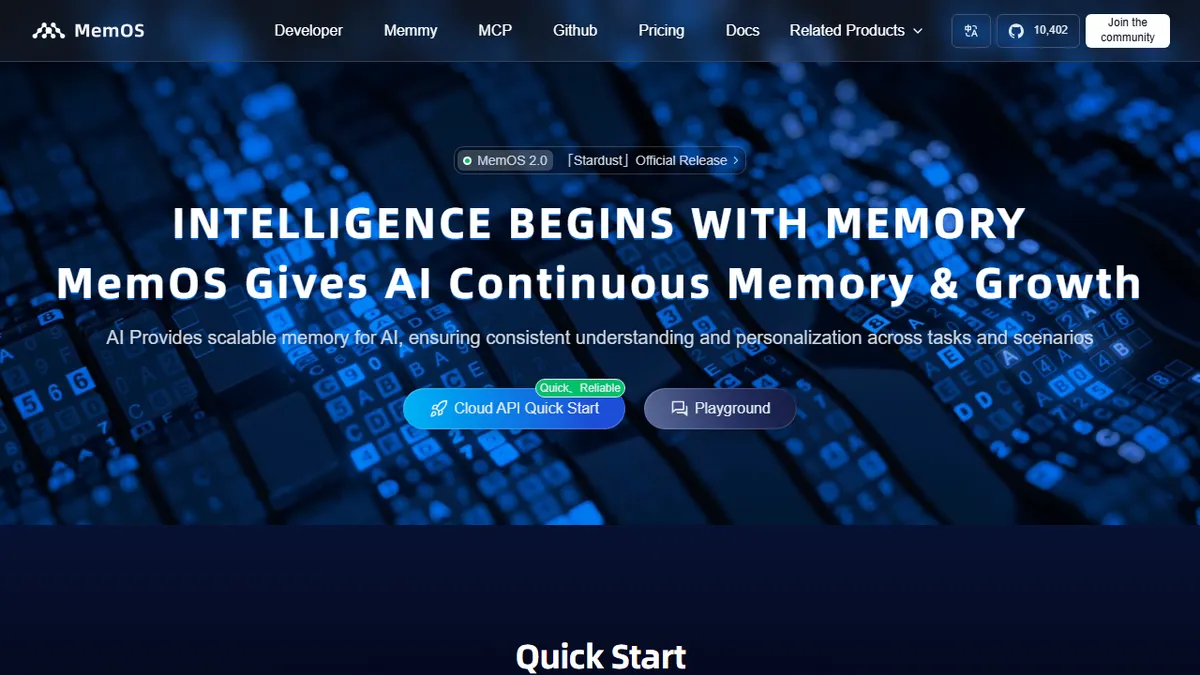

MemOS
Memory operating system that gives LLM agents long-term, structured recall across sessions and models.
In short
MemOS is a memory operating system for LLM agents, providing structured, long-term recall across sessions and models. It offers millisecond-latency APIs and dynamic knowledge graphs for stateful applications.
Pick MemOS if you are building stateful agents or RAG systems that need durable, structured memory beyond a single vector store.
Skip it if you just want a chatbot UI or a managed assistant; this is plumbing, not a product end users touch.
MemOS is a memory management layer for AI applications, positioning itself as an operating system for agent and RAG memory rather than a model or chat product. It provides millisecond-latency read/write APIs, structured memory with dynamic knowledge graphs, and cross-model memory sharing so an assistant can carry context between sessions, tools, and even different underlying LLMs.
The project ships as an open-source core on GitHub plus a hosted service at memos.openmem.net with free, Starter, Pro, and Enterprise tiers gated by API calls and knowledge-base capacity. It targets developers building stateful agents, customer-facing assistants, or long-running RAG pipelines who have outgrown ad-hoc vector-store-plus-summary patterns and want a dedicated substrate for episodic, semantic, and procedural memory.
Integrations cover MCP (Model Context Protocol), common agent frameworks, and enterprise deployments at firms like Alibaba, Anker, and Haier. Deployment is flexible across cloud, private, on-prem, and hybrid setups, which matters for teams that can't ship user transcripts to a third-party SaaS.
MemOS is a credible attempt to standardize agent memory as a first-class layer rather than something every team reinvents on top of Pinecone. The open-source-plus-hosted split is the right shape, and MCP support is forward-looking. Worth a real prototype if you are past toy-agent stage.
— The AI Tool Bible editorial team
Pros
- ✅ Open-source core with a hosted managed option
- ✅ Structured memory plus dynamic knowledge graph, not just vector recall
- ✅ Cross-model memory sharing and MCP integration
- ✅ Self-host, on-prem, and hybrid deployment supported
Cons
- ⚠️ Infrastructure piece, requires engineering work to integrate
- ⚠️ Younger ecosystem than vector DBs like Pinecone or Weaviate
- ⚠️ Pricing for paid tiers is steep once promo ends
Use cases
Frequently asked
- How much does MemOS cost?
- MemOS offers a freemium model. The Free, Starter, and Pro tiers are currently listed at ¥0 (originally ¥150 and ¥2000/month respectively). Enterprise pricing is flexible and depends on specific deployment needs.
- What integrations does MemOS support?
- MemOS integrates with the Model Context Protocol (MCP), common agent frameworks, and enterprise deployments. It supports flexible deployment options including cloud, private, on-prem, and hybrid setups for various infrastructure requirements.
- Is MemOS suitable for simple chatbots?
- No, skip it if you just want a chatbot UI or managed assistant. MemOS is infrastructure plumbing for developers building stateful agents or RAG systems that need durable, structured memory beyond single vector stores.
- Can MemOS share memory across different LLMs?
- Yes, MemOS provides cross-model memory sharing. This allows assistants to carry context between sessions, tools, and even different underlying LLMs, ensuring consistent recall regardless of the specific model used.
- What types of memory does MemOS manage?
- MemOS manages episodic, semantic, and procedural memory. It uses structured memory with dynamic knowledge graphs to provide a dedicated substrate for long-running RAG pipelines and stateful agents.
Explore related
Compare with similar tools
All in Agents →LangGraph
FeaturedStateful, graph-based agent orchestration from LangChain.
CrewAI
FeaturedPython framework for multi-agent orchestration.
Ernie Bot
Baidu's Mandarin-first ChatGPT rival, powered by the ERNIE model family
Moveworks
The enterprise AI assistant that searches, answers, and takes action across your business systems
AWS Bedrock
Build and scale generative AI applications with foundation models
Claude Agent SDK
Anthropic's official SDK for building autonomous Claude agents.