Mem0
Persistent memory layer for AI agents and LLM apps
In short
Mem0 provides a persistent memory layer that allows LLM agents to retain user context across sessions without bloating prompts. It uses hierarchical distillation to store durable facts in vector and graph stores, reducing token spend and latency. It is best for teams building stateful AI applications like support copilots or personal assistants.
Teams shipping stateful AI agents, copilots, or long-running chat apps where cross-session recall of user facts, preferences, and history is a product requirement rather than a nice-to-have.
One-off single-turn chatbots, stateless RAG-over-docs apps, or hobby projects where a short conversation buffer inside the prompt is already enough — the extra infra is not worth it.
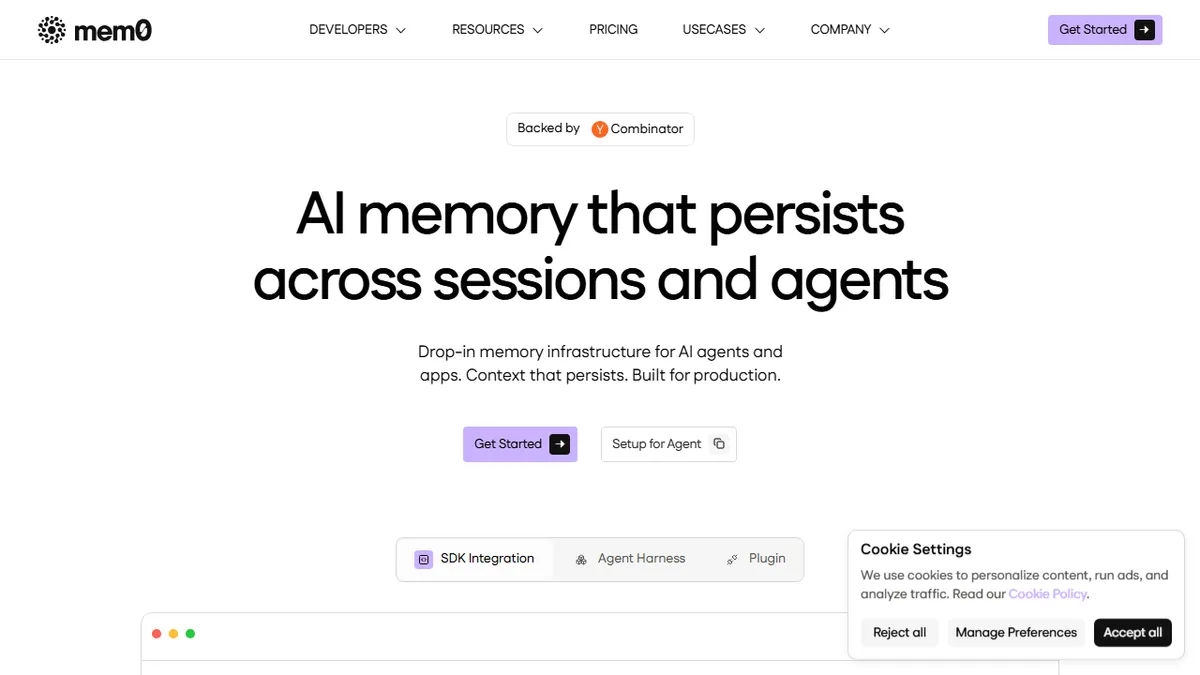
Mem0 is an open-source memory layer that gives LLM agents and chat apps persistent, cross-session context without stuffing every prior turn into the prompt. It sits between your model and your data flow: you call add() with a conversation or event, Mem0 runs a hierarchical distillation pass that extracts durable facts, preferences, and entities, and stores them in a vector-and-graph backed store; you then call search() at inference time to pull only the fragments that matter for the current query. The result is smaller prompts, lower token spend, faster latency, and agents that actually remember what a user told them three sessions ago. It ships as a Python and TypeScript SDK plus a managed cloud (with REST API, CLI, and dashboards) and a self-hostable OSS core, and it plugs into common stacks including OpenAI, Anthropic, Google, and open-weights models via LiteLLM, plus vector stores like Qdrant, Pgvector, Chroma, Weaviate, and graph stores like Neo4j. Typical adopters are teams building customer support copilots, personal AI companions, healthcare and education assistants, sales/CRM enrichment, or long-running autonomous agents where losing state between sessions is the difference between a demo and a product. The managed tier adds project isolation, analytics, SOC 2 Type I, HIPAA readiness, and enterprise governance (audit logs, SSO, air-gapped deployment) for teams that outgrow the OSS install.
Mem0 is the memory layer I reach for first when an agent needs to remember a user across sessions without me building a custom summariser and vector-store pipeline. The OSS-plus-managed split is honest, and the distillation approach genuinely does what it says on the tin. Just be deliberate about which model does the extraction — cheap out there and your 'memory' is mostly noise.
— The AI Tool Bible editorial team
Pros
- ✅ Open-source core with a permissive Apache-2.0 license and a large community — you can self-host end to end if you don't want a managed dependency
- ✅ Model-agnostic and vector-store-agnostic: works with OpenAI, Anthropic, Gemini, Ollama, Qdrant, Pgvector, Chroma, Weaviate, Neo4j and more via drop-in providers
- ✅ Genuine token savings — the hierarchical distillation writes compact facts instead of raw transcripts, which shrinks retrieval prompts and speeds up long-lived agents
- ✅ Both hosted and self-hosted paths, so you can prototype on the free tier and later move to Kubernetes / air-gapped / on-prem without rewriting
- ✅ Enterprise-grade governance on paid tiers: SOC 2 Type I, HIPAA, audit logs, SSO, project isolation — rare in the memory-layer space
- ✅ Simple, well-documented Python and TypeScript SDKs with a small surface (add / search / update / delete) that drops into existing agent frameworks
Cons
- ⚠️ Extraction quality is only as good as the LLM you point it at — cheap models produce shallow or noisy memories and can miss nuance
- ⚠️ Managed pricing scales quickly if your agent writes memory aggressively; the $19 Starter's 50k add-cap is easy to blow past on chatty workloads
- ⚠️ Adds an extra hop and its own vector/graph infra to reason about — for small single-session chatbots it is real overkill
- ⚠️ Graph memory features are newer and less battle-tested than the flat vector-memory path; expect some rough edges on complex ontologies
- ⚠️ Self-hosted setup with graph + vector + LLM providers has meaningful ops surface if you were hoping for a one-line install
Use cases
Frequently asked
- How does Mem0 reduce token usage in AI applications?
- Mem0 runs a hierarchical distillation pass to extract durable facts, preferences, and entities from conversations. It stores these compact fragments in a vector-and-graph backed store, allowing the system to retrieve only relevant data at inference time rather than stuffing every prior turn into the prompt.
- What models and vector stores are compatible with Mem0?
- Mem0 is model-agnostic and works with OpenAI, Anthropic, Google, and open-weights models via LiteLLM. It supports vector stores like Qdrant, Pgvector, Chroma, and Weaviate, as well as graph stores like Neo4j.
- Is Mem0 available for self-hosting?
- Yes, Mem0 ships as an open-source core with an Apache-2.0 license that can be self-hosted. It also offers a managed cloud option with a REST API, CLI, and dashboards for teams requiring enterprise governance features.
- What are the pricing tiers for Mem0?
- Mem0 offers a freemium model with a free Hobby tier. Paid plans include Starter at $19, Pro at $249, and a custom Enterprise tier. The managed tier adds features like SOC 2 Type I, HIPAA readiness, and SSO.
- Who should not use Mem0?
- Mem0 is not recommended for one-off single-turn chatbots, stateless RAG-over-docs apps, or hobby projects where a short conversation buffer inside the prompt is sufficient, as the additional infrastructure may be overkill.
Explore related
Compare with similar tools
All in Agents →LangGraph
FeaturedStateful, graph-based agent orchestration from LangChain.
CrewAI
FeaturedPython framework for multi-agent orchestration.
Ernie Bot
Baidu's Mandarin-first ChatGPT rival, powered by the ERNIE model family
Moveworks
The enterprise AI assistant that searches, answers, and takes action across your business systems
AWS Bedrock
Build and scale generative AI applications with foundation models
Claude Agent SDK
Anthropic's official SDK for building autonomous Claude agents.