HoneyHive
✓ Editorially verifiedOpenTelemetry-native observability and evaluation platform for LLM agents in production.
In short
HoneyHive provides a unified workflow for tracing, evaluating, and annotating LLM agents in production. It is best for teams shipping non-trivial agents who need to catch regressions via CI/CD and manage human review without stitching multiple tools.
Pick HoneyHive if you're running real LLM agents in production and need tracing, evals, and human review under one OTel-native platform.
Skip it if you're prototyping a single prompt, want a self-hostable open-source stack, or need transparent published pricing before talking to sales.
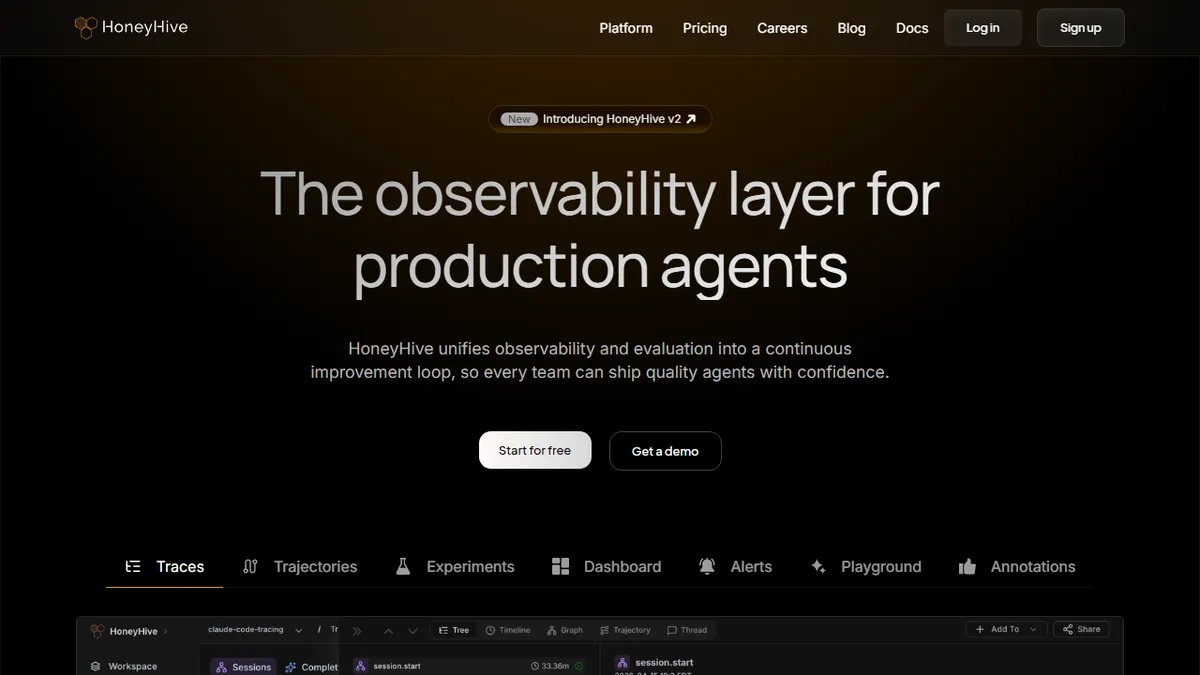
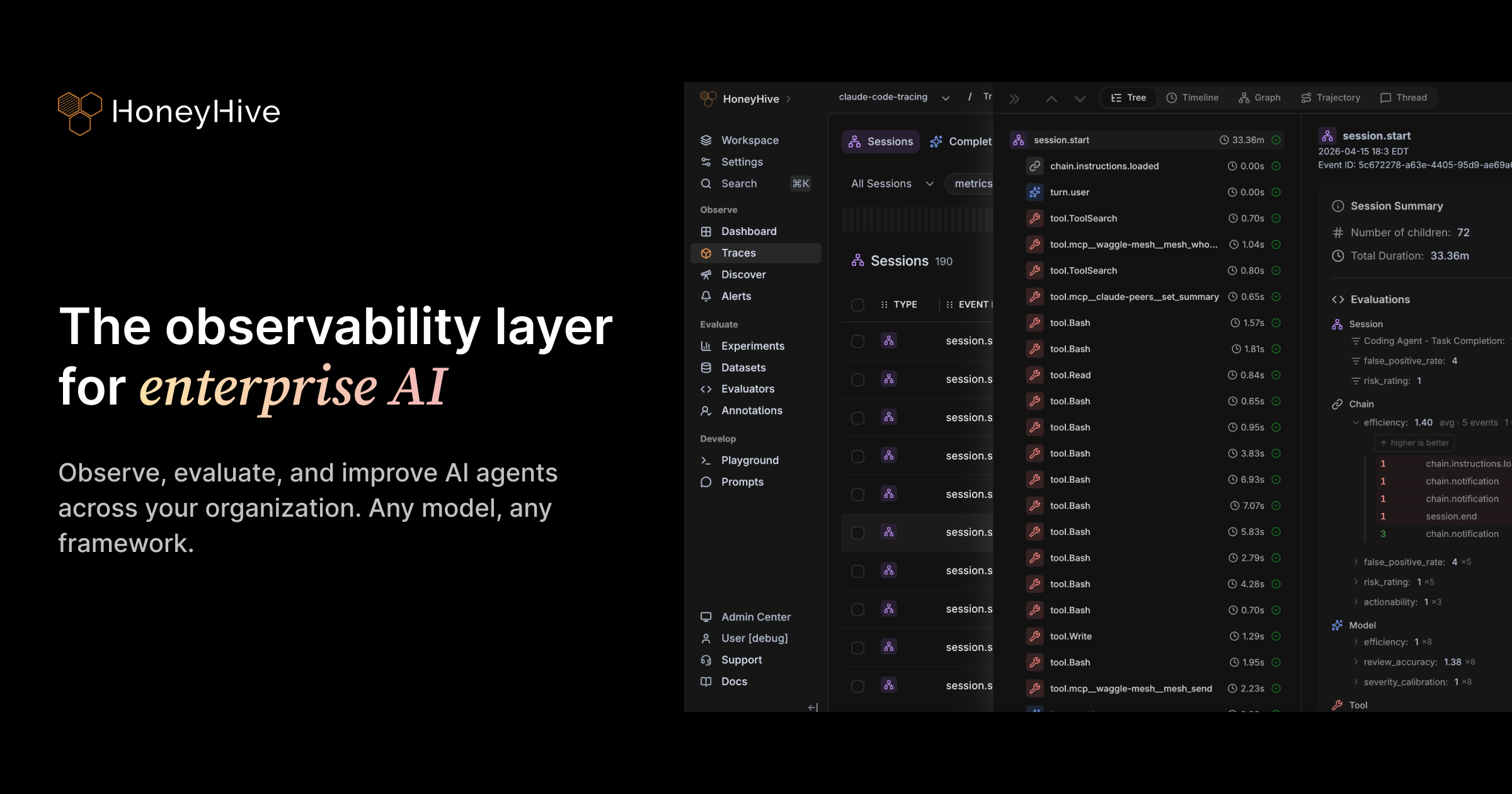
HoneyHive is an observability and evaluation layer built specifically for teams shipping LLM agents to production. It combines distributed tracing (OpenTelemetry-native, with instrumentation for 100+ models and frameworks), online evaluation with LLM-as-a-judge, offline experiments against datasets, drift/failure alerts, and human annotation queues into a single workflow. The pitch is that you can trace an agent from user turn down to individual tool calls, replay sessions in a playground, and wire the same evaluators into CI so regressions get caught before deploy.
It targets AI-native startups and Fortune 500 engineering teams building non-trivial agents, and its differentiation is the tight coupling of tracing, eval, and human review under one roof rather than stitching together LangSmith, Arize, and a spreadsheet. Pricing is not published on the homepage: there is a self-serve free tier ("Start for free") and a sales-led path for larger deployments, so real budgets require a call.
It's framework-agnostic thanks to OTel, ships a CLI and an MCP server for IDE integration, and exposes a documented API for programmatic dataset and trace management. Not open source, and the evaluation-heavy workflow will feel like overkill if you're still prototyping a single prompt.
HoneyHive is one of the more coherent answers to the "we shipped an agent, now what?" problem, and going all-in on OpenTelemetry is the right bet for portability. The unified tracing-plus-eval-plus-annotation loop is genuinely useful, but the opaque pricing and closed-source posture mean you should benchmark it against LangSmith and Arize Phoenix before committing.
— The AI Tool Bible editorial team
Pros
- ✅ OpenTelemetry-native tracing across 100+ LLMs and frameworks
- ✅ Unifies tracing, online eval, experiments, and human annotation
- ✅ CI/CD hooks catch regressions before deploy
- ✅ MCP server and CLI for IDE-level workflows
- ✅ Used by both startups and Fortune 500 teams
Cons
- ⚠️ Pricing not published; enterprise tiers need a sales call
- ⚠️ Closed source SaaS with vendor lock-in on trace format
- ⚠️ Overkill for single-prompt or pre-production projects
Use cases
Frequently asked
- What core features does HoneyHive offer for LLM agents?
- It combines distributed tracing, online evaluation with LLM-as-a-judge, offline experiments, drift alerts, and human annotation queues. It allows tracing from user turns to tool calls and replaying sessions in a playground.
- Is HoneyHive compatible with different LLM frameworks?
- Yes, it is framework-agnostic due to its OpenTelemetry-native architecture. It includes instrumentation for over 100 models and frameworks and ships with a CLI and MCP server for IDE integration.
- How does HoneyHive handle pricing and access?
- HoneyHive operates on a freemium model with a self-serve free tier. Paid and enterprise tiers are available via sales, as specific pricing is not published on the homepage.
- Who is the ideal user for HoneyHive?
- It targets AI-native startups and Fortune 500 engineering teams building non-trivial agents in production. It is not recommended for prototyping single prompts or teams requiring open-source, self-hostable stacks.
- Can HoneyHive integrate with CI/CD pipelines?
- Yes, evaluators can be wired into CI to catch regressions before deployment. The platform also exposes a documented API for programmatic dataset and trace management.
Explore related
Compare with similar tools
All in Evaluation →Braintrust
FeaturedEval, monitor, and improve AI products end-to-end.
LangSmith
LangChain's eval + observability platform.
Weights & Biases
The ML experiment tracker, now with LLM eval features.
Helicone
Open-source LLM observability — one-line proxy install.
Arize AI
Enterprise observability and evaluation platform for LLM agents and generative AI applications.
Giskard
Continuous AI red teaming platform that stress-tests LLM agents for vulnerabilities before they hit production.