Forefront
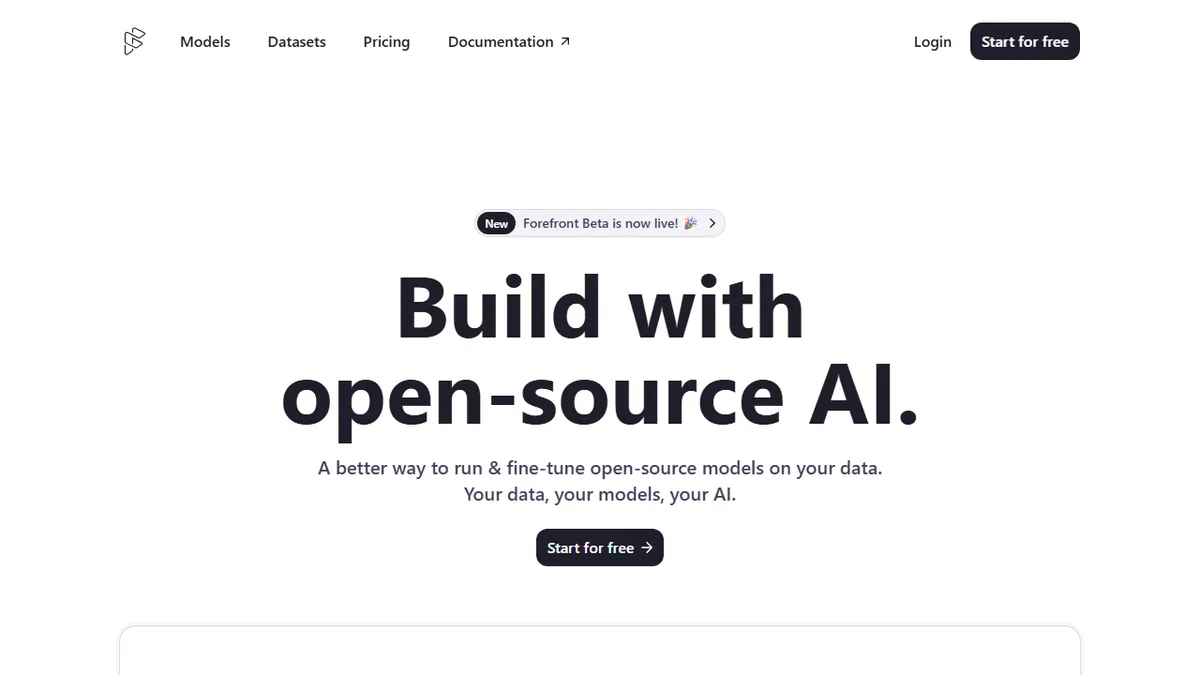
Fine-tune and serve open-source LLMs on your own data without managing GPUs.
In short
Forefront lets developers fine-tune and serve open-source LLMs like Mistral-7B on private data via API, eliminating the need to manage GPU infrastructure.
Pick Forefront if you want to fine-tune a small open-source LLM on proprietary data and serve it via API without standing up your own GPU stack.
Skip it if you need closed frontier models like GPT-4 or Claude, or a polished end-user chatbot rather than a developer fine-tuning workflow.
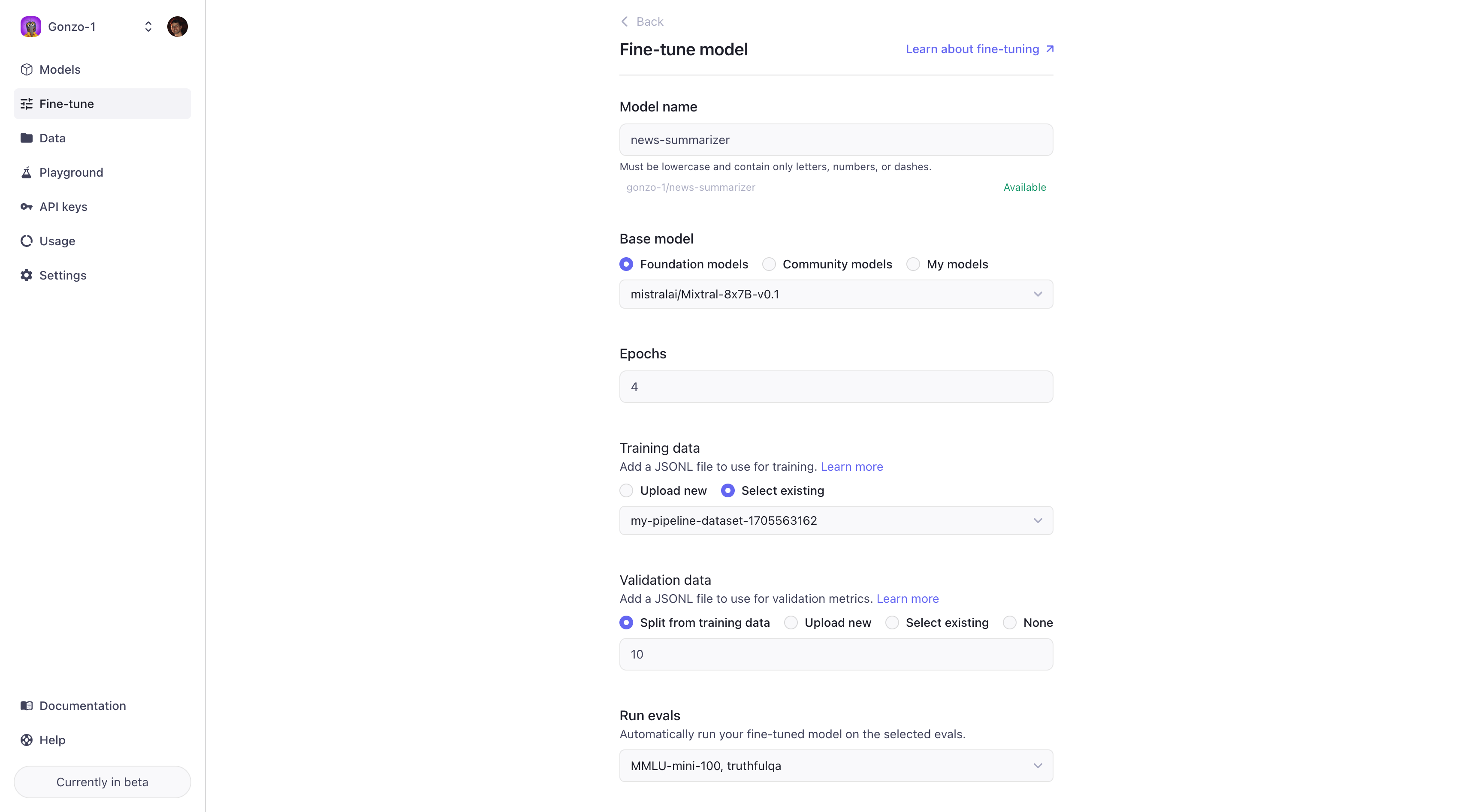
Forefront is a developer platform for fine-tuning and deploying open-source large language models like Mistral-7B, Mixtral, and Phi-2 against your private datasets. You upload data, kick off a fine-tune in minutes, inspect loss curves and standardized benchmarks (MMLU, TruthfulQA, HumanEval), and call the resulting model through a serverless inference API priced per token.
It targets the band of developers, researchers, and startups who want the customization of open-weight models without the cost or pain of provisioning their own GPU fleet. Pricing is usage-based and competitive with hosted inference markets (Phi-2 at $0.0006/1k tokens, Mixtral around $0.004/1k tokens), and Forefront leans hard on a privacy posture: no request logging, automatic scaling, and the ability to export your fine-tuned weights to self-hosted infrastructure if you outgrow the platform.
The sweet spot is teams that have outgrown raw OpenAI calls, want a custom-tuned smaller model for a narrow task, and need an integrated workflow covering dataset management, training, evaluation, and inference. It is not a general chatbot UI or a no-code product — you should be comfortable working with JSONL datasets and API endpoints.
Forefront sits in the increasingly crowded open-source fine-tuning lane, but its integrated data-to-deployment loop and model-export option make it a credible pick for teams that want optionality. The benchmark integration is a nice touch most competitors skip. Watch the model catalog — it needs to keep pace with newer Llama and Qwen releases to stay relevant.
— The AI Tool Bible editorial team
Pros
- ✅ End-to-end workflow: data, training, eval, and inference in one platform
- ✅ No GPU provisioning — serverless scaling with per-token pricing
- ✅ Built-in benchmarks (MMLU, TruthfulQA, HumanEval) for fine-tune evaluation
- ✅ Model export lets you take fine-tuned weights to self-hosted infra
- ✅ Privacy posture: no request logging on inference
Cons
- ⚠️ Model catalog is narrower than Together or Replicate
- ⚠️ Developer-only — no end-user chat UI or no-code tooling
- ⚠️ Pricing transparency depends on the specific model tier picked
Use cases
Frequently asked
- How much does Forefront cost?
- Forefront offers paid plans: Basic at $20, Pro at $50, and Enterprise via sales contact. Inference is priced per token, with examples like Phi-2 at $0.0006 per 1k tokens and Mixtral around $0.004 per 1k tokens.
- Which models can I fine-tune on Forefront?
- You can fine-tune open-source models including Mistral-7B, Mixtral, and Phi-2. The platform is designed for open-weight models, so it does not support closed frontier models like GPT-4 or Claude.
- Do I need to manage my own GPUs?
- No. Forefront handles the infrastructure, allowing you to fine-tune and serve models without provisioning your own GPU fleet. It provides automatic scaling and a serverless inference API for deployment.
- Is Forefront suitable for building a chatbot?
- It is not a general chatbot UI or no-code product. It targets developers comfortable with JSONL datasets and API endpoints who want a custom-tuned model for narrow tasks, not a polished end-user chatbot.
- Can I export my fine-tuned model?
- Yes. If you outgrow the platform, you can export your fine-tuned weights to self-hosted infrastructure. The platform also maintains a privacy posture with no request logging.
Explore related
Compare with similar tools
All in Fine-tuning →Together AI
FeaturedFine-tune & serve open-weight models (Llama, Mistral, DeepSeek).
Modal
Serverless GPUs and infra for training & serving ML.
Replicate
One-API platform for running and fine-tuning open-source models.
OpenAI Fine-tuning
Fine-tune GPT-4o-mini and friends on your own data.
Llama
Meta's open-weight LLM family covering 1B mobile models up to 405B frontier and natively multimodal 10M-context Llama 4 variants.
RunPod
On-demand GPU cloud and serverless inference platform built specifically for AI workloads.