MCP Registry vs Model Context Protocol
A side-by-side look at pricing, capabilities, pros, cons, and our editorial scores.
Tagline
MCP Registry
Official discovery registry for Model Context Protocol servers, with a browsable UI and a public API.Model Context Protocol
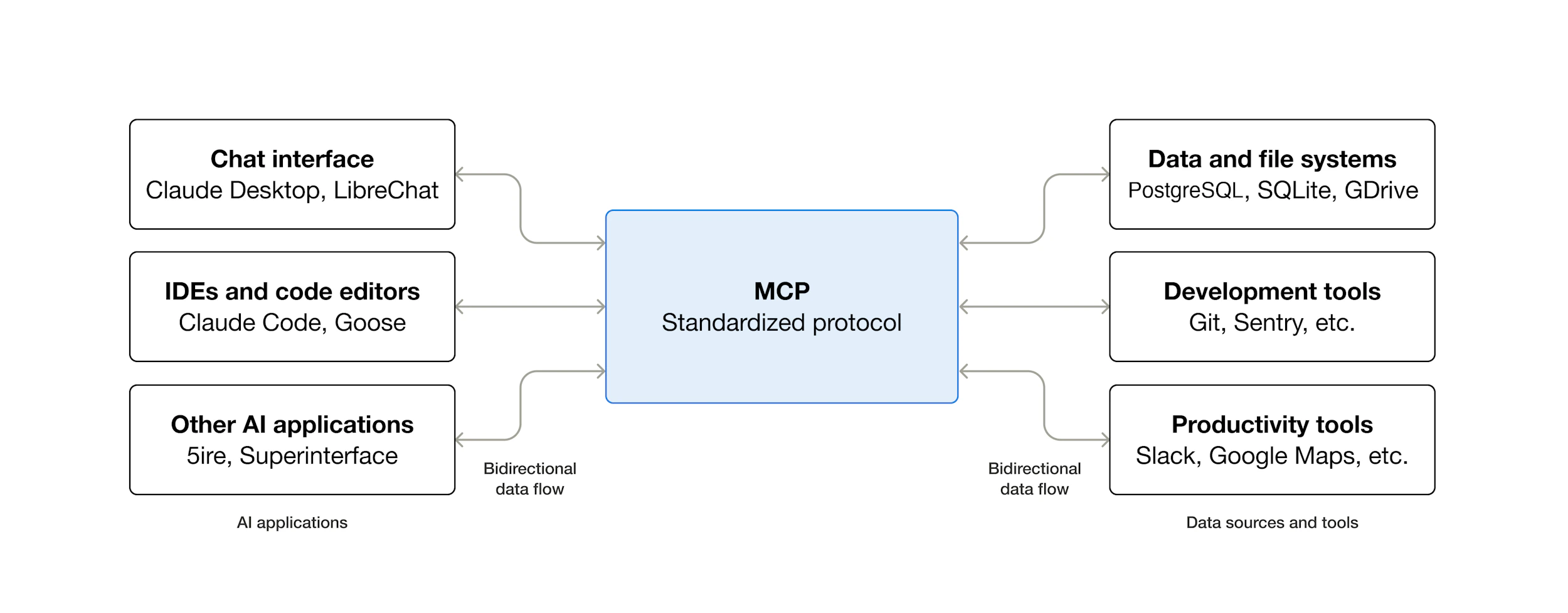
Open standard that lets AI apps plug into data sources, tools, and workflows like USB-C for LLMs.Pricing
MCP Registry
Free· Free and open sourceModel Context Protocol
Free· Free and open source (MIT)API
MCP Registry
YesModel Context Protocol
YesPlatforms
MCP Registry
api
Model Context Protocol
vscode-extensionapi
Open source
MCP Registry
YesModel Context Protocol
YesHacker News stories
MCP Registry
2
checked 2026-11-15
Model Context Protocol
21
checked 2026-11-16
Earliest Wayback capture
MCP Registry
2025-11-28
earliest archived capture of the site, not a launch date
Model Context Protocol
—Model used
MCP Registry
—Model Context Protocol
Model-agnosticBest for
MCP Registry
Pick MCP Registry if you're building agent tooling, an IDE integration, or publishing your own MCP server and need the upstream index.Model Context Protocol
Pick MCP if you're building an agent or LLM-powered app and want one integration layer that works across Claude, ChatGPT, Cursor, VS Code, and other hosts.Not for
MCP Registry
Skip it if you want a curated, opinionated marketplace of vetted agent tools rather than a raw registry feed.Model Context Protocol
Skip it if you want a turnkey product rather than a protocol — MCP is infrastructure that requires you to write or install servers and pick a compatible client.Editorial score
MCP Registry
6.6 / 10Model Context Protocol
7.4 / 10Use cases
MCP Registry
mcp-server-discoveryagent-toolingclient-integrationsregistry-mirror
Model Context Protocol
agent-toolingide-integrationsenterprise-chatbotsdata-source-connectorsworkflow-automation
Pros
MCP Registry
- Official, canonical source for MCP server metadata
- Open source with a public REST API for programmatic access
- Supports multiple environments (production, staging, local)
- Free to use and free to publish servers
Model Context Protocol
- Vendor-neutral standard backed by Anthropic, OpenAI, Microsoft, and major IDE vendors
- Huge and growing library of community-built servers for common tools and data sources
- Official SDKs in TypeScript, Python, Kotlin, Swift, C#, and Rust
- Works with both local stdio and remote HTTP/SSE transports
- Decouples tool integration from any specific model or host
Cons
MCP Registry
- Bare-bones UI focused on discovery, not curation or reviews
- Quality and maintenance varies widely across listed servers
- Aimed at developers; not useful for non-technical end users
Model Context Protocol
- It's a protocol, not a product — you still need a client and servers to do anything useful
- Spec and SDKs still evolve quickly; expect occasional breaking changes
- Auth, sandboxing, and permissioning are largely left to the implementer
- Discovery and trust of third-party servers is still an unsolved UX problem
Editorial score: rule-based, 0–10, from AI-assisted profile inputs (see /methodology) — not a user rating; “—” means unscored. “Not listed” means we have no record of it, not that it is absent. GitHub figures and prices carry the date they were checked or captured; prices are shown as published, unconverted.
Pick MCP Registry if
- ✅ Official, canonical source for MCP server metadata
- ✅ Open source with a public REST API for programmatic access
- ✅ Supports multiple environments (production, staging, local)
- ✅ Free to use and free to publish servers
Pick Model Context Protocol if
- ✅ Vendor-neutral standard backed by Anthropic, OpenAI, Microsoft, and major IDE vendors
- ✅ Huge and growing library of community-built servers for common tools and data sources
- ✅ Official SDKs in TypeScript, Python, Kotlin, Swift, C#, and Rust
- ✅ Works with both local stdio and remote HTTP/SSE transports