Model Context Protocol
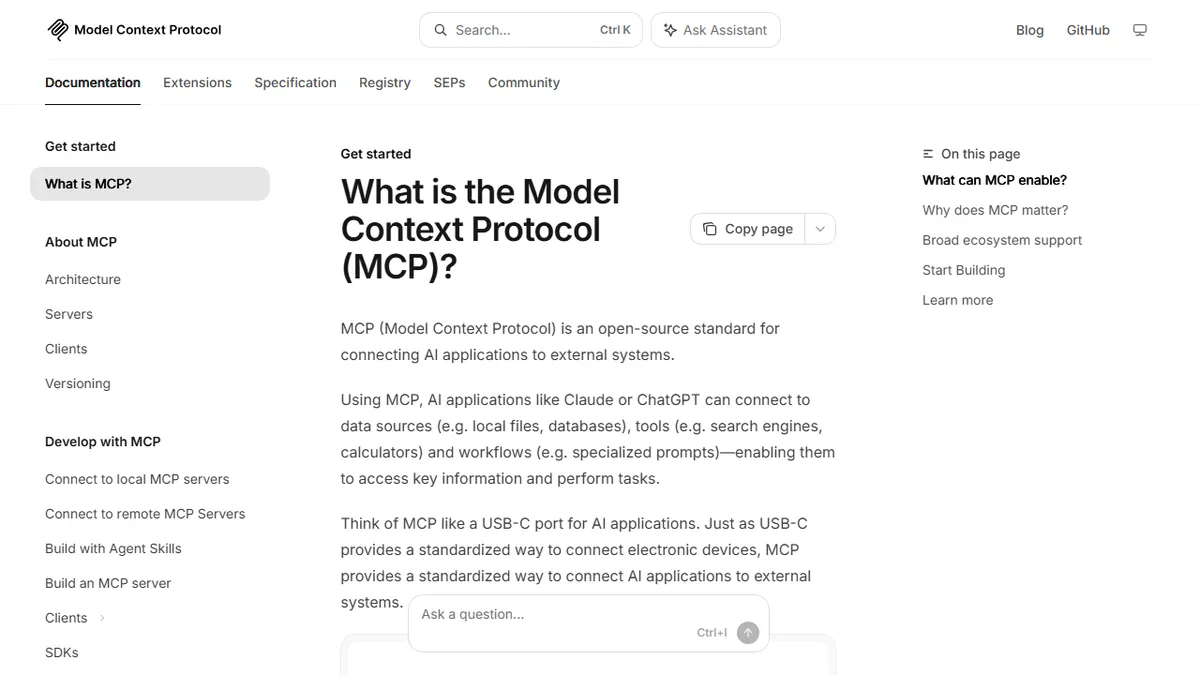
Open standard that lets AI apps plug into data sources, tools, and workflows like USB-C for LLMs.
In short
Model Context Protocol (MCP) is an open-source specification that allows AI applications to connect to external systems like databases and APIs in a uniform way. It is best for developers building agents or LLM-powered apps who want a single integration layer that works across hosts like Claude, ChatGPT, and VS Code.
Pick MCP if you're building an agent or LLM-powered app and want one integration layer that works across Claude, ChatGPT, Cursor, VS Code, and other hosts.
Skip it if you want a turnkey product rather than a protocol — MCP is infrastructure that requires you to write or install servers and pick a compatible client.
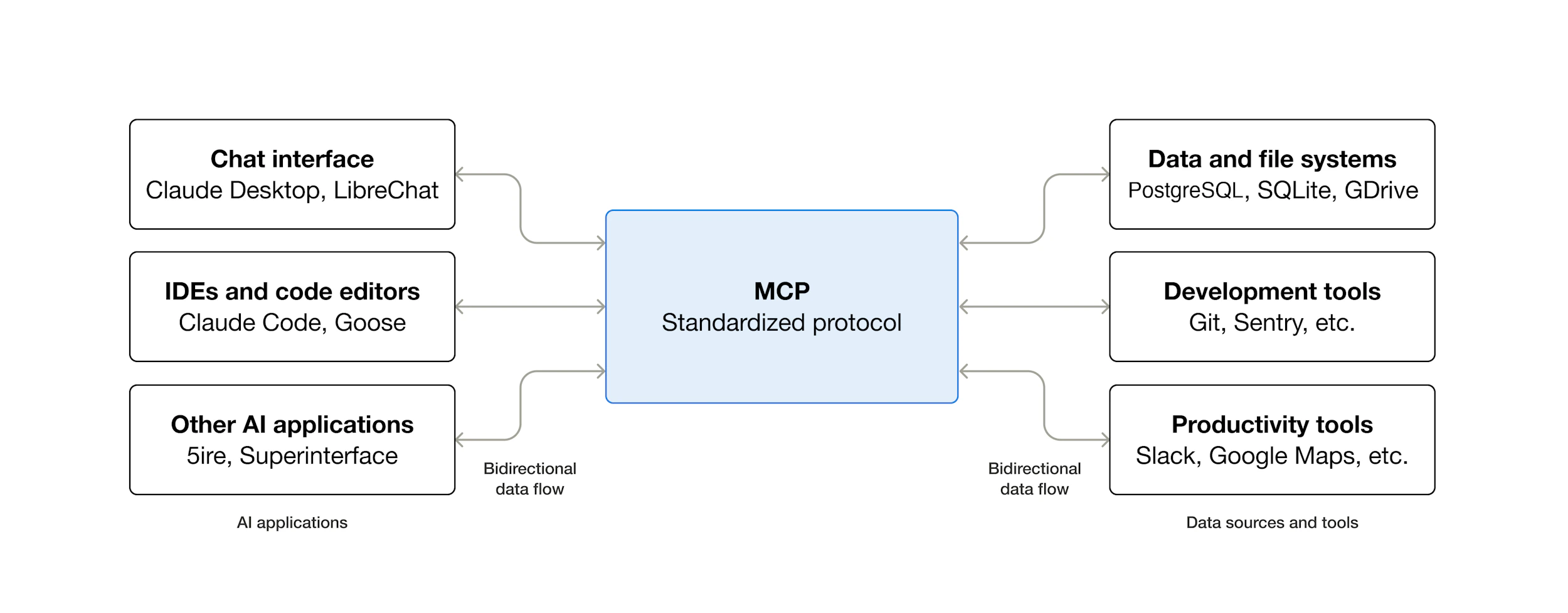
Model Context Protocol (MCP) is an open-source specification, originally proposed by Anthropic, for wiring AI applications to external systems in a uniform way. Instead of writing bespoke integrations for every model and every tool, developers build an MCP server once (exposing files, databases, APIs, prompts) and any MCP-compatible client — Claude, ChatGPT, Cursor, VS Code Copilot, Cline, and dozens more — can talk to it. The protocol covers tool calls, resource exposure, prompt templates, and sampling, all over a JSON-RPC transport.
MCP is aimed at developers building agents, IDE extensions, enterprise chatbots, or any LLM workflow that needs real-world side effects. It isn't a SaaS product and there's no pricing — the spec, SDKs (TypeScript, Python, Kotlin, Swift, C#, Rust), and reference servers are all on GitHub under permissive licenses. The ecosystem has exploded since launch: hundreds of community servers exist for GitHub, Slack, Postgres, Figma, Blender, filesystem, browser automation, and more.
The payoff is portability. Build an integration once and it works across every host that speaks MCP, including local desktop clients and hosted assistants. The caveat is that MCP is plumbing, not a finished product — you still need a client to consume servers, you handle auth and sandboxing yourself, and the spec is evolving fast enough that breaking changes between SDK versions still happen.
MCP has effectively become the de facto standard for AI tool use in the year since launch, and that matters more than any single feature. If you're building anything agent-shaped in 2026, you should be shipping an MCP server alongside (or instead of) a REST API. The rough edges are real but the network effect is already overwhelming.
— The AI Tool Bible editorial team
Pros
- ✅ Vendor-neutral standard backed by Anthropic, OpenAI, Microsoft, and major IDE vendors
- ✅ Huge and growing library of community-built servers for common tools and data sources
- ✅ Official SDKs in TypeScript, Python, Kotlin, Swift, C#, and Rust
- ✅ Works with both local stdio and remote HTTP/SSE transports
- ✅ Decouples tool integration from any specific model or host
Cons
- ⚠️ It's a protocol, not a product — you still need a client and servers to do anything useful
- ⚠️ Spec and SDKs still evolve quickly; expect occasional breaking changes
- ⚠️ Auth, sandboxing, and permissioning are largely left to the implementer
- ⚠️ Discovery and trust of third-party servers is still an unsolved UX problem
Use cases
Frequently asked
- Is Model Context Protocol free to use?
- Yes, MCP is free and open source under the MIT license. It is a specification and SDK, not a SaaS product, so there are no pricing fees.
- Which programming languages are supported?
- Official SDKs are available for TypeScript, Python, Kotlin, Swift, C#, and Rust. The protocol uses JSON-RPC transport for communication.
- What is the best use case for MCP?
- It is best for developers building agents, IDE extensions, or enterprise chatbots that need real-world side effects. It allows you to build an integration once and have it work across any MCP-compatible client.
- Does MCP handle authentication and security?
- No, MCP is a protocol, not a finished product. Developers must handle authentication, sandboxing, and permissioning themselves, as these are left to the implementer.
Explore related
Compare with similar tools
All in Agents →LangGraph
FeaturedStateful, graph-based agent orchestration from LangChain.
CrewAI
FeaturedPython framework for multi-agent orchestration.
Ernie Bot
Baidu's Mandarin-first ChatGPT rival, powered by the ERNIE model family
Moveworks
The enterprise AI assistant that searches, answers, and takes action across your business systems
AWS Bedrock
Build and scale generative AI applications with foundation models
Claude Agent SDK
Anthropic's official SDK for building autonomous Claude agents.