Langflow vs Nexent
A side-by-side look at pricing, capabilities, pros, cons, and our editorial scores.
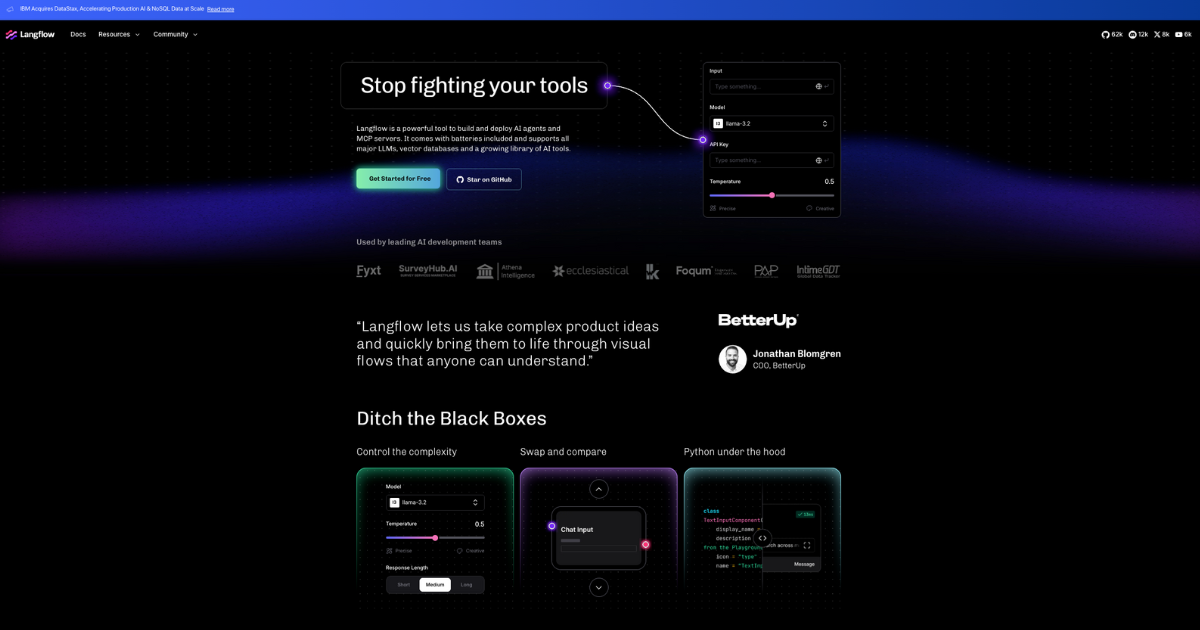

Tagline
Langflow
Open-source visual builder for LangChain-style AI agents and RAG pipelines.Nexent
Open-source, zero-code platform for spinning up production-grade AI agents from a single natural-language prompt.Pricing
Langflow
Freemium· Open-source free; hosted free tier + paid enterprise via DataStaxNexent
Free· Free, open-source (MIT); self-hosted infra + model API costs applyFree trial
Langflow
YesNexent
YesAPI
Langflow
YesNexent
YesPlatforms
Langflow
webslack
Nexent
api
Open source
Langflow
Yes · MITNexent
YesGitHub stars
Langflow
155,378
checked 2026-09-29
Nexent
—Last GitHub push
Langflow
2026-09-29Nexent
—First commit
Langflow
2023-02Nexent
—Model used
Langflow
Multi-modelNexent
Multi-model (OpenAI-compatible: any LLM/Embedding/VLM/STT/TTS)Best for
Langflow
Pick Langflow if you're a Python developer who wants a visual scratchpad for LangChain-style agents and RAG flows without giving up code-level control.Nexent
Pick Nexent if you want a self-hosted, MCP-native agent platform you can describe in plain language instead of wiring up in a canvas editor.Not for
Langflow
Skip it if you're a non-technical user hoping to build production agents by dragging boxes, or if you need a stable, slow-moving platform.Nexent
Skip it if you want a managed SaaS, a polished low-code UI, or a stable v1 API to build a production product on this quarter.Editorial score
Langflow
8.1 / 10Nexent
7.2 / 10Use cases
Langflow
agent-prototypingrag-pipelinesworkflow-automationllm-orchestrationchatbot-development
Nexent
multi-agent-orchestrationzero-code-agentsknowledge-base-ragenterprise-automationmcp-tool-integration
Pros
Langflow
- Open source and self-hostable with a permissive license
- Visual graph maps cleanly to LangChain concepts developers already know
- Broad LLM and vector-DB coverage out of the box
- Every node is editable Python, not a locked black box
- Flows deploy as APIs without extra glue code
Nexent
- MIT-licensed and fully self-hostable on Docker or Kubernetes
- Prompt-to-agent generation skips drag-and-drop canvas entirely
- Model-agnostic across LLM, embedding, vision, STT and TTS slots
- Built-in multi-tenancy, RBAC, A2A protocol, and agent marketplace
- Knowledge base ingests 20+ document formats out of the box
Cons
Langflow
- Fast-moving codebase; version upgrades can break existing flows
- Visual metaphor still assumes LangChain-level familiarity
- Hosted tier is tied to DataStax's Astra ecosystem
Nexent
- Self-host only; no managed cloud offering to point at
- Young project (v2.0); APIs and abstractions still evolving
- Documentation is partly Chinese-first and uneven in English
Editorial score: rule-based, 0–10, from AI-assisted profile inputs (see /methodology) — not a user rating; “—” means unscored. “Not listed” means we have no record of it, not that it is absent. GitHub figures and prices carry the date they were checked or captured; prices are shown as published, unconverted.
Pick Langflow if
- ✅ Open source and self-hostable with a permissive license
- ✅ Visual graph maps cleanly to LangChain concepts developers already know
- ✅ Broad LLM and vector-DB coverage out of the box
- ✅ Every node is editable Python, not a locked black box
Pick Nexent if
- ✅ MIT-licensed and fully self-hostable on Docker or Kubernetes
- ✅ Prompt-to-agent generation skips drag-and-drop canvas entirely
- ✅ Model-agnostic across LLM, embedding, vision, STT and TTS slots
- ✅ Built-in multi-tenancy, RBAC, A2A protocol, and agent marketplace