Langflow
✓ Editorially verifiedOpen-source visual builder for LangChain-style AI agents and RAG pipelines.
In short
Langflow is an open-source visual builder for LangChain-style agents and RAG pipelines, letting Python developers prototype flows visually while retaining full code-level control.
Pick Langflow if you're a Python developer who wants a visual scratchpad for LangChain-style agents and RAG flows without giving up code-level control.
Skip it if you're a non-technical user hoping to build production agents by dragging boxes, or if you need a stable, slow-moving platform.
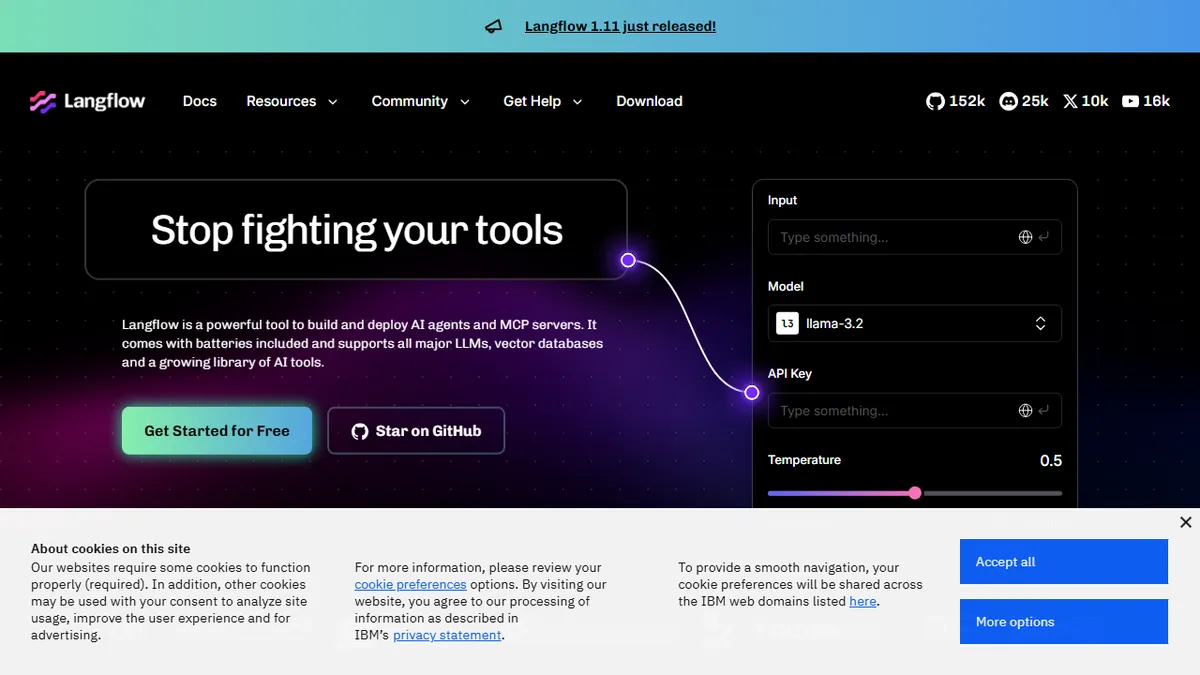
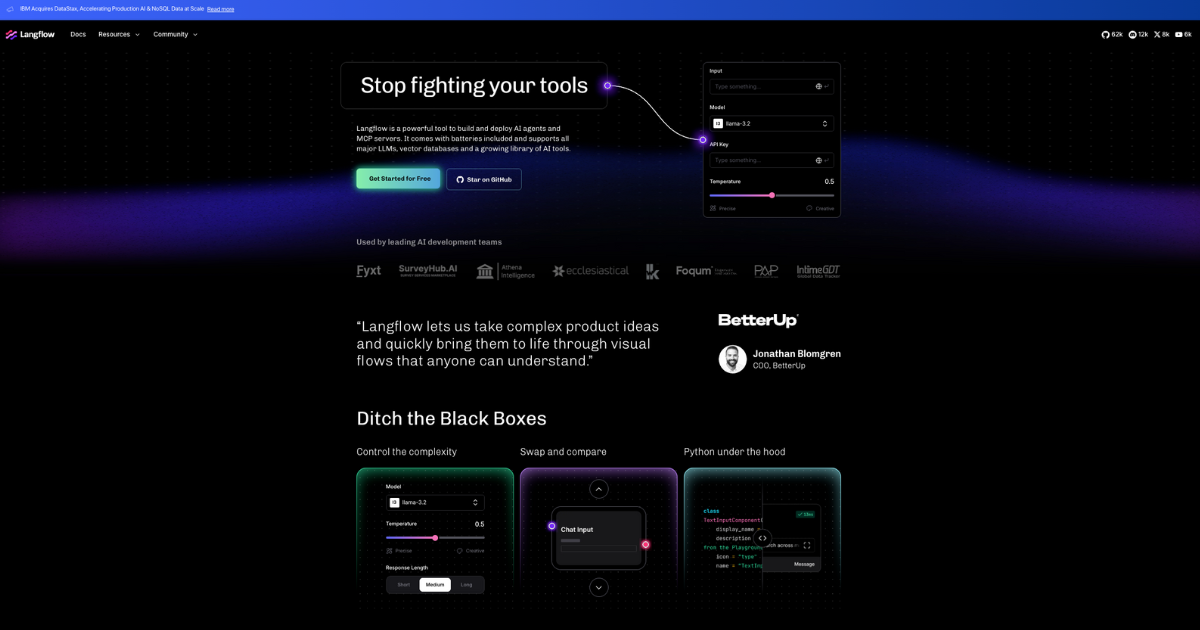
Langflow is a low-code, node-based canvas for assembling LLM agents and retrieval-augmented generation pipelines. You drag components onto a graph, wire prompts to models to tools to vector stores, and iterate on the flow live before exporting it as an API endpoint or a Python module. It supports the usual LLM providers (Anthropic, OpenAI, Groq, Mistral, Llama variants) and most serious vector databases (Weaviate, Qdrant, Milvus, Pinecone, Astra DB).
It sits in the same visual-agent-builder niche as Flowise and n8n's AI nodes, but leans harder into the Python developer workflow: any node can be edited as code, and flows compile down to something you can actually run in production rather than a black-box SaaS graph. The core project is open source (MIT, six-figure GitHub stars) and self-hostable; DataStax also offers a hosted Langflow with a free tier plus paid enterprise plans for teams that don't want to run it themselves.
Best thought of as a prototyping surface for people who already know LangChain concepts and want to skip the boilerplate. Non-developers will hit the limits of the abstraction quickly, and the fast-moving codebase means flows built on older versions sometimes need rework after upgrades.
Langflow is the most credible open-source visual builder in the LangChain orbit right now, and the fact that every node drops down to real Python is what keeps it usable past the demo stage. Just don't mistake the canvas for a shortcut around understanding agents; it accelerates the people who already get it.
— The AI Tool Bible editorial team
Pros
- ✅ Open source and self-hostable with a permissive license
- ✅ Visual graph maps cleanly to LangChain concepts developers already know
- ✅ Broad LLM and vector-DB coverage out of the box
- ✅ Every node is editable Python, not a locked black box
- ✅ Flows deploy as APIs without extra glue code
Cons
- ⚠️ Fast-moving codebase; version upgrades can break existing flows
- ⚠️ Visual metaphor still assumes LangChain-level familiarity
- ⚠️ Hosted tier is tied to DataStax's Astra ecosystem
Use cases
Frequently asked
- How much does Langflow cost?
- Langflow is open-source and free to use. DataStax offers a hosted version with a free tier and paid enterprise plans for teams that prefer not to self-host the infrastructure.
- Is Langflow suitable for non-technical users?
- No, it is best for Python developers. Non-technical users hoping to build production agents by dragging boxes will likely hit the limits of the abstraction quickly and may struggle with the workflow.
- Which AI models and vector databases does it support?
- It supports multi-model providers including Anthropic, OpenAI, Groq, Mistral, and Llama variants. For vector stores, it integrates with Weaviate, Qdrant, Milvus, Pinecone, and Astra DB.
- Can I export my Langflow projects for production use?
- Yes, flows can be exported as an API endpoint or a Python module. Unlike black-box SaaS graphs, Langflow compiles down to code you can actually run in production environments.
- How does Langflow compare to Flowise or n8n?
- While similar to Flowise and n8n's AI nodes, Langflow leans harder into the Python developer workflow. Any node can be edited as code, offering more control than typical visual builders.
Explore related
Compare with similar tools
All in Agents →LangGraph
FeaturedStateful, graph-based agent orchestration from LangChain.
CrewAI
FeaturedPython framework for multi-agent orchestration.
Ernie Bot
Baidu's Mandarin-first ChatGPT rival, powered by the ERNIE model family
Moveworks
The enterprise AI assistant that searches, answers, and takes action across your business systems
AWS Bedrock
Build and scale generative AI applications with foundation models
Claude Agent SDK
Anthropic's official SDK for building autonomous Claude agents.