Yuxi
✓ Text source-checked Nov 21, 2026Yuxi is a privately deployable multi-tenant knowledge agent platform.
Source-checked against the vendor's site · rebuilt from the vendor's own pagesProfile updated Link checked How we rate
In short
Yuxi is a private, multi-tenant knowledge agent platform combining RAG, knowledge graphs, and multi-agent orchestration. It supports self-deployment for teams needing strict data and permission control.
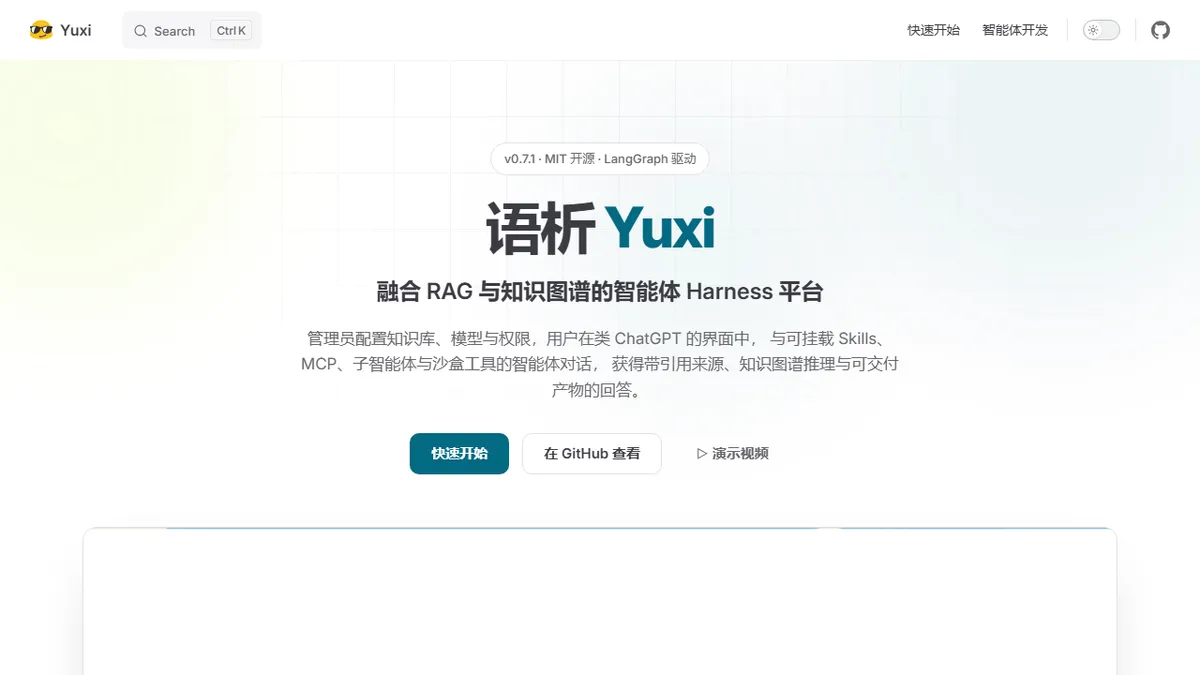
Yuxi is a privately deployable multi-tenant knowledge agent platform. The platform integrates knowledge base retrieval, knowledge graphs, LangGraph multi-agent orchestration, MCP/Skills, sandbox tools, and permission management into a single workspace.
The system supports parsing of common document formats including PDF, Word, PPT, Excel, and Markdown. Yuxi automatically extracts entities and relationships from the knowledge base to build knowledge graph indexes in Milvus and Neo4j. The platform supports multiple SubAgents executing deep research, data analysis, or content generation asynchronously in parallel.
Yuxi targets teams that require enterprise self-deployment of multi-user Agent products and need to control their own data, models, and permissions.
Deployment requires Docker and a model API, with a default Container sandbox that does not require additional execution nodes. When VM isolation or persistent user environments are needed, users select Cube and prepare a Linux/KVM execution node.
According to Yuxi: Yuxi is a privately deployable multi-tenant knowledge agent platform. Its pages list this strength: The core product is licensed under the MIT License.
— The AI Tool Bible editorial team
Pros
- ✅ The core product is licensed under the MIT License.
- ✅ The system builds knowledge graph indexes by extracting entities and relationships from the knowledge base.
- ✅ The platform supports asynchronous parallel execution of tasks by multiple SubAgents.
- ✅ The system supports integration with major large model providers including OpenAI, Anthropic, DeepSeek, Qwen, and OpenAI-compatible endpoints.
Facts
- Platforms
- api (not source-checked)
- API available
- Yes
- Open source
- Yes (license: MIT)
- GitHub stars
- 7,659 (checked Nov 13, 2026) (not source-checked)
- Last GitHub push
- Nov 13, 2026 (not source-checked)
- First commit
- Jul 2024 (not source-checked)
- Launched
- Jan 1, 2025 (not source-checked)
- Model used
- Multi-model (not source-checked)
Where this tool sits
Use cases
Frequently asked
- How much does Yuxi cost?
- Yuxi is listed as free, though no specific pricing details are provided in the documentation. It is designed for private deployment, allowing teams to control their own infrastructure costs.
- What document formats can Yuxi process?
- The platform supports parsing common document formats including PDF, Word, PPT, Excel, and Markdown. It automatically extracts entities and relationships from these files to build knowledge graph indexes.
- What are the deployment requirements for Yuxi?
- Deployment requires Docker and a model API. It uses a default Container sandbox that does not require additional execution nodes. For VM isolation, users must select Cube and prepare a Linux/KVM execution node.
- Does Yuxi support multi-agent workflows?
- Yes, Yuxi integrates LangGraph multi-agent orchestration. It supports multiple SubAgents that can execute deep research, data analysis, or content generation asynchronously in parallel within a single workspace.
- Who is Yuxi designed for?
- Yuxi targets teams requiring enterprise self-deployment of multi-user Agent products. It is ideal for organizations that need to maintain control over their own data, models, and permission management structures.