
Wren AI
✓ Editorially verifiedOpen-source GenBI semantic layer that lets AI agents query your warehouse in natural language with governed, accurate SQL.
In short
Wren AI translates natural language into governed SQL using a semantic layer that encodes business definitions. It is best for data engineers who need an open-source, LLM-agnostic infrastructure for agentic BI rather than a no-code dashboard.
Pick Wren AI if you want an open-source, governed text-to-SQL layer that any LLM agent can hit instead of pointing models straight at your warehouse.
Skip it if you need a polished, no-code BI dashboard for business users or a turnkey SaaS without any semantic modeling work.
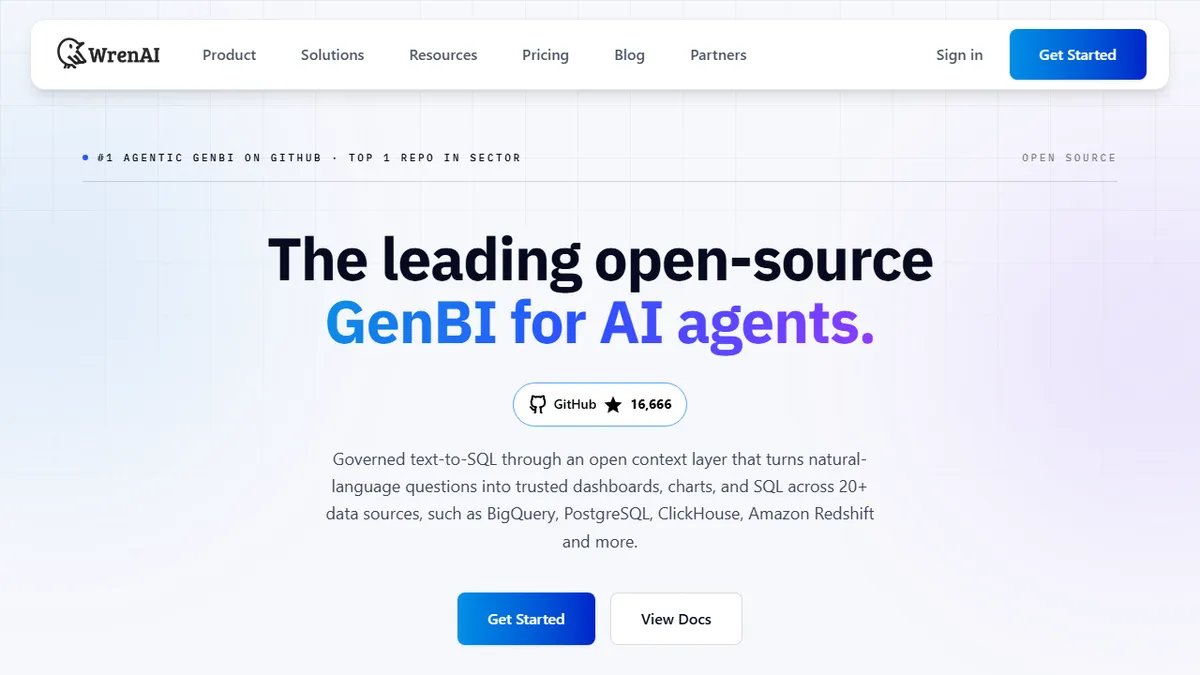
Wren AI is an open-source generative business intelligence platform that sits between AI agents and your data warehouse, translating natural-language questions into governed SQL queries. Its core abstraction is a Modeling Definition Language (MDL) semantic layer that encodes business definitions, joins, and metrics as code so an LLM does not have to guess schema. It ships with text-to-SQL, connectors for 20+ sources (BigQuery, PostgreSQL, Redshift, Snowflake, and friends), and integrations with 60+ agent frameworks.
The project is LLM-agnostic, plugging into OpenAI, Anthropic, Google Gemini, or self-hosted private models, which makes it a sensible pick for regulated teams that cannot ship schema to a vendor-locked SaaS. The OSS edition is free and self-hostable; the company also sells a managed Enterprise Cloud tier with governance, SSO, and support. It is positioned for data and analytics engineers who want an MCP-style context server for BI rather than for end users looking for a polished dashboard product.
With ~1,700 Discord contributors and weekly releases, Wren is one of the more active open GenBI projects on GitHub, and it integrates with dbt so existing semantic work isn't thrown away. Expect the usual self-host trade-offs: you own the vector store, the LLM bill, and the prompt-tuning work.
Wren is the most credible open-source answer to the agentic-BI question right now: a real semantic layer rather than a thin text-to-SQL wrapper. The OSS edition is genuinely useful, but treat it as infrastructure - you will spend real engineering time on MDL before agents return trustworthy numbers.
— The AI Tool Bible editorial team
Pros
- ✅ Apache-licensed semantic layer you can fully self-host
- ✅ LLM-agnostic; works with OpenAI, Anthropic, Gemini or private models
- ✅ 20+ warehouse connectors and dbt integration out of the box
- ✅ Active community with weekly releases and 60+ agent integrations
Cons
- ⚠️ Requires data-engineering effort to model MDL well
- ⚠️ Enterprise features (SSO, governance UI) gated behind paid cloud
- ⚠️ Quality of generated SQL still depends on the LLM you bring
Use cases
Frequently asked
- What is the core function of Wren AI?
- It acts as a semantic layer between AI agents and data warehouses, translating natural-language questions into governed SQL queries using a Modeling Definition Language (MDL).
- Which LLMs and data sources does Wren AI support?
- The platform is LLM-agnostic, supporting OpenAI, Anthropic, Google Gemini, or self-hosted models. It includes connectors for over 20 sources, including BigQuery, PostgreSQL, Redshift, and Snowflake.
- Is Wren AI suitable for non-technical business users?
- No, it is positioned for data and analytics engineers. It is not recommended for users seeking a polished, no-code BI dashboard product, as it requires engineering effort to model the semantic layer.
- What are the pricing options for Wren AI?
- Wren AI offers a free open-source edition for self-hosting. Managed cloud options include Essential Cloud at $179, Enterprise Cloud at $559, and Enterprise Plus with custom pricing.
- Does Wren AI integrate with existing data modeling tools?
- Yes, it integrates with dbt to preserve existing semantic work and supports over 60 agent frameworks for agentic BI applications.
Explore related
Compare with similar tools
All in RAG →Pinecone
FeaturedManaged vector database for production-scale similarity search.
LlamaIndex
FeaturedData framework for connecting LLMs to your data.
Elasticsearch Vector Search
Hybrid vector + keyword search in the enterprise-grade Elasticsearch engine
Snowflake Cortex
Generative AI and RAG built into the Snowflake data cloud
DataStax Astra DB
Serverless vector and document database for production RAG and AI agents
MongoDB Atlas Vector Search
Vector search built into the operational database you're already using.