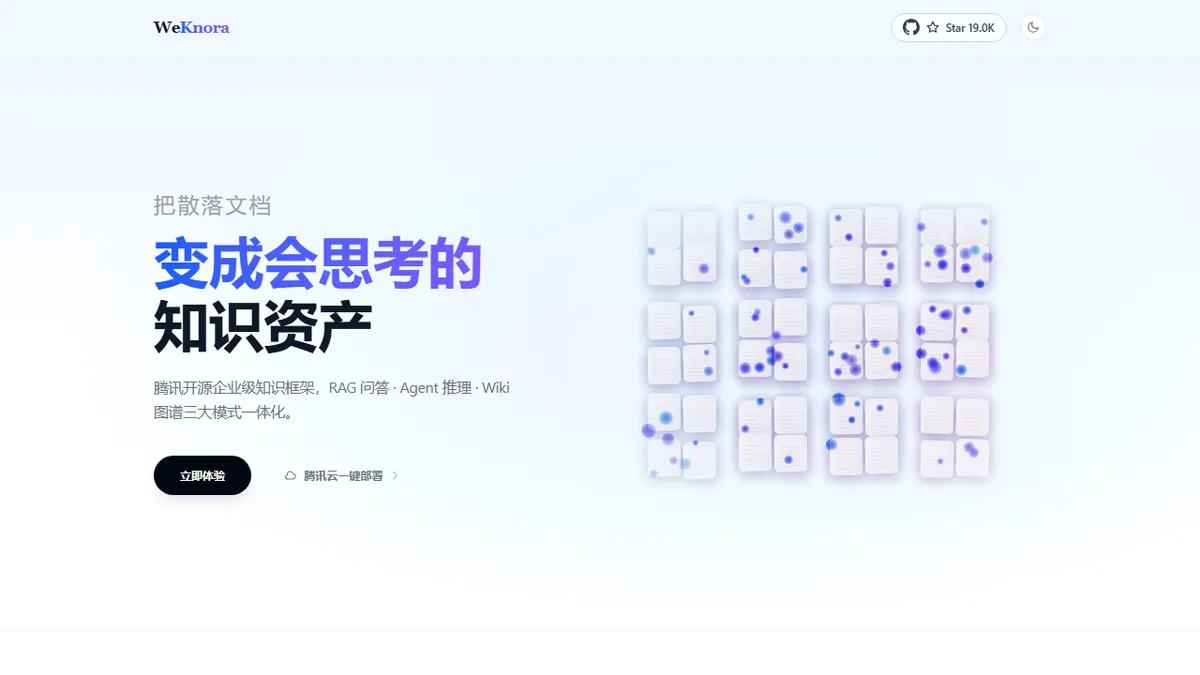
WeKnora
Tencent's open-source RAG framework that turns raw documents into a queryable knowledge base, ReAct agent, and self-maintaining wiki.
In short
WeKnora is Tencent's open-source RAG framework for building private, modular knowledge bases with ReAct agents and self-maintaining wikis.
Pick WeKnora if you want a Tencent-backed, fully modular open-source RAG stack you can deploy on your own infrastructure with strict data-sovereignty.
Skip it if you want a hosted, click-to-deploy RAG SaaS or a small team without the appetite to run a vector DB and LLM endpoints yourself.
WeKnora is an enterprise-grade open-source LLM knowledge platform from Tencent's WeChat team, built around three modes: classic RAG Q&A over a document corpus, a ReAct agent that orchestrates retrieval plus MCP tools and web search for multi-step questions, and a Wiki mode that distills uploaded files into an interlinked, self-maintaining markdown knowledge base with an interactive knowledge graph. It ingests 10+ formats (PDF, Word, Excel, images, etc.) and can auto-sync from Feishu, Notion, and Yuque.
The project is aimed at teams that want a production RAG stack they fully control rather than a hosted SaaS. It is fully modular - you can swap the LLM (OpenAI, DeepSeek, Qwen, Zhipu, Hunyuan, Gemini, MiniMax, NVIDIA, Ollama), the vector database, and the storage backend - and is designed for local or private-cloud deployment so data never leaves your network. Answers can be served back through WeCom, Feishu, Slack, and Telegram, which makes it a natural fit for internal knowledge-bot use cases.
Being a Tencent OSS project, documentation and primary marketing skew Chinese-first, and operating it at scale requires real infra work (vector DB, embeddings, LLM endpoints, observability). It is best thought of as a framework you deploy, not a turnkey product.
WeKnora is one of the more ambitious open RAG frameworks of 2026 - the Wiki and ReAct modes go beyond the usual chat-over-PDF template. It is squarely for engineering teams, not end users, and the China-first docs are real friction, but if you need an auditable, on-prem alternative to hosted RAG platforms it is a serious option.
— The AI Tool Bible editorial team
Pros
- ✅ Three modes in one stack: RAG Q&A, ReAct agent, and self-maintaining wiki with knowledge graph
- ✅ Backed by Tencent and actively maintained on GitHub
- ✅ Pluggable LLMs, vector DBs, and storage; runs fully on-prem
- ✅ Native connectors for Feishu, Notion, Yuque, plus IM delivery via WeCom/Slack/Telegram
- ✅ Handles 10+ document formats including PDFs, Office docs, and images
Cons
- ⚠️ Self-hosted only - you operate the LLM, vector DB, and infra
- ⚠️ Docs and community lean Chinese-first; English material is thinner
- ⚠️ No managed cloud or SLA; not a turnkey SaaS
Use cases
Frequently asked
- Is WeKnora free to use?
- Yes, WeKnora is free and open-source. It is designed for self-hosted deployment, meaning you do not pay licensing fees but must manage your own infrastructure for vector databases and LLM endpoints.
- Which LLMs does WeKnora support?
- It supports a multi-model approach, allowing you to swap between OpenAI, DeepSeek, Qwen, Zhipu, Hunyuan, Gemini, MiniMax, NVIDIA, and Ollama. This modularity lets you choose the best model for your specific needs.
- Can I integrate WeKnora with my existing chat tools?
- Yes, answers can be served through WeCom, Feishu, Slack, and Telegram. It also auto-syncs content from Feishu, Notion, and Yuque, making it suitable for internal knowledge-bot use cases.
- Is WeKnora suitable for small teams?
- It is best for teams wanting full control over their RAG stack. Small teams without the appetite to run vector DBs and LLM endpoints themselves should skip it, as it requires significant infrastructure work.
- What file formats can WeKnora ingest?
- WeKnora ingests over 10 formats, including PDF, Word, Excel, and images. It can also auto-sync documents from platforms like Feishu, Notion, and Yuque to keep your knowledge base updated.
Explore related
Compare with similar tools
All in RAG →Pinecone
FeaturedManaged vector database for production-scale similarity search.
LlamaIndex
FeaturedData framework for connecting LLMs to your data.
Elasticsearch Vector Search
Hybrid vector + keyword search in the enterprise-grade Elasticsearch engine
Snowflake Cortex
Generative AI and RAG built into the Snowflake data cloud
DataStax Astra DB
Serverless vector and document database for production RAG and AI agents
MongoDB Atlas Vector Search
Vector search built into the operational database you're already using.