Vigla
Open-source mission control for AI coding agents
In short
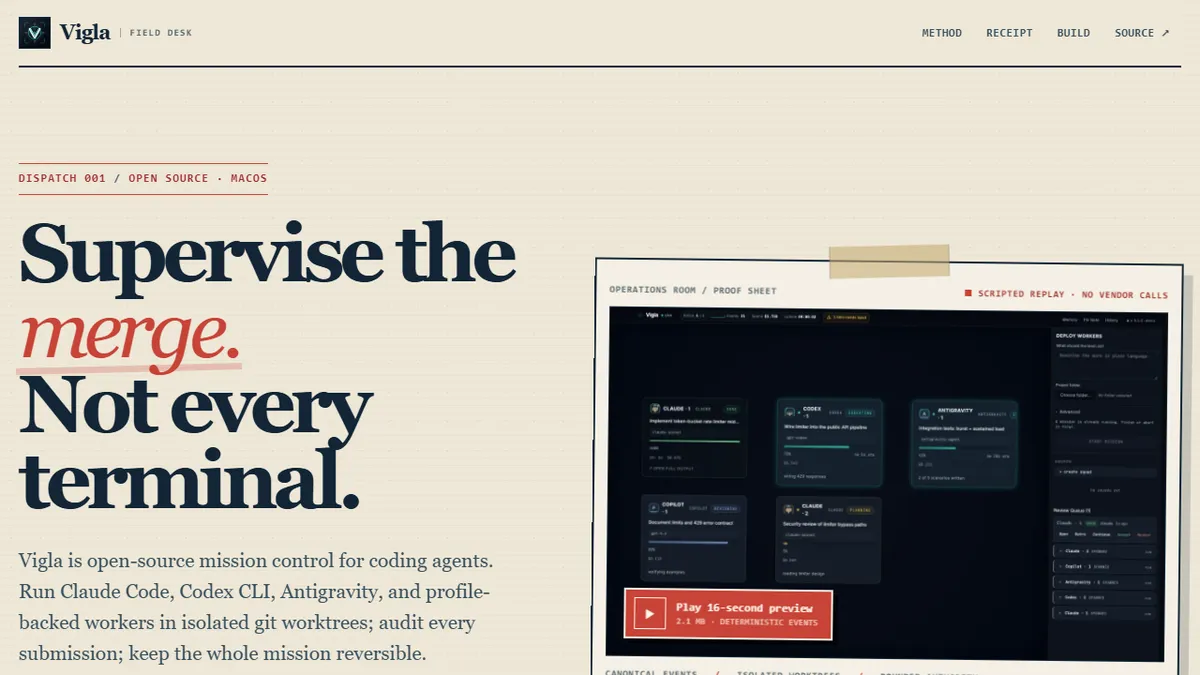
Vigla is an open-source mission control tool that wraps AI coding agents like Claude Code and Codex CLI in a governance layer. It runs agents in isolated git worktrees and performs pre-merge audits to ensure changes meet scope and test criteria before reaching your main branch.
Individual engineers or small dev teams on macOS who run multiple AI coding agents in parallel on the same repo and want an audited, worktree-isolated review gate before anything hits main.
Windows or Linux developers, non-technical users who want a click-to-install product, or teams that need a hosted, multi-user control plane with SSO and shared state.
Vigla is an open-source mission-control desktop app for supervising AI coding agents. Instead of replacing agents like Claude Code, Codex CLI, or Antigravity, it wraps them in a governance layer that runs each worker in an isolated git worktree, audits the resulting diff against scope, tests, and risk criteria, and only then lets you merge the change back into your main branch. The design goal is to sit between agent output and your protected branch, so teams get parallelism and delegation without the usual blast radius of an autonomous coder pushing directly to a shared tree.
Each 'mission' spawns a worktree per agent, records the prompt, tool calls, and file changes, and produces an auditable trail that can be reviewed, replayed, or rolled back. The pre-merge audit is opinionated: it flags out-of-scope edits, missing or failing tests, and risky patterns before you ever look at the diff yourself, which turns multi-agent orchestration from a trust exercise into a review workflow.
Because the control plane is local Rust with no vendor lock-in and no telemetry, Vigla is a natural fit for engineers who want to run several coding agents in parallel on the same repo but keep review, secrets, and merge policy under their own laptop. It is currently macOS 12+ only and ships as source you build yourself with Rust 1.95, Node 22, pnpm 10, and Xcode command line tools, so it targets developers comfortable with a toolchain build rather than click-to-install users.
Vigla is a sharp, honest take on the missing piece around today's coding agents: not another agent, but the review and rollback plane that lets you actually let them work. The macOS-only, build-from-source posture keeps it firmly in early-adopter territory, but the worktree isolation plus pre-merge audit is exactly the shape I want when running Claude Code and Codex side by side.
— The AI Tool Bible editorial team
Pros
- ✅ Cross-vendor: coordinates Claude Code, Codex CLI, Antigravity, and other coding agents from one cockpit
- ✅ Isolated git worktrees per agent prevent parallel workers from stepping on each other
- ✅ Pre-merge audit checks scope, tests, and risk before changes reach your main branch
- ✅ Full mission audit trail with reversible rollback for anything that ships
- ✅ Local control plane, no telemetry, no cloud dependency, Apache-2.0 licensed
- ✅ Model-agnostic — you keep using whatever LLM your chosen agent already ships with
Cons
- ⚠️ macOS 12+ only today; no Linux or Windows builds
- ⚠️ No pre-built binaries — requires a Rust/Node/pnpm/Xcode toolchain build from source
- ⚠️ Early-stage project with a small footprint and limited documentation compared to established agent frameworks
- ⚠️ No hosted or team collaboration layer; state lives on the operator's laptop
- ⚠️ No external API for programmatic control from other systems
Use cases
Frequently asked
- What is the primary function of Vigla?
- Vigla acts as a mission-control desktop app that supervises AI coding agents by running them in isolated git worktrees. It audits the resulting diffs against scope, tests, and risk criteria before allowing a merge to the main branch.
- Which AI coding agents does Vigla support?
- Vigla is model-agnostic and coordinates agents such as Claude Code, Codex CLI, and Antigravity. It delegates to the underlying LLM used by the chosen agent rather than replacing the agent itself.
- What are the system requirements for using Vigla?
- Vigla is currently available only for macOS 12+ and requires building from source using Rust 1.95, Node 22, pnpm 10, and Xcode command line tools. It does not offer pre-built binaries or support for Windows and Linux.
- Is Vigla free to use?
- Yes, Vigla is free and open source under the Apache-2.0 license. There are no paid tiers, and the control plane runs locally with no telemetry or cloud dependency.
- How does Vigla handle errors or unwanted changes from agents?
- Each mission records the prompt, tool calls, and file changes to create an auditable trail. This allows users to review, replay, or roll back any agent mission that went wrong before it impacts the shared codebase.
Explore related
Compare with similar tools
All in Agents →LangGraph
FeaturedStateful, graph-based agent orchestration from LangChain.
CrewAI
FeaturedPython framework for multi-agent orchestration.
Ernie Bot
Baidu's Mandarin-first ChatGPT rival, powered by the ERNIE model family
Moveworks
The enterprise AI assistant that searches, answers, and takes action across your business systems
AWS Bedrock
Build and scale generative AI applications with foundation models
Claude Agent SDK
Anthropic's official SDK for building autonomous Claude agents.