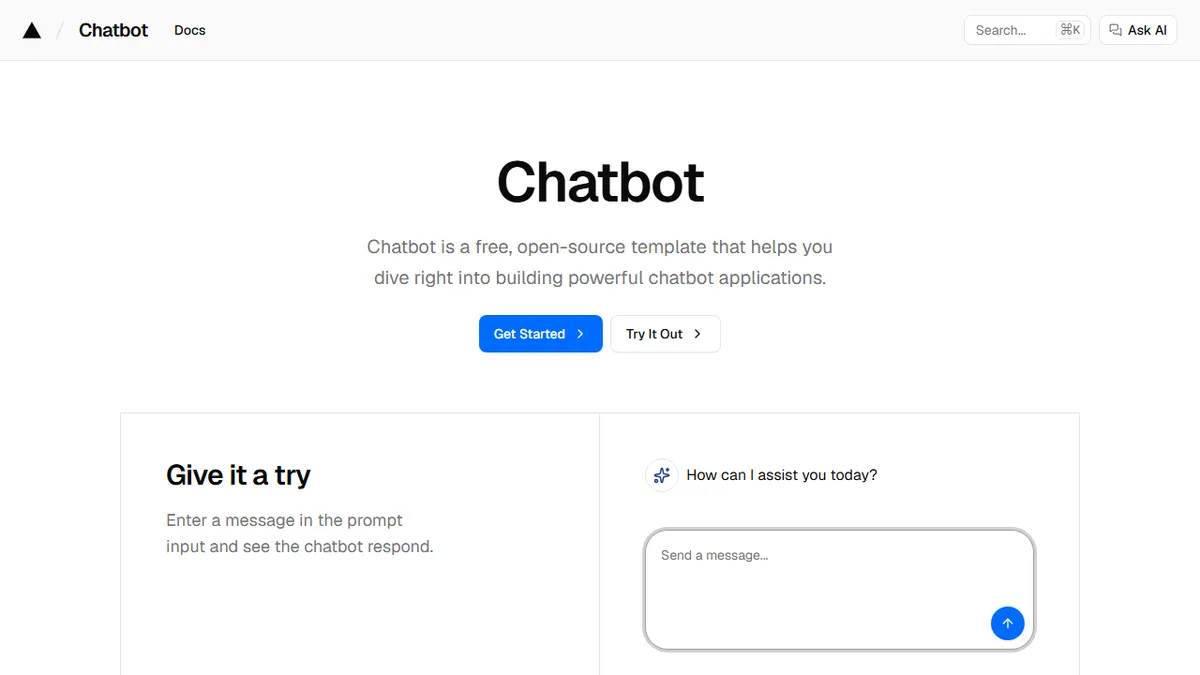
Chatbot by Vercel
Open-source Next.js chatbot template built on the Vercel AI SDK
In short
This tool is a free, open-source Next.js template that provides a batteries-included starting point for building conversational AI applications. It is best for product engineers who want a provider-agnostic codebase to fork, avoiding the need to assemble streaming, auth, and tool-calling from scratch.
Product and platform engineers who want a modern, provider-agnostic Next.js codebase to fork as the foundation of an internal or customer-facing chatbot, rather than assembling streaming, auth, and tool-calling from scratch.
Non-technical users, teams looking for a hosted no-code chatbot builder, or anyone who wants a turnkey SaaS with billing, analytics, and support included out of the box.
Chatbot by Vercel is a free, open-source Next.js template for building production-ready conversational AI applications. Distributed through the Vercel AI SDK ecosystem (ai-sdk.dev) and its companion GitHub repository (github.com/vercel/chatbot), it gives developers a batteries-included starting point rather than a hosted SaaS product. Out of the box the template ships with modern chat UX patterns such as streaming responses, message parts, resumable streams, reasoning traces, and artifacts (a side-panel for code, documents, or spreadsheets the model produces), along with theming, font customization, and tool-approval workflows for gating agentic actions. Because it is built on the Vercel AI SDK, the underlying model is pluggable: developers can wire it to OpenAI, Anthropic, Google, xAI, Groq, Mistral, or self-hosted providers by swapping a few lines of provider configuration, and can add tools, RAG retrieval, and auth on top. Typical audiences include product engineers who need an internal Copilot-style assistant, startups prototyping a customer-facing chatbot, and hobbyists who want a serious codebase to fork instead of assembling one from scratch. Common workflows are: deploy to Vercel with a one-click template, add an API key for the chosen LLM provider, then extend it with domain-specific tools, retrieval, and branding. It is not a no-code product and it is not a hosted chatbot service, but for teams comfortable in TypeScript it removes weeks of scaffolding around auth, persistence, streaming, and multi-modal input.
This is the reference chatbot codebase a lot of teams end up cloning anyway, just officially maintained. If you are building on the Vercel AI SDK it is close to a no-brainer starting point; the artifacts panel, resumable streams, and tool-approval scaffolding are exactly the pieces most teams underinvest in. Just remember it is a template you have to operate, not a product you buy.
— The AI Tool Bible editorial team
Pros
- ✅ Free and open-source under a permissive license, with an active repo maintained by Vercel
- ✅ Provider-agnostic through the Vercel AI SDK, so you can swap between OpenAI, Anthropic, Google, xAI, Groq, and others
- ✅ Ships with modern UX patterns most teams reinvent: streaming, reasoning traces, artifacts panel, resumable streams, message parts
- ✅ One-click deploy to Vercel plus a clean Next.js App Router codebase that is straightforward to fork and extend
- ✅ Includes tool-approval workflows and theming hooks, so agentic actions and branding are first-class rather than bolt-ons
- ✅ Serves as the reference implementation for the AI SDK, so it tracks new SDK features quickly
Cons
- ⚠️ It is a template, not a hosted product; you own deployment, scaling, auth, and observability
- ⚠️ Requires TypeScript, Next.js, and general web-app operations knowledge to customize seriously
- ⚠️ You pay for underlying model API usage separately, and costs can surprise teams that ship without guardrails
- ⚠️ Opinionated toward the Vercel deployment target; running it elsewhere works but loses some conveniences
- ⚠️ Documentation lives across the repo, AI SDK docs, and blog posts rather than in one polished product manual
Use cases
Frequently asked
- Is Chatbot by Vercel a hosted SaaS product?
- No, it is a free, open-source Next.js template distributed through the Vercel AI SDK ecosystem. Users must handle their own hosting costs and AI provider API usage.
- Which AI model providers are supported?
- The template is provider-agnostic via the Vercel AI SDK, allowing developers to wire it to OpenAI, Anthropic, Google, xAI, Groq, Mistral, or self-hosted providers by swapping configuration lines.
- What features are included in the template out of the box?
- It ships with modern chat UX patterns including streaming responses, message parts, resumable streams, reasoning traces, and an artifacts side-panel for code or documents.
- Who is this tool designed for?
- It is intended for product and platform engineers comfortable with TypeScript who want a modern codebase to fork for internal or customer-facing chatbots, rather than a no-code solution.
- Does the template include tool-approval workflows?
- Yes, it includes tool-approval workflows for gating agentic actions, along with theming and font customization hooks for branding.
Explore related
Compare with similar tools
All in Coding →Cursor
FeaturedAI-first VS Code fork — chat, edit, and agentic coding in one IDE.
GitHub Copilot
FeaturedThe original AI pair programmer, now with chat and agents.
Replit Agent
FeaturedBuild & deploy a full app from a single prompt.
Warp
The agentic development environment, from the terminal up
Cline
Open-source agentic coding assistant that plans, edits, and runs code inside your IDE
Aider
Terminal-based AI pair programmer that writes commits.