Vectara
✓ Editorially verifiedEnterprise agent platform with built-in retrieval, grounding, and hallucination controls
In short
Vectara provides a managed RAG pipeline with built-in hallucination detection and citation features for regulated enterprises. It supports flexible deployment models, including on-premises, for organizations requiring strict data residency and audit trails.
Regulated enterprises (finance, legal, healthcare, manufacturing) building production RAG or agent workflows over private corpora who need grounding, citations, audit trails, and VPC or on-prem deployment.
Solo developers, hobbyists, or startups on a budget — the $100K/year entry point and enterprise sales motion make it unsuitable for early-stage or self-serve use.
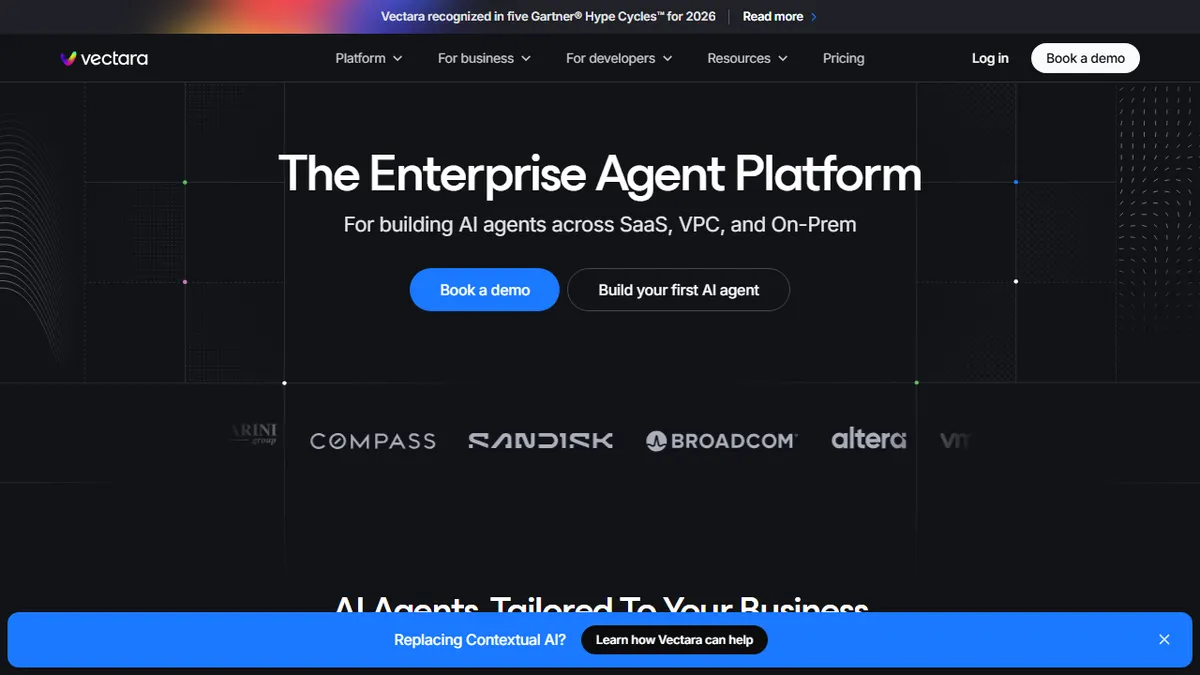
Vectara is an enterprise-grade RAG and agent platform that packages the full retrieval-augmented generation pipeline — ingestion, chunking, embedding, vector storage, hybrid retrieval, reranking, generation, and citation — behind a single API. It ships with proprietary models (Boomerang for retrieval, Mockingbird for generation) but is model-agnostic, so teams can bring their own LLM (Claude, GPT, Gemini, open weights) for the generation step while keeping Vectara's grounding and safety layers in place. The platform is aimed at regulated industries — financial services, legal, healthcare, manufacturing, semiconductors — where hallucinations, audit trails, and data residency are gating concerns rather than nice-to-haves. Distinctive features include real-time factual-consistency scoring on every generated answer (their HHEM hallucination-evaluation model is open-sourced separately and widely used as a benchmark), automatic citations tied to source spans, multimodal ingestion that handles tables and images in PDFs, role-based access controls, and version-aware retrieval so a query can be pinned to a specific document revision. Deployment is flexible: managed SaaS, single-tenant VPC in any major cloud, or fully on-premises for air-gapped environments. Typical workflows are enterprise-search chatbots over private document corpora, customer-support assistants grounded in product docs and past tickets, contract and policy analysis, and internal knowledge agents for large organizations. Developers interact through a REST API plus SDKs and an admin console; there is no low-code builder aimed at non-engineers.
Vectara is one of the most credible managed RAG platforms for enterprises that care about hallucination control and deployment posture rather than the cheapest per-token bill. The HHEM hallucination-evaluation model is genuinely respected in the space, and the VPC/on-prem options plug a gap most hosted RAG services leave open. Pricing puts it firmly in the RFP tier — if you're evaluating, you're already past the prototype stage.
— The AI Tool Bible editorial team
Pros
- ✅ End-to-end managed RAG stack — you ship documents and queries, Vectara handles chunking, embeddings, vector store, retrieval, reranking, and grounded generation
- ✅ Built-in hallucination detection (HHEM) that scores factual consistency of every response, not just a black-box confidence number
- ✅ Automatic citation of source passages, essential for legal, medical, and financial use cases
- ✅ Model-agnostic — bring your own LLM (OpenAI, Anthropic, Google, open weights) while keeping Vectara's retrieval and safety layers
- ✅ Deployment flexibility including single-tenant VPC and fully on-premise for regulated / air-gapped environments
- ✅ Handles multimodal ingestion (text, tables, images in PDFs) without extra plumbing
- ✅ Version-aware retrieval and role-based access controls suited to enterprise governance requirements
Cons
- ⚠️ Enterprise pricing only — starts at $100K/year for SaaS and climbs to $500K/year for on-prem, ruling out solo devs and small teams
- ⚠️ No transparent self-serve tier beyond the 30-day trial; production use requires a sales conversation
- ⚠️ Core platform is closed-source (only the HHEM eval model is open); teams wanting to inspect or fork the retrieval stack should look elsewhere
- ⚠️ Opinionated pipeline means less control over individual components (custom chunkers, exotic rerankers) than a DIY LangChain/LlamaIndex stack
- ⚠️ Heavier onboarding than lightweight vector-DB-plus-LLM setups; overkill for prototypes or single-app use
Use cases
Frequently asked
- What industries is Vectara designed for?
- Vectara targets regulated industries such as financial services, legal, healthcare, manufacturing, and semiconductors where hallucinations and data residency are critical concerns.
- Can I use my own LLM with Vectara?
- Yes, the platform is model-agnostic, allowing teams to bring their own LLMs like Claude, GPT, or Gemini for generation while retaining Vectara's retrieval and safety layers.
- What deployment options does Vectara offer?
- Vectara supports managed SaaS, single-tenant VPC in major clouds, and fully on-premises deployment for air-gapped environments.
- How does Vectara handle hallucinations?
- It includes real-time factual-consistency scoring using the HHEM model and provides automatic citations tied to source spans for every generated answer.
- Is Vectara suitable for small teams or startups?
- No, with enterprise pricing starting at $100K/year and a sales-based motion, it is not suitable for solo developers, hobbyists, or budget-constrained startups.
Explore related
Compare with similar tools
All in RAG →Pinecone
FeaturedManaged vector database for production-scale similarity search.
LlamaIndex
FeaturedData framework for connecting LLMs to your data.
Elasticsearch Vector Search
Hybrid vector + keyword search in the enterprise-grade Elasticsearch engine
Snowflake Cortex
Generative AI and RAG built into the Snowflake data cloud
DataStax Astra DB
Serverless vector and document database for production RAG and AI agents
MongoDB Atlas Vector Search
Vector search built into the operational database you're already using.