Vapi
✓ Editorially verifiedDeveloper platform for building, deploying, and scaling production voice AI agents
In short
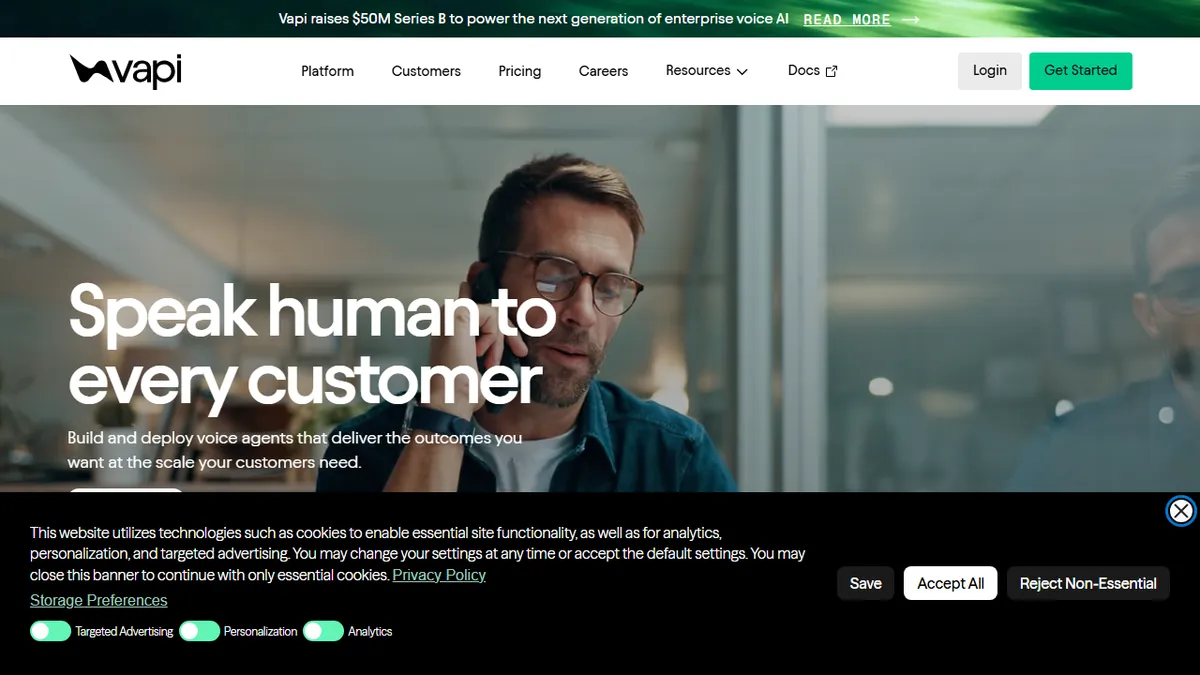
Vapi is a voice AI orchestration platform that enables developers to build, deploy, and scale production-grade phone and web voice agents. It abstracts the complex real-time voice plumbing, such as turn-taking and interruption handling, while allowing teams to select their own LLM and speech providers. It is best suited for product and engineering teams who need full control over their model stack and require robust API and SDK support.
Product and engineering teams building voice agents for phone-based support, sales, or scheduling who want control over the model stack without engineering the real-time voice pipeline themselves.
Non-technical operators looking for a fully packaged, no-code IVR replacement, or hobbyists who need a truly free tier with predictable flat pricing.
Vapi is a voice AI orchestration platform that lets developers assemble production-grade phone and web voice agents by wiring together a speech-to-text engine, a large language model, and a text-to-speech voice, then handling the messy real-time plumbing (turn-taking, interruption handling, endpointing, function/tool calls, telephony, and observability) so teams do not have to build it themselves. Agents can be configured through a dashboard or entirely via the REST API and SDKs (Node, Python, Web, iOS, Android, Flutter, React Native), and Vapi provisions Twilio-style numbers, SIP trunks, and inbound/outbound calling out of the box. It is model-agnostic: teams can pick from OpenAI GPT-4o, Anthropic Claude, Google Gemini, Groq, DeepSeek, or Llama for the reasoning layer, mix providers like Deepgram, ElevenLabs, PlayHT, Cartesia, and Azure for STT/TTS, and bring their own API keys to control costs. Common workflows include voice-driven customer support, outbound lead qualification, appointment scheduling, order taking, receptionist replacement, and internal IVR modernization. Enterprise features include SOC 2, HIPAA and PCI compliance, SSO, RBAC, on-call SLAs, and a dedicated deployment engineer. The platform is designed for sub-500ms latency at scale and is used by teams running millions of calls per month.
Vapi is the most credible general-purpose voice agent platform we have tested: it stays out of your way on model choice, exposes a clean API, and quietly solves the hardest 20% of real-time voice work. Just budget carefully — the platform fee is only one line on the bill, and HIPAA is a genuine enterprise add-on rather than a checkbox.
— The AI Tool Bible editorial team
Pros
- ✅ Model-agnostic stack lets you swap LLM, STT, and TTS providers per assistant and bring your own API keys
- ✅ Handles the real-time voice plumbing (interruption detection, endpointing, barge-in, backchanneling) that is painful to build from scratch
- ✅ First-class REST API and SDKs across Node, Python, Web, iOS, Android, Flutter, and React Native
- ✅ Built-in telephony: provisions phone numbers, supports SIP trunks, and covers inbound and outbound calls
- ✅ Tool/function calling and 25+ prebuilt integrations (Salesforce, HubSpot, Zapier, Make, Cal.com, etc.) for real workflows
- ✅ Enterprise compliance path: SOC 2, HIPAA (add-on), PCI, SSO, RBAC, Zero Data Retention available
- ✅ Transparent per-minute platform fee with model costs passed through at cost rather than marked up opaquely
Cons
- ⚠️ Total cost is hard to predict because platform fee, LLM, STT, TTS, and telephony are billed separately and stack up
- ⚠️ HIPAA compliance and Zero Data Retention are paid add-ons ($2,000/mo and $1,000/mo) rather than included
- ⚠️ Latency and voice naturalness ultimately depend on the third-party providers you choose, not Vapi itself
- ⚠️ Build plan retains call history only 14 days and chat history 30 days, so long-term analytics require your own pipeline
- ⚠️ Not a no-code tool — meaningful agents still require prompt engineering, tool wiring, and webhook code
- ⚠️ Concurrency beyond 10 lines costs $10/line/month, which adds up for high-volume outbound campaigns
Use cases
Frequently asked
- What voice and AI models does Vapi support?
- Vapi is model-agnostic, allowing teams to pick from OpenAI GPT-4o, Anthropic Claude, Google Gemini, Groq, DeepSeek, or Llama for reasoning. For speech processing, it supports providers like Deepgram, ElevenLabs, PlayHT, Cartesia, and Azure.
- Does Vapi require coding to build agents?
- Yes, Vapi is not a no-code tool. Agents are configured through a dashboard or entirely via REST API and SDKs (Node, Python, Web, iOS, Android, Flutter, React Native), requiring prompt engineering and tool wiring.
- What telephony features are included?
- Vapi provisions Twilio-style numbers and supports SIP trunks out of the box. It handles inbound and outbound calling, as well as real-time features like interruption handling, endpointing, and function calls.
- Is Vapi suitable for enterprise compliance requirements?
- Vapi offers enterprise features including SOC 2, PCI compliance, SSO, and RBAC. HIPAA compliance and Zero Data Retention are available as paid add-ons.
Explore related
Compare with similar tools
All in Audio →ElevenLabs
FeaturedThe gold standard for AI voice cloning and TTS.
Suno
FeaturedText-to-song AI — full vocal tracks from a prompt.
Udio
Suno's main rival for AI-generated full songs.
AssemblyAI
Speech-to-text API with diarisation, summarisation, and topic detection.
Chorus by ZoomInfo
Enterprise conversation intelligence bundled with ZoomInfo's B2B data graph
Whisper
OpenAI's open-source speech-to-text — the de-facto baseline.