Unstructured.io
✓ Editorially verifiedTurn unstructured enterprise documents into LLM-ready data
In short
Unstructured.io is a document ingestion platform that transforms messy enterprise files into clean, embedding-ready data for RAG systems. It is best for engineering teams needing to process PDFs, Office docs, and emails without building custom parsers.
Engineering and data teams building production RAG or document-intelligence pipelines who need to ingest heterogeneous enterprise documents (PDF, Office, email) into a vector store with minimal custom parsing code.
Solo hobbyists doing small-scale personal RAG over a handful of text files, or teams whose documents are already clean Markdown/HTML where a simple text splitter is sufficient.
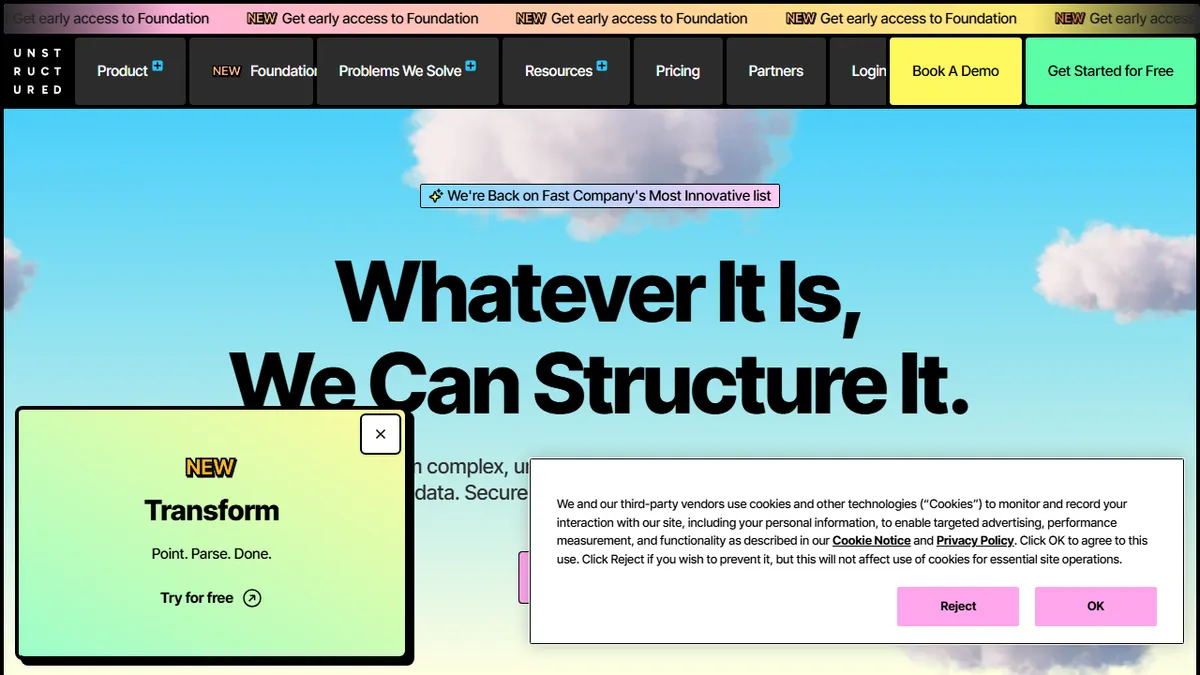
Unstructured.io is a document ingestion and preprocessing platform purpose-built for retrieval-augmented generation (RAG) and other LLM pipelines. Its core job is turning messy real-world inputs — PDFs, PPTX, DOCX, XLSX, HTML, EML, images, scanned forms and 60+ other file types — into clean, chunkable, embedding-ready JSON with element-level structure (titles, narrative text, tables, list items, images, page numbers). The company ships two complementary things: an open-source Python library (`unstructured`) that runs locally with pluggable partitioners and OCR back-ends, and a commercial platform (Serverless API, hosted Workflow UI, and MCP server) that adds high-accuracy models, table extraction, layout-aware chunking, enrichment (summaries, entities), embedding generation, and 30+ source/destination connectors for object stores, databases and vector DBs like S3, SharePoint, Snowflake, Databricks, MongoDB, Pinecone, Weaviate, Elastic and pgvector. Teams typically wire it up as the extract-transform stage of a RAG pipeline: point it at a bucket or SharePoint site, let the Workflow engine partition + chunk + embed on a schedule, and stream the results straight into a vector index. It is aimed at engineering teams who don't want to hand-roll PDF parsers, wrestle with PyMuPDF/Tesseract quirks and re-invent chunking heuristics, and at enterprises that need SOC 2 / HIPAA / GDPR / FedRAMP-grade handling of sensitive documents on the ingest path.
Unstructured is the closest thing the RAG ecosystem has to a default 'ingest layer'. The OSS library alone saves weeks of PDF-wrangling, and the hosted Workflow tier is genuinely useful when you'd otherwise be babysitting a home-grown Airflow DAG. Pricing bites at scale and the free library isn't as accurate as the paid models, but for enterprise document RAG it's the sensible first pick.
— The AI Tool Bible editorial team
Pros
- ✅ Handles 64+ file formats through a single unified API, including notoriously ugly ones like scanned PDFs, PPTX and EML with attachments
- ✅ Element-level output (Title, NarrativeText, Table, ListItem, Image) enables smarter, layout-aware chunking than naive text splitters
- ✅ Open-source core library means you can run everything locally, air-gapped, with no vendor lock-in for basic partitioning
- ✅ Serverless API and Workflow UI remove the operational burden of GPU-backed OCR and table models
- ✅ Deep connector library (S3, Azure Blob, SharePoint, Google Drive, Snowflake, Databricks, plus Pinecone/Weaviate/Elastic/pgvector destinations) makes end-to-end pipelines declarative
- ✅ Enterprise-grade compliance stack: SOC 2 Type II, HIPAA, GDPR and FedRAMP High, which is rare among ingestion tools
- ✅ MCP server exposes ingestion to Claude, Cursor and other agent hosts as a first-class tool
Cons
- ⚠️ Hosted API pricing is per-page and can get expensive at millions-of-pages scale versus rolling your own with the OSS library
- ⚠️ The open-source library's accuracy on complex tables and scanned documents lags the paid 'hi_res' and VLM strategies noticeably
- ⚠️ Cold-start latency and heavyweight model dependencies (Detectron2, Tesseract, ONNX) make local installs bulky
- ⚠️ Chunking and enrichment options are opinionated — teams with unusual layouts often still need custom post-processing
- ⚠️ Documentation covers many surfaces (OSS, API, Platform, MCP) and can be confusing when deciding which product to use
Use cases
Frequently asked
- What file formats does Unstructured.io support?
- The platform handles over 60 file types, including PDFs, PPTX, DOCX, XLSX, HTML, EML, images, and scanned forms. It processes these into element-level JSON structures with titles, text, tables, and images.
- Is Unstructured.io available as open-source software?
- Yes, the core Python library is open-source and can run locally with pluggable partitioners and OCR back-ends. This allows teams to perform basic partitioning without vendor lock-in or external dependencies.
- How does the commercial platform differ from the open-source library?
- The commercial platform adds high-accuracy models, table extraction, layout-aware chunking, and enrichment features. It also provides a Serverless API, hosted Workflow UI, and 30+ connectors for object stores and vector databases.
- What compliance standards does Unstructured.io meet?
- The enterprise offering supports SOC 2 Type II, HIPAA, GDPR, and FedRAMP High compliance. This makes it suitable for handling sensitive documents in regulated industries.
- Who is Unstructured.io designed for?
- It is aimed at engineering and data teams building production RAG pipelines who need to ingest heterogeneous enterprise documents. It is not intended for solo hobbyists or teams with already clean Markdown or HTML files.
Explore related
Compare with similar tools
All in RAG →Pinecone
FeaturedManaged vector database for production-scale similarity search.
LlamaIndex
FeaturedData framework for connecting LLMs to your data.
Elasticsearch Vector Search
Hybrid vector + keyword search in the enterprise-grade Elasticsearch engine
Snowflake Cortex
Generative AI and RAG built into the Snowflake data cloud
DataStax Astra DB
Serverless vector and document database for production RAG and AI agents
MongoDB Atlas Vector Search
Vector search built into the operational database you're already using.