TurboVec
Rust-powered vector index with 2-4 bit TurboQuant compression for SIMD-accelerated RAG search.
In short
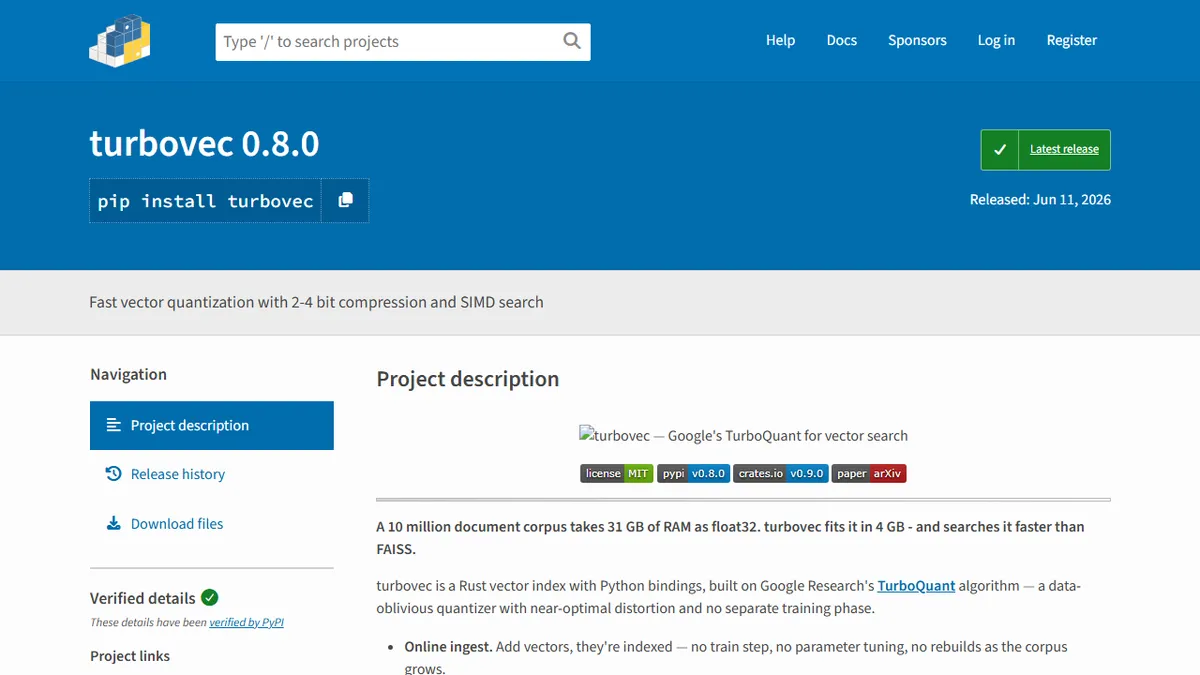
TurboVec is an open-source vector index library that compresses embeddings to 2-4 bits using TurboQuant. It is best for engineers building RAG pipelines who need lightweight, in-process search without the overhead of full vector databases.
Pick TurboVec if you need a lightweight in-process ANN index for RAG and want to fit millions of embeddings in a few GB of RAM.
Skip it if you need a managed, multi-tenant vector database with replication, persistence guarantees, and a mature ops story.
TurboVec is an open-source vector index library written in Rust with Python bindings, implementing Google Research's TurboQuant quantization algorithm. It aggressively compresses high-dimensional embeddings down to 2-4 bits per dimension while keeping similarity search fast through hand-written SIMD kernels (ARM NEON, x86 AVX-512BW). The author claims a 10M-document corpus that would normally need 31GB of RAM fits in roughly 4GB with TurboVec.
The project is aimed at engineers building RAG pipelines or embedding-search backends who don't want to run a full vector database like Qdrant or Weaviate, but who also can't afford the memory cost of naive in-memory cosine search at scale. Unlike FAISS or HNSWlib, TurboVec emphasizes online ingestion with no training phase or hyperparameter tuning, plus filtered search via ID allowlists. It ships integrations for LangChain, LlamaIndex, Haystack, and Agno, so it can drop into existing retrieval stacks. It's free under MIT, requires Python 3.9+, and works on macOS, Linux, and Windows. Current release is 0.8.0 (June 2026), authored by Ryan Codrai — still pre-1.0 and relatively niche compared to mainstream ANN libraries.
TurboVec is a genuinely interesting bet: a Rust implementation of TurboQuant exposed to Python, aimed squarely at RAG engineers who find FAISS heavy and hosted vector DBs overkill. It's early-stage and single-maintainer, so we'd reach for it on side projects and prototypes before trusting it in production.
— The AI Tool Bible editorial team
Pros
- ✅ Aggressive 2-4 bit quantization shrinks RAM cost ~8x vs float32
- ✅ Hand-tuned SIMD kernels for ARM NEON and x86 AVX-512BW
- ✅ Online ingestion, no training step or hyperparameter tuning
- ✅ Drop-in integrations for LangChain, LlamaIndex, Haystack, Agno
- ✅ MIT licensed and cross-platform
Cons
- ⚠️ Pre-1.0 (0.8.0) and authored by a single developer
- ⚠️ Niche compared to FAISS, HNSWlib, or hosted vector DBs
- ⚠️ Limited ecosystem, docs, and production track record
Use cases
Frequently asked
- How does TurboVec reduce memory usage for vector search?
- It implements Google Research's TurboQuant algorithm to compress high-dimensional embeddings down to 2-4 bits per dimension. This allows a 10M-document corpus to fit in roughly 4GB of RAM instead of 31GB.
- What programming languages and platforms does TurboVec support?
- TurboVec is written in Rust with Python bindings, requiring Python 3.9 or higher. It works on macOS, Linux, and Windows, utilizing hand-written SIMD kernels for ARM NEON and x86 AVX-512BW.
- Which RAG frameworks integrate with TurboVec?
- The library ships with integrations for LangChain, LlamaIndex, Haystack, and Agno, allowing it to drop into existing retrieval stacks.
- Is TurboVec suitable for production environments?
- TurboVec is currently pre-1.0 (version 0.8.0) and authored by a single developer. It is recommended for side projects and prototypes rather than production systems requiring mature ops stories.
- Does TurboVec require a training phase for indexing?
- No, TurboVec emphasizes online ingestion with no training phase or hyperparameter tuning, distinguishing it from libraries like FAISS or HNSWlib.
Explore related
Compare with similar tools
All in RAG →Pinecone
FeaturedManaged vector database for production-scale similarity search.
LlamaIndex
FeaturedData framework for connecting LLMs to your data.
Elasticsearch Vector Search
Hybrid vector + keyword search in the enterprise-grade Elasticsearch engine
Snowflake Cortex
Generative AI and RAG built into the Snowflake data cloud
DataStax Astra DB
Serverless vector and document database for production RAG and AI agents
MongoDB Atlas Vector Search
Vector search built into the operational database you're already using.