TuneAI
Voice-based oral exam practice with rubric-grounded AI feedback
In short
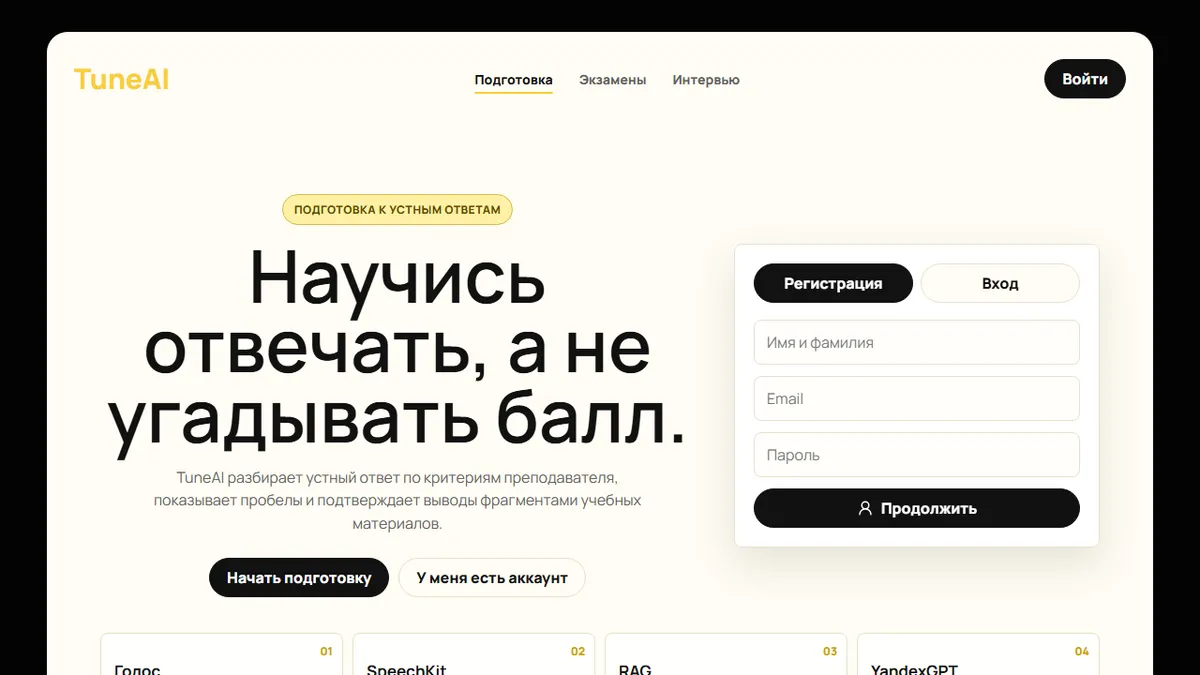
TuneAI helps Russian-speaking students prepare for oral exams by transcribing spoken answers and grading them against teacher-defined rubrics. It provides structured feedback grounded in specific source materials using Yandex AI models. It is best for viva-style assessment rehearsal where cited, rubric-based corrections are needed.
Russian-speaking students prepping for oral exams, university admission interviews, or viva-style assessments who want rubric-scored feedback grounded in their actual course materials.
English-first learners, teams building general RAG applications, or anyone needing an API, fine-tuning controls, or model choice beyond Yandex's stack.
TuneAI is a Russian-language AI oral exam preparation platform built on Yandex's cloud AI stack. Students speak their answers into a microphone, the platform transcribes the response using SpeechKit, evaluates it against teacher-provided criteria and rubrics, and returns structured feedback generated by YandexGPT. The feedback is grounded in the underlying study material through retrieval-augmented generation (RAG), so explanations point back to specific passages in textbooks, lecture notes, or handouts rather than being invented by the model. The tool is aimed at learners preparing for viva-style assessments, university interviews, professional certification vivas, and any exam format where an examiner listens to a spoken answer and grades it against a defined rubric. Typical workflows: a teacher (or the student themselves) uploads reference materials and defines the criteria for a question; the student records an answer; TuneAI transcribes, compares the answer against the criteria, identifies missing concepts and misconceptions, and cites the source passages that address each gap. Iterated attempts let the learner close gaps ahead of the real exam. Because the underlying models are Yandex's, the product is best positioned for Russian-speaking students and content, and pairs well with curricula already published in Russian. It is not an LLM playground, a fine-tuning studio, or a general-purpose transcription tool — the value is the closed-loop of speech-in, rubric-graded, source-cited feedback-out.
A focused niche tool that does one useful thing well: closing the loop between spoken practice and rubric-graded feedback with citations back to the source. The Yandex-model dependency and Russian-only interface make it a regional pick rather than a global one, and the lack of public pricing or API docs is a red flag for anyone evaluating it for institutional use.
— The AI Tool Bible editorial team
Pros
- ✅ Grounds feedback in teacher-supplied source material via RAG, reducing hallucinated corrections
- ✅ Voice-first workflow mirrors real oral-exam conditions rather than typed practice
- ✅ Rubric/criterion-based scoring gives structured, actionable feedback instead of vague praise
- ✅ Uses Yandex SpeechKit, which is strong for Russian-language transcription
- ✅ Focused product scope — does one thing (oral exam prep) rather than sprawling feature list
Cons
- ⚠️ Russian-language interface and Yandex-model stack limit usefulness for non-Russian learners
- ⚠️ Public pricing is not disclosed on the site — you must register to see plans
- ⚠️ No documented public API for embedding the assessment loop in other LMS platforms
- ⚠️ Depends on quality of the teacher-uploaded criteria; weak rubrics produce weak feedback
- ⚠️ Small, single-purpose tool — no fine-tuning, model choice, or examiner-persona configuration surfaced
Use cases
Frequently asked
- How does TuneAI generate feedback for oral exam answers?
- The platform transcribes the student's spoken response using Yandex SpeechKit and evaluates it against teacher-provided criteria. It then uses YandexGPT to generate structured feedback that cites specific passages from uploaded study materials.
- Is TuneAI available for English-speaking students?
- No, the tool is built on Yandex's cloud AI stack and features a Russian-language interface. It is specifically positioned for Russian-speaking students and content, making it unsuitable for English-first learners.
- What types of assessments is TuneAI designed for?
- It is aimed at learners preparing for viva-style assessments, university interviews, professional certification vivas, and any exam format where an examiner grades a spoken answer against a defined rubric.
- Does TuneAI offer a public API or free trial?
- TuneAI does not have a documented public API for embedding its assessment loop in other platforms. However, account registration is available, suggesting a free tier or trial, though public pricing is not disclosed on the site.
Explore related
Compare with similar tools
All in RAG →Pinecone
FeaturedManaged vector database for production-scale similarity search.
LlamaIndex
FeaturedData framework for connecting LLMs to your data.
Elasticsearch Vector Search
Hybrid vector + keyword search in the enterprise-grade Elasticsearch engine
Snowflake Cortex
Generative AI and RAG built into the Snowflake data cloud
DataStax Astra DB
Serverless vector and document database for production RAG and AI agents
MongoDB Atlas Vector Search
Vector search built into the operational database you're already using.