
TreeScale
No-code platform that wraps LLM prompt chains into deployable, integration-ready APIs.
In short
TreeScale is a no-code platform that converts LLM prompt chains into production-ready APIs. It handles backend infrastructure, versioning, and evaluation for model-agnostic deployments.
Pick TreeScale if you want to expose prompt chains as production APIs without writing a backend or running your own orchestrator.
Skip it if you need full source-level control, on-prem deployment, or a mature open-source ecosystem around your agent stack.
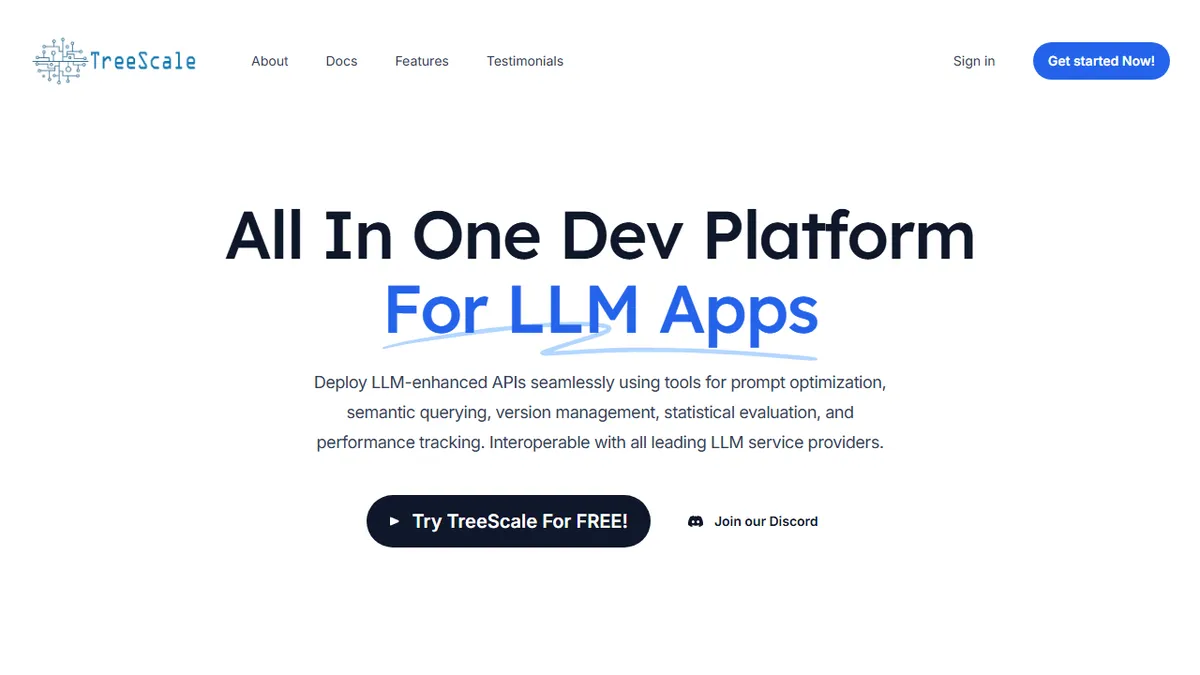
TreeScale is a no-code platform that turns LLM prompts and prompt chains into production-ready API endpoints without any backend code. You define endpoints, chain prompts together, store reusable context, and TreeScale exposes the whole thing as a callable API your apps and integrations can hit. It bundles prompt optimization, version management, a built-in debugger, and statistical evaluation so teams can iterate on prompts the way engineers iterate on services.
The pitch is aimed at builders who want LLM-powered features behind an API surface but don't want to babysit infrastructure, write glue code, or hand-roll a prompt orchestrator. It is model-agnostic, supporting popular providers like OpenAI alongside self-hosted open-source models, and ships LLM Integrations (its term for agent-style tool connectors) that let chains call out to external services. Pricing starts with a free tier that lets you publish your first LLM app, with paid tiers layered on top.
It sits in the same conceptual space as LangChain-as-a-service, Dify, and Flowise, but skews further toward the API-product use case rather than chat UI building. The trade-off is the usual hosted-platform one: you trade portability for speed of delivery and a managed runtime.
TreeScale is a credible no-code bridge between a prompt and a real API endpoint, and the debugger plus eval tooling raise it above the average prompt-to-API toy. The bet you're making is that a hosted, less-known platform will keep up with the LangChain and Dify worlds; for small teams shipping LLM features fast, that bet is reasonable.
— The AI Tool Bible editorial team
Pros
- ✅ No-code prompt chains compile straight into callable API endpoints
- ✅ Provider-agnostic: OpenAI, other commercial APIs, and self-hosted open models
- ✅ Built-in debugger, versioning, and statistical evaluation of prompts
- ✅ Free tier is enough to ship a first LLM app end-to-end
Cons
- ⚠️ Hosted-only; you don't own the orchestration layer
- ⚠️ Pricing tiers above free are not transparent on the marketing site
- ⚠️ Smaller ecosystem and community than LangChain or Dify
Use cases
Frequently asked
- How much does TreeScale cost?
- TreeScale uses a freemium model. You can start with a free tier to publish your first LLM app. Paid tiers are available on top of the free plan for additional needs.
- Which AI models does TreeScale support?
- TreeScale is model-agnostic. It supports popular providers like OpenAI as well as self-hosted open-source models. This flexibility allows you to choose the best model for your specific prompt chains.
- Do I need to write backend code?
- No. TreeScale is a no-code platform that exposes prompt chains as callable APIs without requiring you to write backend code or manage your own infrastructure. It handles the orchestration for you.
- What features help with prompt management?
- The platform includes prompt optimization, version management, a built-in debugger, and statistical evaluation. These tools allow teams to iterate on prompts efficiently, similar to how engineers iterate on services.
- Can TreeScale connect to external services?
- Yes. It ships with LLM Integrations, which are agent-style tool connectors. These allow your prompt chains to call out to external services, enabling more complex agent workflows.
- Is TreeScale suitable for on-premises deployment?
- No. You should skip TreeScale if you need on-prem deployment or full source-level control. It is a hosted platform that trades portability for speed of delivery and a managed runtime.
Explore related
Compare with similar tools
All in Agents →LangGraph
FeaturedStateful, graph-based agent orchestration from LangChain.
CrewAI
FeaturedPython framework for multi-agent orchestration.
Ernie Bot
Baidu's Mandarin-first ChatGPT rival, powered by the ERNIE model family
Moveworks
The enterprise AI assistant that searches, answers, and takes action across your business systems
AWS Bedrock
Build and scale generative AI applications with foundation models
Claude Agent SDK
Anthropic's official SDK for building autonomous Claude agents.