Transept
AI translation workspace with shared glossaries, styleguides, and decision-context memory
Literary translators, indie publishers, and small localization teams handling long-form content across many languages where tone consistency and terminology decisions must survive across chapters and reviewers.
Engineering teams needing programmatic translation pipelines via API, high-volume enterprise localization shops already on Trados or Phrase, or anyone requiring on-prem deployment for confidentiality.
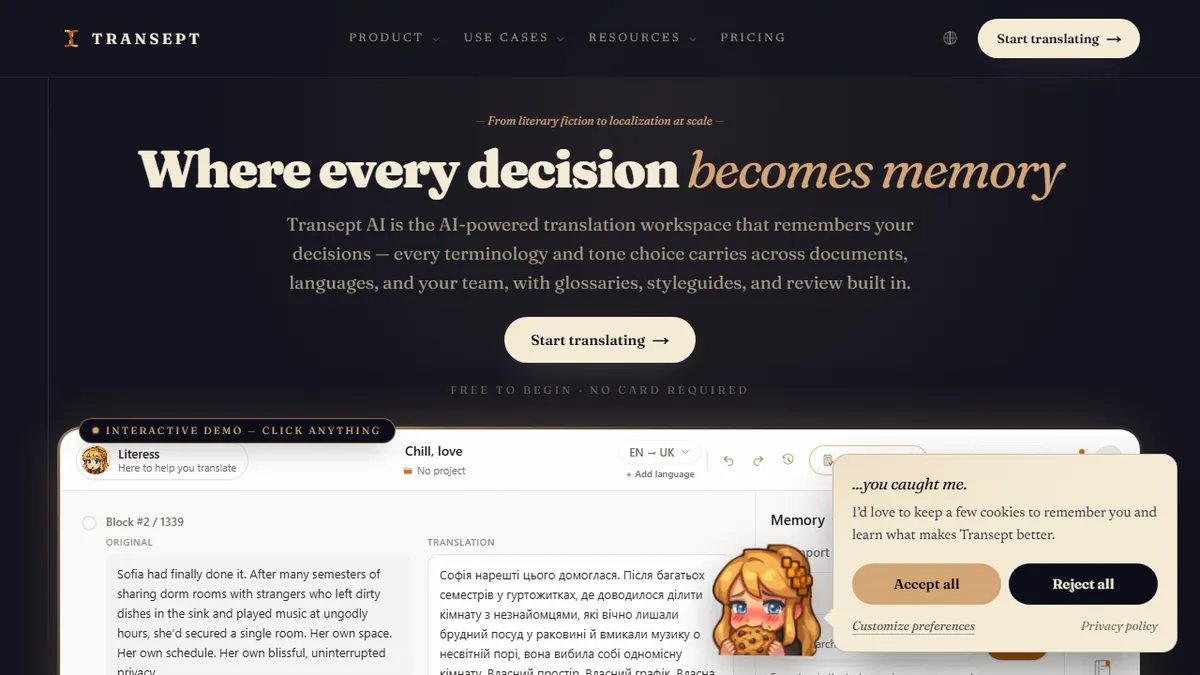
Transept is an AI translation workspace built for people who care about how their words land in another language, not just whether they parse. Instead of framing translation as a one-shot machine job, it treats a project as an ongoing document with shared glossaries, styleguides, and a decision-context memory that records the wording chosen, the alternatives rejected, and the comments that explained the call. Files come in as DOCX, PDF, Markdown, TXT, or via Notion and Google Drive connectors; translated output can be exported back to those formats plus Google Docs and localization-industry TMX/XLIFF. The editor is side-by-side with sentence-level regeneration, custom rewrite directions, QA checks, and collaborative comment threads. Two quality modes are exposed as word budgets: Standard spends roughly one word per source word, while Pro spends about three, letting teams trade cost against depth of reasoning. A layer called Literess acts as an agentic literary editor that flags tone inconsistencies across a manuscript and can execute multi-step editing workflows, with up to 20 remembered preferences per account. Under the hood, Transept says it benchmarks Claude, GPT, Gemini, and open models rather than committing to a single family, so the product's value is really the wrapper: the glossary/styleguide enforcement, the decision memory, the team-shared pools, and the localization-friendly file plumbing. Typical workflows include translating a book or long-form manuscript into 8-12 languages while keeping character voice consistent, running client-specific styleguides across recurring marketing briefs, and localizing product content where terminology accuracy matters more than raw throughput. Free viewers are unlimited on paid plans, so reviewers, authors, and clients can sit inside the same project without extra seat cost.
Most MT products either give you a raw engine or a heavy enterprise TMS. Transept sits in a genuinely underserved middle: a writer-friendly workspace that remembers why you translated a line the way you did. The decision-context memory and Literess editor are the interesting bets. The missing API and opaque model choice will matter to some buyers, but for a translator working on a novel or a brand voice across ten markets, this is a sharp fit.
— The AI Tool Bible editorial team
Pros
- ✅ Decision-context memory records why a phrasing was chosen, not just the final word, which is unusual for MT tools
- ✅ Shared glossaries and styleguides apply across every document in a project, not per-file
- ✅ Side-by-side editor with sentence-level regeneration and custom rewrite prompts
- ✅ Handles real localization file formats (DOCX, PDF, Markdown, TMX/XLIFF) plus Notion and Google Drive
- ✅ Two explicit quality/cost tiers (Standard vs Pro) so teams can spend more compute on high-stakes passages
- ✅ Unlimited free viewer seats make collaborative review with authors and clients cheap
- ✅ Literess adds an agentic editing layer that flags tone drift across long manuscripts
Cons
- ⚠️ No public API documented on the marketing site, limiting programmatic pipelines
- ⚠️ Underlying model is opaque - the site mentions benchmarking several families but does not commit to one
- ⚠️ Word-budget pricing can be hard to forecast for teams used to per-seat SaaS
- ⚠️ Free tier at 1,500 words/month is really just a demo, not usable for real work
- ⚠️ No self-hosted or open-source option for regulated industries or confidential manuscripts
- ⚠️ Literess memory is capped at 20 notes per account, which is thin for long book series or large style systems
Use cases
Explore related
Compare with similar tools
All in Writing →Claude
FeaturedAnthropic's flagship assistant for long-form writing, analysis, and coding.
GPT-4o
FeaturedOpenAI's multimodal flagship behind ChatGPT.
Gemini Advanced
Google's flagship — strong at math, long context, and Workspace integration.
Llama 3
Meta's open-weights LLM family that put serious frontier-adjacent models in everyone's hands.
Qwen
Alibaba's open-weight foundation model family covering chat, vision, image generation, translation, and safety classification.
Jan
Open-source desktop ChatGPT alternative that runs local LLMs and routes to cloud providers from one app.