Tavus
✓ Editorially verifiedConversational video AI — build real-time face-to-face agents with a developer API
Product and growth teams that specifically want a face-to-face AI experience — sales agents on landing pages, healthcare/HR intake, language tutors, and enterprises willing to pay a premium for realtime avatar UX with an API and whitelabel.
Solo creators making pre-rendered talking-head videos on a budget (HeyGen/Synthesia are cheaper), or teams whose use case is fine with a text or voice-only chatbot where an avatar adds cost and uncanny-valley risk without lifting outcomes.
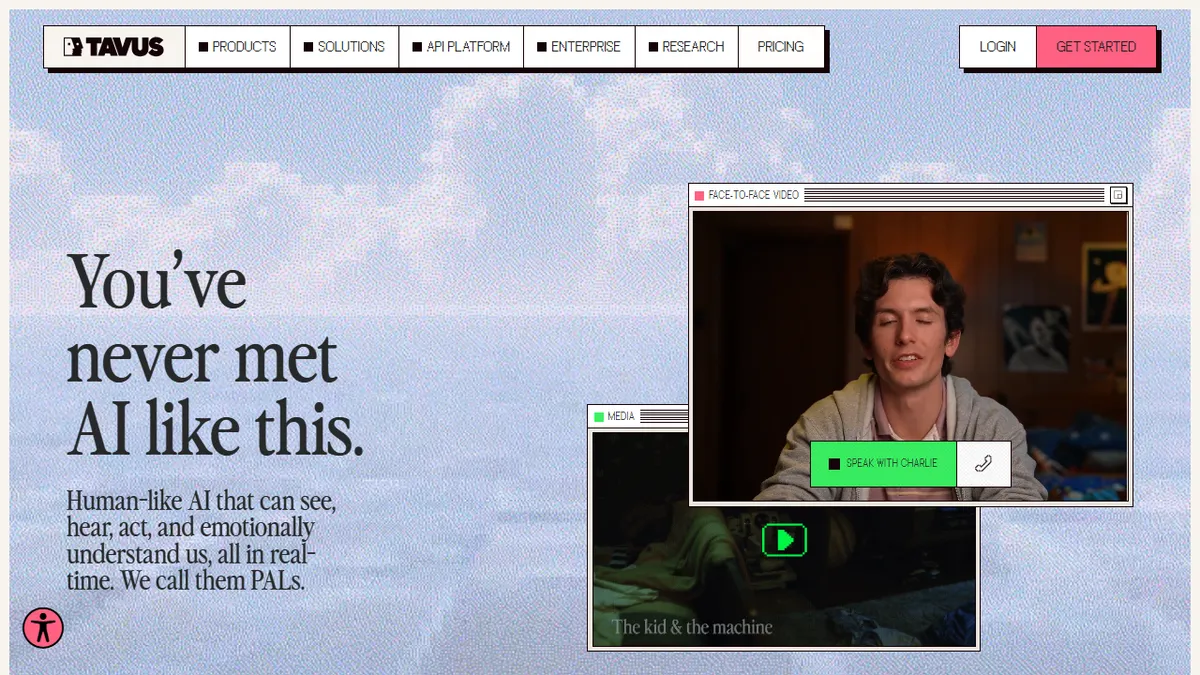
Tavus is a research lab and developer platform for building 'Conversational Video Interfaces' (CVI) — real-time AI agents that appear as a photorealistic human head on screen, can see the user through their webcam, hear them, take turns naturally, and respond with synchronized lip movement and facial expressions. It is built around three in-house models: Phoenix-4 for real-time face rendering, Raven-1 for multimodal perception (vision, audio, emotion), and Sparrow-1 for conversational turn-taking with human-like latency and interruption handling. Developers can spin up a hosted stock 'replica,' clone their own likeness from a couple of minutes of consented video, or ship a fully custom persona via the API. The runtime returns a WebRTC/Daily-based video room your app embeds, and the persona is driven by any LLM you plug in (bring-your-own OpenAI/Anthropic key, or use the built-in stack). PAL Maker is a no-code layer that lets non-engineers stand up an agent by describing it in plain language. Typical workflows: an AI sales rep that greets visitors on a landing page and books a demo; an onboarding coach inside a SaaS product; a healthcare intake avatar that collects symptoms before a real clinician joins; a language-tutor or L&D bot that reads a learner's face for confusion; a synthetic focus-group participant for UX research. Beyond live conversation, Tavus also offers a video-generation API for personalized 1-to-many outreach videos (each rendered with the recipient's name/company baked into the audio and lip-sync). Customers cited include Deloitte, Amazon, Salesforce and CVS Health, and the platform advertises 30+ languages and whitelabel API access on every paid tier.
Tavus is the most technically serious player in real-time conversational video — the in-house Phoenix/Raven/Sparrow stack shows in the sub-second turn-taking that avatar-video competitors still can't match. That said, I'd only reach for it when the face itself is load-bearing to the product (sales, therapy, tutoring, intake). For a generic support bot it's an expensive way to add a mouth to something users would rather just type at.
— The AI Tool Bible editorial team
Pros
- ✅ In-house model stack (Phoenix-4 rendering, Raven-1 perception, Sparrow-1 turn-taking) purpose-built for sub-second conversational latency, not just talking-head playback
- ✅ Genuine developer platform with a documented REST/WebRTC API, bring-your-own LLM, and a free tier that includes real API minutes rather than a demo sandbox
- ✅ Photoreal replicas can be cloned from a short consented recording; also ships 25+ stock avatars for teams that don't want to manage likeness rights
- ✅ Whitelabel is available on every paid plan — the rendered video room can live entirely inside your product with no Tavus branding
- ✅ PAL Maker gives non-technical stakeholders a no-code path, so product/marketing can prototype before engineering wires up the API
- ✅ 30+ languages supported for both speech-in and speech-out, useful for global support and sales use cases
- ✅ Personalized video-generation API (pre-rendered, not conversational) is available alongside the live CVI product for outbound/1-to-many workflows
Cons
- ⚠️ CVI minutes are expensive at scale — overage runs $0.32–$0.37/min, so a always-on support agent can burn thousands of dollars a month
- ⚠️ The uncanny-valley problem is real; Phoenix-4 is state-of-the-art but micro-expressions and gaze can still read as 'off' in longer sessions and turn users away
- ⚠️ Custom-replica cloning requires explicit consent recordings and a review step, which slows down teams that want to iterate on personas quickly
- ⚠️ You are locked into Tavus's rendering + transport stack (Daily-based WebRTC); you can swap the LLM brain, but not the face or the pipes
- ⚠️ Free and Starter tiers cap concurrent conversations tightly (3 on Starter), so any production traffic pushes you to Growth or Enterprise fast
- ⚠️ Live video avatars are a narrow modality — for many support/sales flows a text or voice-only agent is cheaper, faster and less creepy
Use cases
Explore related
Compare with similar tools
All in Video →Runway
FeaturedPro-grade AI video editor and Gen-4 generation.
Sora
FeaturedOpenAI's flagship text-to-video model.
Luma Dream Machine
Fast, accessible text-to-video with strong camera control.
HeyGen
Avatar video + lip-sync translation at scale.
Google Veo
Google DeepMind's flagship text-to-video model with native audio generation and cinematic camera control.
Higgsfield
AI video and image generation suite that aggregates 30+ frontier models under one workflow.