
SystemPrompt
✓ Text source-checked Nov 13, 2026SystemPrompt is a self-hosted control plane that sits between AI clients, model providers, and tools to manage access and audit.
Source-checked against the vendor's site · rebuilt from the vendor's own pagesProfile updated Link checked How we rate
In short
SystemPrompt is a self-hosted Rust control plane for managing AI model access, tool permissions, and audit logs. It connects clients to providers like Anthropic and OpenAI within your own infrastructure.
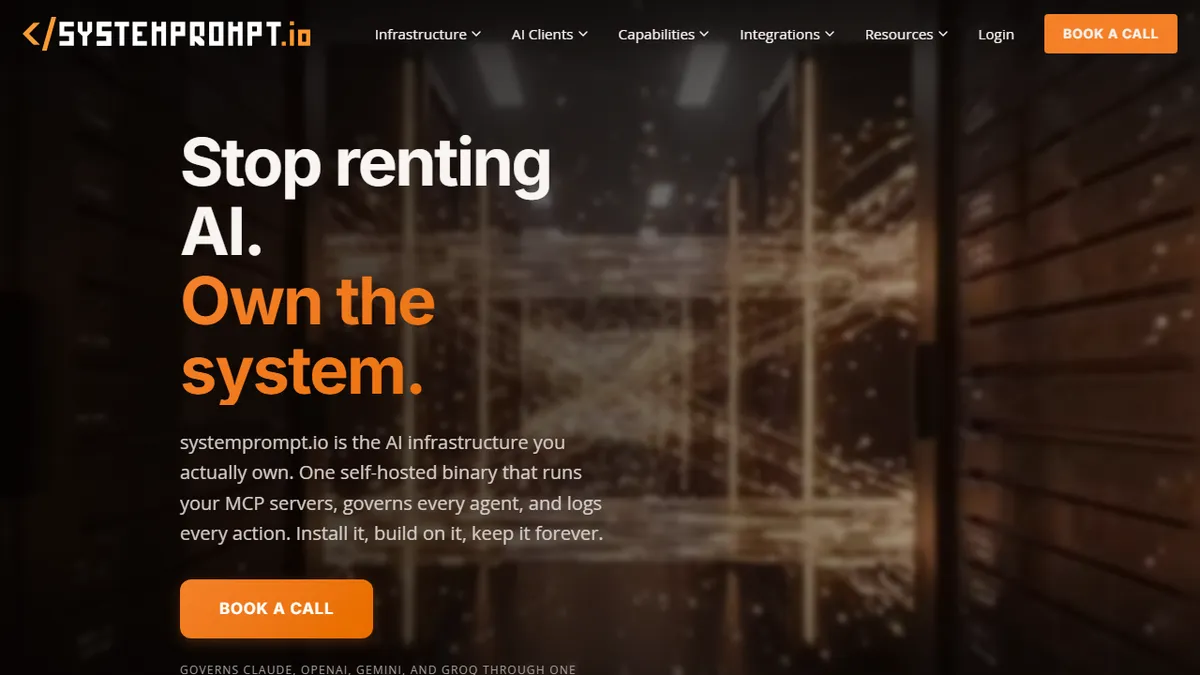
SystemPrompt acts as a shared control point between connected AI clients, model providers, and tools. The platform manages model access, tool permissions, credentials, and audit logs within the user's own environment. SystemPrompt connects teams to supported models from Anthropic, OpenAI, Google, and Groq.
SystemPrompt applies access rules to authenticated users and agents. SystemPrompt checks governed tool calls before they are executed. Policy decisions, execution records, and usage data are kept in the user's environment.
SystemPrompt is deployed as a Rust runtime with PostgreSQL on infrastructure controlled by the user. The product is a Rust library that users compile with their own extensions to add custom capabilities.
Evaluation and non-production use are free under the Core licence. The Core component is source-available under BSL 1.1 and requires a commercial licence for production use, converting to Apache 2.0 after four years.
According to SystemPrompt: SystemPrompt acts as a shared control point between connected AI clients, Model providers, and tools. Its pages list this strength: Policy decisions, execution records, and usage data remain in the user's environment. They also state this limitation: Production use requires a commercial licence.
— The AI Tool Bible editorial team
Pros
- ✅ Policy decisions, execution records, and usage data remain in the user's environment.
- ✅ Supports routing requests to models from Anthropic, OpenAI, Google, and Groq.
- ✅ Users can compile custom Rust extensions to add specific business capabilities.
- ✅ Evaluation and non-production use are available for free.
Cons
- ⚠️ Production use requires a commercial licence.
- ⚠️ Fully disconnected operation requires local inference and local dependencies.
Facts
- Platforms
- web
- Pricing
- free - Evaluation and non-production use are free (not source-checked)
- API available
- Yes (not source-checked)
- Free trial
- Yes (not source-checked)
- Open source
- Yes (license: NOASSERTION) (not source-checked)
- GitHub stars
- 29 (checked Nov 13, 2026) (not source-checked)
- Last GitHub push
- Oct 28, 2026 (not source-checked)
- First commit
- Dec 2025 (not source-checked)
- Company
- System Prompt, Inc. (not source-checked)
- Model used
- Multi-model (not source-checked)
- Docs pages indexed
- 83 pages we found in the docs (not source-checked)
- Hacker News
- 1 story · top 1 points · last Feb 6, 2025 · checked Nov 22, 2026
- Earliest Wayback capture
- 2024-09-19 (earliest archived capture of the site, not a launch date)
Where this tool sits
Use cases
Frequently asked
- How much does SystemPrompt cost?
- Evaluation and non-production use are free under the Core licence. Production use requires a commercial licence. The Core component is source-available under BSL 1.1 and converts to Apache 2.0 after four years.
- Which AI model providers does it support?
- SystemPrompt connects teams to supported models from Anthropic, OpenAI, Google, and Groq. It acts as a shared control point between these providers, AI clients, and tools within your environment.
- How is SystemPrompt deployed?
- It is deployed as a Rust runtime with PostgreSQL on infrastructure controlled by the user. The product is a Rust library that users compile with their own extensions to add custom capabilities.
- What data stays in my environment?
- Policy decisions, execution records, and usage data are kept in the user's environment. The platform manages model access, tool permissions, credentials, and audit logs locally.
- Does it manage tool execution?
- Yes, SystemPrompt checks governed tool calls before they are executed. It applies access rules to authenticated users and agents, ensuring tool permissions are enforced before any action occurs.