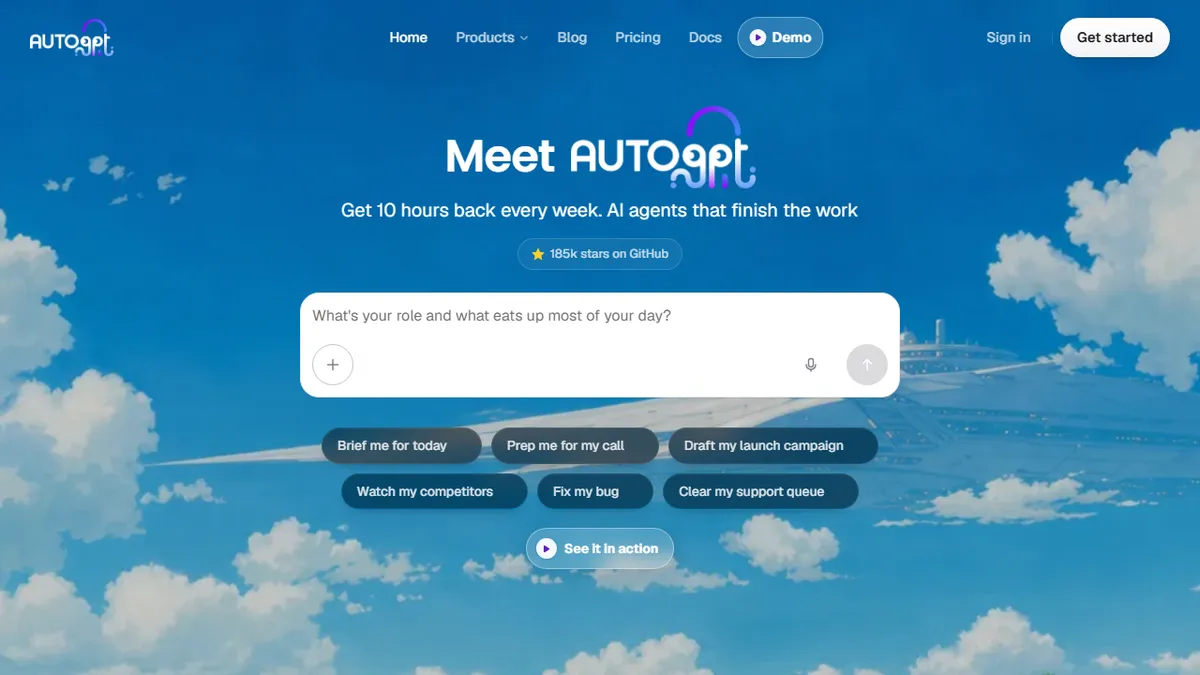

AutoGPT
✓ Editorially verifiedOpen-source platform for building autonomous AI agents.
In short
AutoGPT is an open-source platform for building, deploying, and monitoring goal-driven AI agents. It is best for hobbyist projects, learning agent patterns, or leveraging extensive community resources. It is not recommended for production-grade systems where stronger orchestration abstractions are needed.
Pick AutoGPT for hobbyist projects, learning the agent pattern, or building when you want maximum community resources.
Skip it for production agentic systems — LangGraph or CrewAI have stronger abstractions.
AutoGPT was the project that popularised the idea of autonomous agents in early 2023 — give a goal, the agent plans, executes, and iterates until the goal is met (or it gets stuck, which was most of the time in 2023). The project has since matured into an open-source platform for building, deploying, and monitoring goal-driven agents.
The current product is meaningfully more reliable than the original prototype. You can self-host or use AutoGPT's hosted platform. The community is large and the integration surface is broad.
For production-grade agentic systems, LangGraph and CrewAI have better abstractions for orchestrating, observing, and recovering from multi-step failures. AutoGPT remains useful as an accessible entry point and for projects where its specific affordances fit.
AutoGPT is the project that made everyone realise agents were a thing. The current product is competent, but the centre of gravity in the agent ecosystem has moved to the more disciplined frameworks like LangGraph.
— The AI Tool Bible editorial team
Pros
- ✅ Open source
- ✅ Huge community
- ✅ Self-host or use the platform
- ✅ Accessible entry point
Cons
- ⚠️ Agents still go off the rails on long tasks
- ⚠️ Setup is technical
Use cases
Frequently asked
- What is AutoGPT primarily used for?
- AutoGPT is used for building autonomous agents, task automation, and open-source projects. It is particularly well-suited for hobbyist projects and learning the agent pattern.
- Is AutoGPT suitable for production environments?
- No, the entry advises skipping AutoGPT for production agentic systems. It suggests that frameworks like LangGraph or CrewAI have stronger abstractions for orchestrating and recovering from multi-step failures.
- How can I deploy AutoGPT?
- You can either self-host the platform or use AutoGPT's hosted platform. The core project is free and open-source, while the hosted platform is paid.
- What are the main limitations of AutoGPT?
- Agents may still go off the rails on long tasks, and the setup process is technical. It lacks the disciplined abstractions found in other frameworks for complex production systems.
- Does AutoGPT require a specific AI model?
- No, AutoGPT uses a Bring Your Own (BYO) model approach, supporting Claude, GPT, and open models.
Explore related
Compare with similar tools
All in Agents →LangGraph
FeaturedStateful, graph-based agent orchestration from LangChain.
CrewAI
FeaturedPython framework for multi-agent orchestration.
Ernie Bot
Baidu's Mandarin-first ChatGPT rival, powered by the ERNIE model family
Moveworks
The enterprise AI assistant that searches, answers, and takes action across your business systems
AWS Bedrock
Build and scale generative AI applications with foundation models
Claude Agent SDK
Anthropic's official SDK for building autonomous Claude agents.