Superpowers
Opinionated agentic skills framework that turns coding agents into disciplined, spec-driven software engineers.
In short
Superpowers is a framework that turns coding agents into disciplined engineers by enforcing spec-driven planning, TDD, and strict code review before shipping.
Pick Superpowers if you run a coding agent for hours at a time and want it to behave like a senior engineer who plans, tests, and reviews before shipping.
Skip it if you mostly want a chat-style assistant for ad-hoc snippets - the spec-and-plan ceremony will feel like overhead.
Superpowers is a software development methodology delivered as a composable set of skills and bootstrap instructions for coding agents. Instead of letting an agent leap into code, it forces a spec-first conversation, then produces a chunked, readable plan, then dispatches subagent-driven-development with strict TDD, YAGNI and DRY discipline, and reviews the work as it goes. The result is an agent that can run autonomously for hours without drifting from the agreed plan.
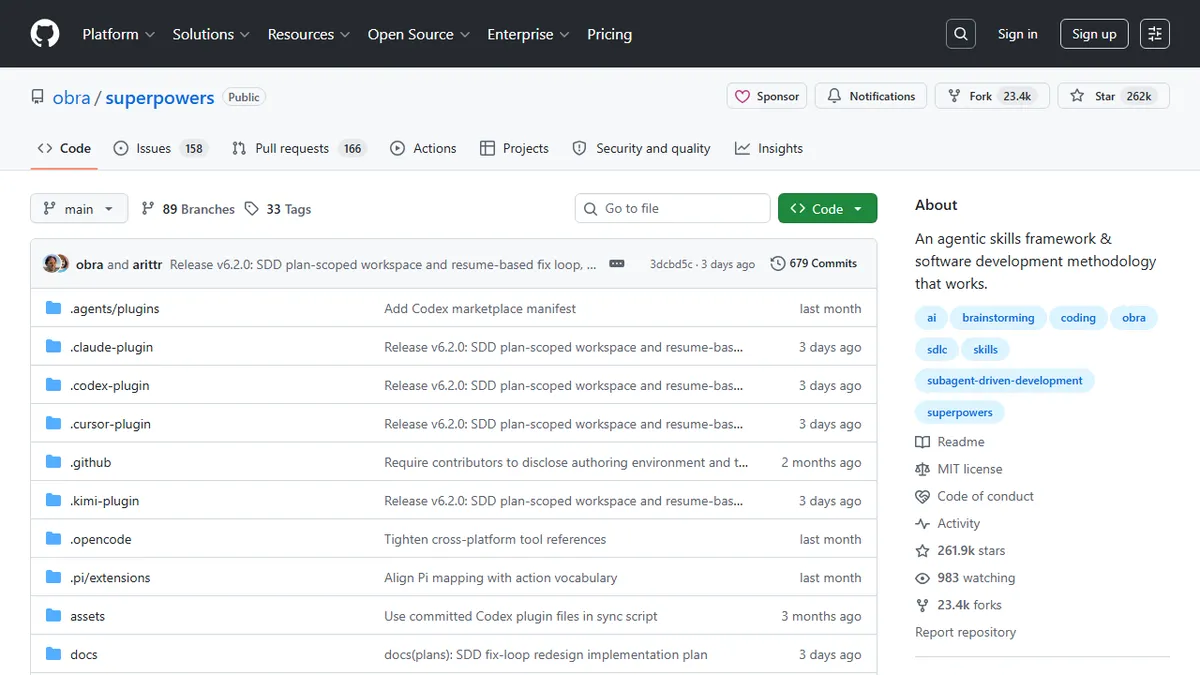
It is built by obra (Jesse Vincent of Primeradiant) and is harness-agnostic: Superpowers ships as an official plugin for Claude Code, Codex App and CLI, Cursor, Antigravity, Factory Droid, Gemini CLI, GitHub Copilot CLI, Kimi Code, OpenCode and Pi. The repository is MIT-licensed and free to install; Primeradiant offers paid commercial support, additional tooling and managed spend for enterprise users. It's aimed at engineers who already use coding agents heavily and want to impose process on them.
Under the hood it's a library of skills that auto-trigger based on context, plus bootstrap prompts that re-inject themselves after compaction, so you don't have to remember to invoke anything. Because skills are composable, teams can extend or replace pieces to fit their own SDLC, and the same install works across whichever harness you happen to be using that week.
This is the closest thing to a real SDLC for coding agents, and it's free. The subagent-driven-development loop genuinely keeps long-running runs on the rails, and the fact that it installs cleanly into nearly every major agent harness is rare. If you take agentic coding seriously, install it.
— The AI Tool Bible editorial team
Pros
- ✅ Works across Claude Code, Codex, Cursor, Gemini CLI, Copilot CLI and more from one repo
- ✅ Forces spec-first, TDD and subagent review instead of vibe-coding
- ✅ Skills auto-trigger after compaction so the discipline survives long sessions
- ✅ MIT-licensed and installable from official plugin marketplaces
- ✅ Backed by a commercial entity (Primeradiant) for enterprise support
Cons
- ⚠️ Opinionated methodology - fights you if you want quick throwaway scripts
- ⚠️ Quality depends on the underlying coding agent and model you point it at
- ⚠️ Documentation is harness-fragmented; setup differs per tool
Use cases
Frequently asked
- How much does Superpowers cost?
- Superpowers is freemium. The free tier is $0. Team plans cost $4 per user/month, and Enterprise plans cost $21 per user/month. The core repository is MIT-licensed and free to install, with paid support available.
- Which coding agents does Superpowers support?
- It is harness-agnostic and ships as an official plugin for Claude Code, Codex App and CLI, Cursor, Antigravity, Factory Droid, Gemini CLI, GitHub Copilot CLI, Kimi Code, OpenCode, and Pi.
- Is Superpowers suitable for quick, ad-hoc coding tasks?
- No. It is best for long-running autonomous sessions. If you mostly want a chat-style assistant for ad-hoc snippets, the spec-and-plan ceremony will feel like unnecessary overhead.
- How does Superpowers prevent agent drift?
- It forces a spec-first conversation, produces a chunked plan, and uses subagent-driven development with strict TDD, YAGNI, and DRY discipline. Bootstrap prompts re-inject after compaction to maintain context.
- Can teams customize the Superpowers workflow?
- Yes. The skills are composable, allowing teams to extend or replace pieces to fit their own SDLC. The same install works across different harnesses, and skills auto-trigger based on context.
Explore related
Compare with similar tools
All in Agents →LangGraph
FeaturedStateful, graph-based agent orchestration from LangChain.
CrewAI
FeaturedPython framework for multi-agent orchestration.
Ernie Bot
Baidu's Mandarin-first ChatGPT rival, powered by the ERNIE model family
Moveworks
The enterprise AI assistant that searches, answers, and takes action across your business systems
AWS Bedrock
Build and scale generative AI applications with foundation models
Claude Agent SDK
Anthropic's official SDK for building autonomous Claude agents.