Suna
✓ Editorially verifiedOpen-source AI command center for deploying a workforce of autonomous agents across your company
In short
Suna allows companies to build and deploy a workforce of AI agents by treating them as versioned files in a git repository. It is best for technical teams requiring auditable autonomous work with bring-your-own-model flexibility and extensive integrations.
Engineering, ops, and research teams that want an open-source, self-hostable agent platform with SSO, audit trails, and a git-style review model for autonomous work.
Non-technical solo users who want a polished, fully managed no-code assistant, or teams unwilling to manage model API keys, credits, and connector configuration themselves.
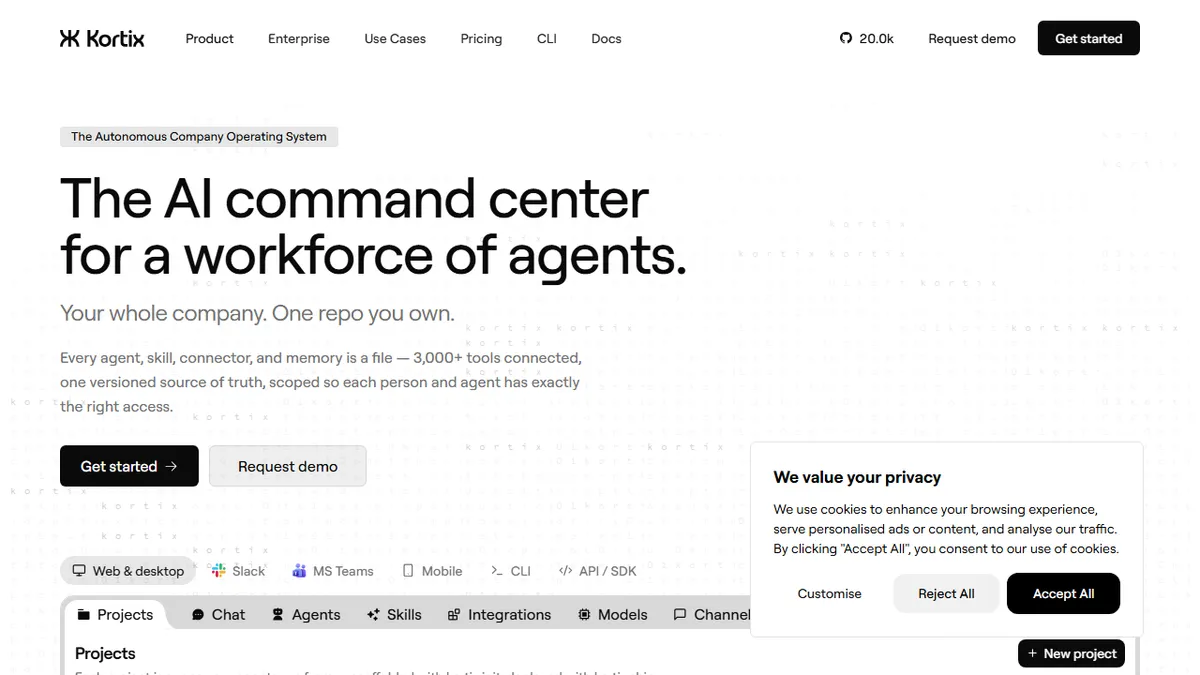
Suna, developed by Kortix (suna.so now redirects to kortix.com), is an open-source platform for building, deploying, and orchestrating a workforce of AI agents inside a company. It treats agents, skills, integrations, secrets, and institutional knowledge as versioned files inside a git repository, so agent behavior can be reviewed, diffed, and rolled back like normal code. Users scaffold projects via CLI, and each agent runs in an isolated cloud sandbox on its own branch — proposed changes land in main only through reviewed pull requests, which makes autonomous work auditable rather than opaque. The platform is built around a bring-your-own-model philosophy: it works with any LLM provider and can attach to existing ChatGPT, Claude, or Cursor subscriptions and API keys rather than forcing a vendor. It ships with a large connector library (3,000+ integrations via MCP, OpenAPI, GraphQL, and plain HTTP), an encrypted secrets manager that scopes credentials to individual runs, a memory system that accumulates company knowledge over time, and triggers for cron- and webhook-driven agent sessions. Humans interact with agents through Slack, Microsoft Teams, a web UI, or the CLI. Deployment options span managed Kortix Cloud, Docker on a laptop or VPS, VPC hosting, and fully air-gapped installs, so the same stack works for a solo builder and for a regulated enterprise. Typical workloads include research and market intel, data extraction and enrichment, browser automation, report generation, ticket triage, code and PR review agents, and scheduled maintenance jobs. With 20,000+ GitHub stars and 3,400+ forks, it is one of the more actively developed open-source general-agent frameworks aimed squarely at multi-user teams rather than hobbyist single-user setups.
Suna is the most credible open-source answer to closed enterprise agent platforms right now — the git-repo-as-agent-source-of-truth pattern plus reviewed sandbox PRs is genuinely the right abstraction for autonomous work. It rewards teams that treat agents like software; if you want a hosted chat pet, look elsewhere.
— The AI Tool Bible editorial team
Pros
- ✅ Fully open source and self-hostable, including air-gapped Docker deployments for regulated environments
- ✅ Bring-your-own-model design works with any LLM provider and can reuse existing ChatGPT/Claude/Cursor subscriptions
- ✅ 3,000+ integrations spanning MCP, OpenAPI, GraphQL, and HTTP, so most SaaS tools are reachable out of the box
- ✅ Git-native workflow (agents as files, isolated sandboxes, reviewed change requests) makes autonomous work auditable
- ✅ Multi-surface access via Slack, Teams, web, and CLI suits real cross-functional teams rather than solo devs
- ✅ Enterprise-grade controls at the top tier: SAML SSO, SCIM directory sync, audit logging, and SLA support
- ✅ Generous free tier plus a flat per-seat price on Team, with pooled credits that scale with headcount
Cons
- ⚠️ Sandbox compute is credit-metered on cloud tiers, so heavy browser-automation runs can burn through allocations quickly
- ⚠️ Self-hosting is powerful but non-trivial — Docker, secrets management, and connector setup require real DevOps effort
- ⚠️ You still supply and pay for model API keys separately; the subscription only covers orchestration and sandboxing
- ⚠️ General-purpose agent framework rather than a tuned vertical tool, so you build the workflows and evals yourself
- ⚠️ Documentation and community are growing fast but still lag behind more mature closed-source agent platforms
Use cases
Frequently asked
- How does Suna manage agent behavior and changes?
- Suna treats agents, skills, and integrations as versioned files inside a git repository. Proposed changes from isolated sandboxes land in the main branch only through reviewed pull requests, making autonomous work auditable.
- Which AI models can be used with Suna?
- Suna follows a bring-your-own-model philosophy, working with any LLM provider. It can attach to existing ChatGPT, Claude, or Cursor subscriptions and API keys rather than forcing a specific vendor.
- What deployment options are available for Suna?
- Deployment options span managed Kortix Cloud, Docker on a laptop or VPS, VPC hosting, and fully air-gapped installs. This flexibility allows the stack to work for both solo builders and regulated enterprises.
- How do users interact with agents in Suna?
- Humans interact with agents through Slack, Microsoft Teams, a web UI, or the CLI. The platform also supports triggers for cron- and webhook-driven agent sessions.
- What is the pricing structure for Suna?
- Suna offers a freemium model with a free tier at $0. The Team plan costs $40 per seat per month, while Enterprise pricing is custom.
Explore related
Compare with similar tools
All in Agents →LangGraph
FeaturedStateful, graph-based agent orchestration from LangChain.
CrewAI
FeaturedPython framework for multi-agent orchestration.
Ernie Bot
Baidu's Mandarin-first ChatGPT rival, powered by the ERNIE model family
Moveworks
The enterprise AI assistant that searches, answers, and takes action across your business systems
AWS Bedrock
Build and scale generative AI applications with foundation models
Claude Agent SDK
Anthropic's official SDK for building autonomous Claude agents.