Stele
Shared project memory for AI coding agents across Claude Code, Cursor, Codex, and Copilot
Developers and small teams who juggle multiple AI coding agents (Claude Code, Cursor, Codex, Copilot) and want a persistent, shared project memory that survives tool switches and session resets.
Solo developers who stay inside one agent and one IDE, or enterprises with strict data-residency rules who cannot wait for the self-hosted edition.
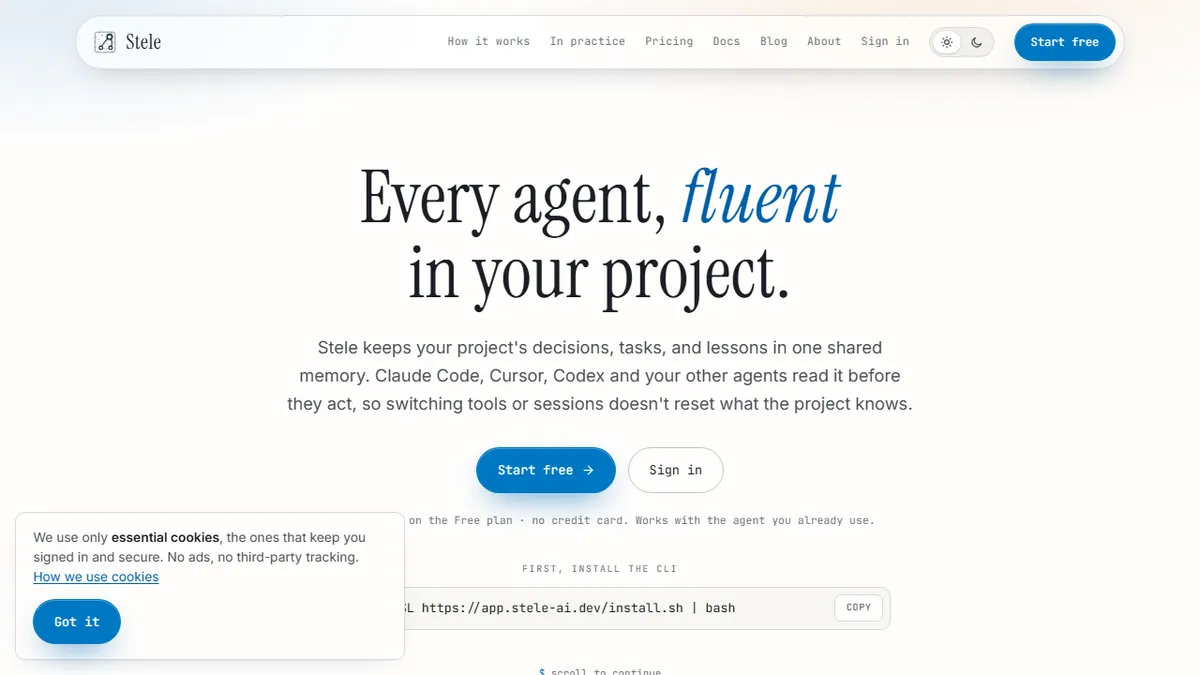
Stele is a hosted shared-memory layer that lets multiple AI coding agents work on the same project without losing context between sessions or tools. It maintains a per-project graph of decisions, tasks, attempted-and-failed solutions, open risks, and lessons learned, which agents read before acting and update as they work. In practice, this means Claude Code, Cursor, Codex, GitHub Copilot, and any MCP-compatible client can pick up where another agent left off, avoid re-litigating design choices, and stop repeating the same failed refactors. Setup is a single-line CLI install that wires Stele into your MCP config; the platform then onboards itself by ingesting the existing codebase and building an initial project graph. A shared task queue lets agents (or humans directing them) claim work, hand off partial progress, and prevent two sessions from stepping on each other. The graph is self-maintaining: entries get flagged as stale when the code moves on, resolved risks retire themselves, and contradictions surface as conflicts rather than silently overwriting. Typical workflows include running one agent for architecture spikes and another for implementation, alternating between a laptop-based Cursor session and a cloud-based Codex run on the same ticket, or letting a Copilot-driven refactor consult the notes an earlier Claude Code session wrote about why a particular abstraction was rejected. Projects are private by default with export and deletion controls, and a self-hosted SQLite-backed edition has been announced for teams that need full data residency.
Stele is targeting a real pain point: agentic coding tools each have their own scratchpad, and switching between them today means re-explaining every architectural decision. Making the memory MCP-native instead of building yet another IDE plugin is the right call. Worth trying on the free tier if you actually rotate between Cursor, Claude Code, and Codex; less urgent if you have already picked one.
— The AI Tool Bible editorial team
Pros
- ✅ MCP-native, so it works with Claude Code, Cursor, Codex, and Copilot without per-tool adapters
- ✅ One-line CLI install with automatic onboarding from an existing repo
- ✅ Shared task queue prevents two agents from duplicating the same work
- ✅ Graph-based memory captures failed attempts, not just successful ones, so agents stop repeating dead ends
- ✅ Free tier is genuinely usable for solo developers (unlimited public projects, one private)
- ✅ Self-hosted SQLite edition on the roadmap for teams that need local data
- ✅ Export and deletion controls on private project graphs
Cons
- ⚠️ Currently hosted-only; the promised self-hosted build is not yet shipped
- ⚠️ Value depends on running multiple agents or switching tools often, less compelling for single-agent users
- ⚠️ Shared memory across agents can propagate a bad decision if not curated
- ⚠️ Early-stage product with limited public track record and small community
- ⚠️ Private project quota on the free tier is tight for anyone with several client repos
Use cases
Explore related
Compare with similar tools
All in Agents →LangGraph
FeaturedStateful, graph-based agent orchestration from LangChain.
CrewAI
FeaturedPython framework for multi-agent orchestration.
Ernie Bot
Baidu's Mandarin-first ChatGPT rival, powered by the ERNIE model family
Moveworks
The enterprise AI assistant that searches, answers, and takes action across your business systems
AWS Bedrock
Build and scale generative AI applications with foundation models
Claude Agent SDK
Anthropic's official SDK for building autonomous Claude agents.