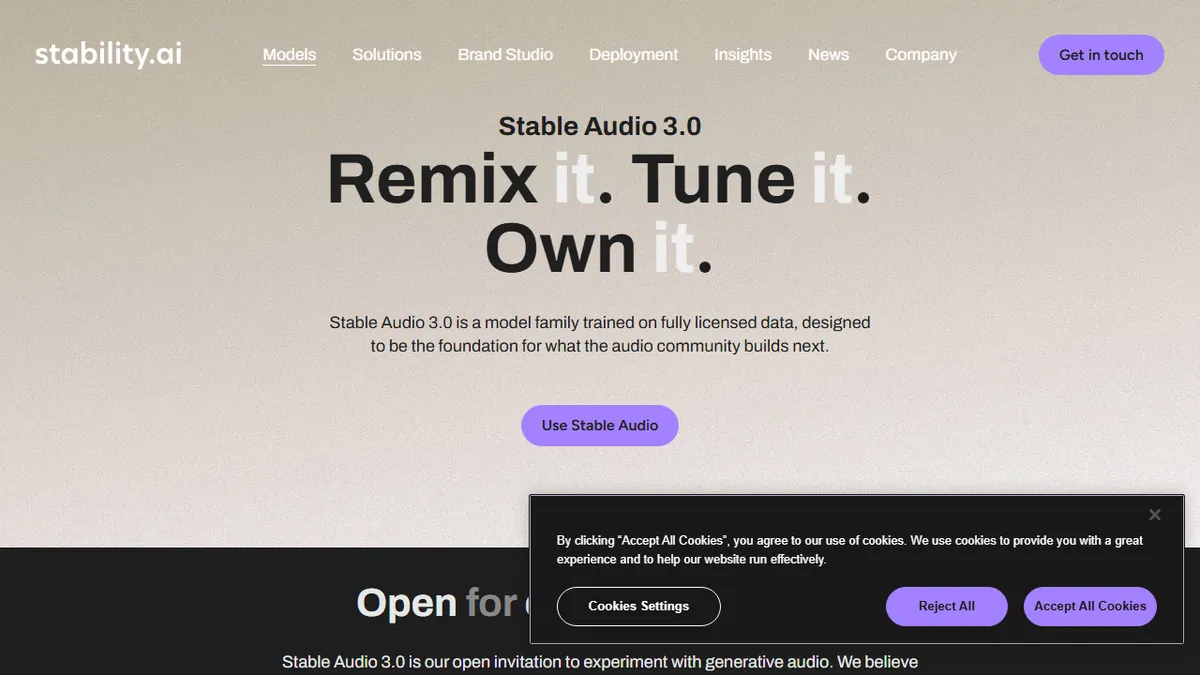

Stable Audio
Stability AI's generative audio model family for music and sound effects, with open weights for the smaller variants.
In short
Stable Audio generates full-length musical tracks and sound effects from text prompts, with strong adherence to genre and mood. It is best for indie creators and developers needing licensed, royalty-clean audio via a hosted API or self-hosted open-weight models.
Pick Stable Audio if you need licensed, prompt-controllable music and SFX with the option to self-host smaller models or hit a managed API.
Skip it if you need realistic lead vocals, lyric-driven songs, or a fully free unlimited service.
Stable Audio 3.0 is Stability AI's text-to-audio system, capable of producing full-length musical tracks up to six minutes long as well as discrete sound effects. The lineup ships as a family of models (Large, Medium, Small, and Small SFX), trained on fully licensed data and tuned for strong prompt adherence across genre, mood, and instrumentation. You can use it through the hosted Stable Audio web app, call it via the Stability AI Platform API, or self-host the open-weights Medium and Small checkpoints from Hugging Face.
It's aimed at three quite different audiences: indie creators and podcasters who want quick, royalty-clean beds and stingers; app developers who need a managed API for background score generation; and enterprise studios that want to license the Large model for in-house pipelines. Pricing isn't published on the product page — the hosted app has a free entry tier, the API is metered, and Large is sold via enterprise contract. The licensed training data is a real differentiator versus models with murkier provenance, which matters if you intend to actually ship the output commercially.
The trade-offs are typical of audio diffusion models in 2026: it's stronger on instrumental loops, ambience, and SFX than on coherent vocals or long-form song structure, and the Small variants noticeably lag the Large model on fidelity. But the combination of open weights for tinkering and a hosted API for production is rare in this category, and the lineage from Stable Audio 1/2 makes it one of the more mature options.
Stable Audio 3.0 is the most credible 'open-ish' music-generation stack going, mainly because the licensed training data and downloadable weights remove the legal asterisks attached to a lot of competitors. It's not a Suno-killer for songs with vocals, but for score, ambience, and SFX it's a serious tool with a real deployment story.
— The AI Tool Bible editorial team
Pros
- ✅ Generates full tracks up to six minutes with strong prompt adherence
- ✅ Open weights available for Medium and Small variants on Hugging Face
- ✅ Trained on fully licensed data, reducing commercial-use risk
- ✅ Hosted API plus self-host options cover most deployment shapes
Cons
- ⚠️ No transparent pricing for API or enterprise tier on the page
- ⚠️ Vocal generation and long-form song structure remain weak spots
- ⚠️ Smaller open-weight variants trail the Large model in fidelity
Use cases
Frequently asked
- What types of audio can Stable Audio generate?
- It produces full-length musical tracks up to six minutes long as well as discrete sound effects. The system is tuned for strong prompt adherence across genre, mood, and instrumentation.
- Is Stable Audio open source?
- Yes, the Medium and Small model variants are available as open weights on Hugging Face for self-hosting. The Large model is available via enterprise licensing.
- How is Stable Audio priced?
- The service operates on a freemium model with a free web app tier. The API is metered, and the Large model is sold via enterprise contract, though specific pricing is not published on the product page.
- What are the limitations of Stable Audio?
- The model is weaker on coherent vocals and long-form song structure compared to instrumental loops and ambience. Additionally, the smaller open-weight variants have lower fidelity than the Large model.
Explore related
Compare with similar tools
All in Audio →ElevenLabs
FeaturedThe gold standard for AI voice cloning and TTS.
Suno
FeaturedText-to-song AI — full vocal tracks from a prompt.
Udio
Suno's main rival for AI-generated full songs.
AssemblyAI
Speech-to-text API with diarisation, summarisation, and topic detection.
Chorus by ZoomInfo
Enterprise conversation intelligence bundled with ZoomInfo's B2B data graph
Whisper
OpenAI's open-source speech-to-text — the de-facto baseline.