Stability AI
Creators of Stable Diffusion, now an enterprise-focused multi-modal generative media platform spanning image, video, audio, and 3D.
In short
Stability AI provides a multi-modal platform for generating images, video, audio, and 3D assets. It is best suited for enterprises requiring open-weight models that can be self-hosted, fine-tuned, and embedded into custom pipelines.
Pick Stability AI if you need open-weight generative models you can self-host, fine-tune, and embed in enterprise pipelines across image, video, audio, and 3D.
Skip it if you want best-in-class image fidelity out of the box or a simple consumer subscription with no API or self-hosting concerns.
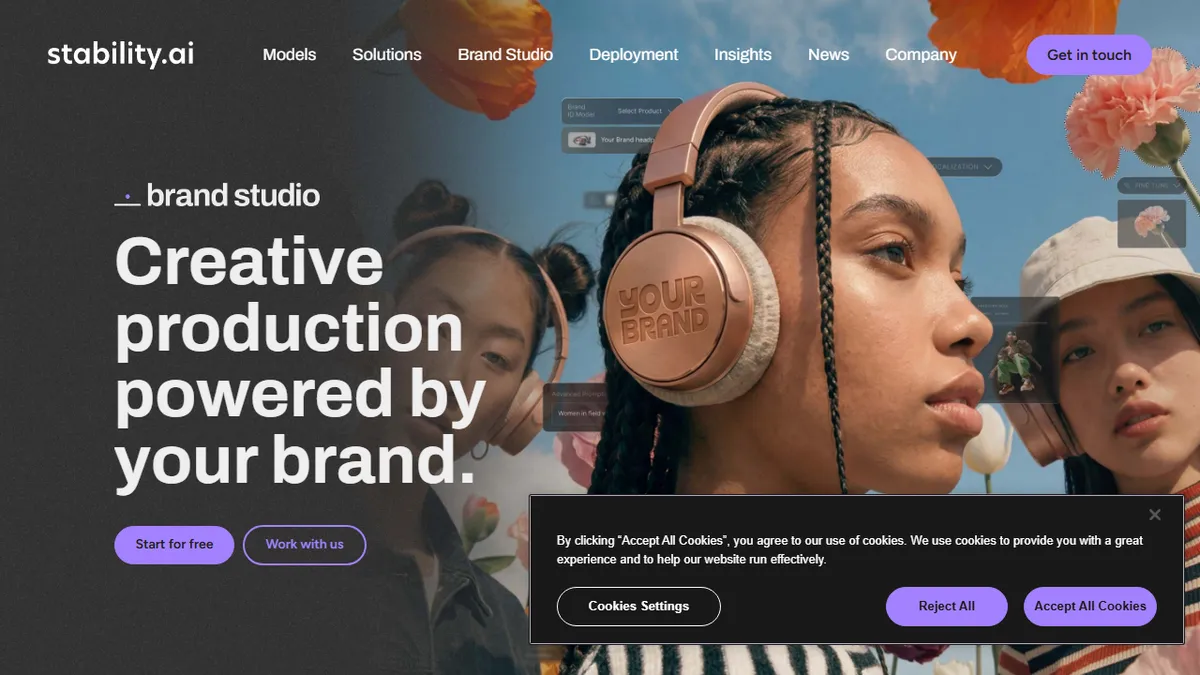
Stability AI is the company behind Stable Diffusion and a family of open-weight generative models that helped kick off the consumer image-AI era. The current platform bundles image generation and editing, video (including 3D/4D volumetric models), Stable Audio 3.0 for music and sound design, and 3D asset creation, all accessible via a Platform API, a managed Brand Studio app, and self-hosted enterprise licensing.
The pitch is now firmly enterprise: marketing teams producing on-brand campaign assets, gaming studios building worlds, and film/TV production pipelines needing storyboards, concept art, or color grading. Pricing isn't surfaced on the homepage and varies by product line, with the API metered per-credit and Brand Studio sold in tiers; serious deployments route through sales. Many model weights remain openly downloadable on Hugging Face under Stability's community license, but the hosted services are commercial.
Integrations include AWS and Azure for cloud deployment, and the broader Stable Diffusion ecosystem (ComfyUI, Automatic1111, Fooocus) still leans on Stability's checkpoints. Caveats: the company has been through well-documented financial and leadership turbulence, and frontier image quality has arguably been overtaken by Midjourney, Flux, and Ideogram, leaving Stability competing on breadth, openness, and enterprise terms rather than raw fidelity.
Stability remains strategically important as the open-weights counterweight to closed labs, and Stable Audio plus the 3D work are genuinely interesting. But for pure image quality the frontier has moved on, so we recommend it primarily to teams that value self-hosting, fine-tuning, and licensing control over raw output polish.
— The AI Tool Bible editorial team
Pros
- ✅ Multi-modal: image, video, audio, and 3D under one roof
- ✅ Open-weight models available for self-hosting and fine-tuning
- ✅ Enterprise deployment options including AWS, Azure, and on-prem
- ✅ Mature ecosystem around Stable Diffusion (ComfyUI, A1111, LoRAs)
Cons
- ⚠️ Image quality has fallen behind Midjourney, Flux, and Ideogram
- ⚠️ Pricing opaque; serious use routes through sales
- ⚠️ Company has had a turbulent financial and leadership history
- ⚠️ Community license has commercial-use restrictions above certain revenue
Use cases
Frequently asked
- What types of media can Stability AI generate?
- The platform supports image generation and editing, video creation including 3D/4D volumetric models, audio generation via Stable Audio 3.0, and 3D asset creation.
- Can I self-host Stability AI models?
- Yes, many model weights are openly downloadable under Stability's community license, allowing for self-hosting and fine-tuning. Enterprise licensing is also available for on-premises deployment.
- How is Stability AI priced?
- Pricing is freemium with a Core plan at $50 and custom Enterprise pricing. The API is metered per-credit, Brand Studio is sold in tiers, and serious deployments often route through sales.
- What integrations does Stability AI support?
- The platform supports cloud deployment via AWS and Azure. It also integrates with the broader Stable Diffusion ecosystem, including tools like ComfyUI, Automatic1111, and Fooocus.
Explore related
Compare with similar tools
All in Image Generation →Midjourney
FeaturedThe gold standard for aesthetic AI image generation.
Flux
FeaturedBlack Forest Labs' open-weights image model — rivals Midjourney quality.
Stable Diffusion
Open-source image generation — run anywhere, fine-tune anything.
Nano Banana (Gemini Image)
Google DeepMind's Gemini-powered image generation and conversational editing model family
DALL·E 3
OpenAI's image model — strong on prompt adherence and text-in-image.
Canva Magic Studio
Canva's all-in-one AI creative suite for design, image, video, copy, and presentations