
Skyvern
✓ Text source-checked Nov 19, 2026Skyvern automates browser-based workflows using LLMs and computer vision.
Source-checked against the vendor's site · rebuilt from the vendor's own pagesProfile updated Link checked Pricing captured How we rate
In short
Skyvern automates browser workflows using LLMs and computer vision. It handles CAPTCHAs, 2FA, and data extraction via Python/TypeScript SDKs or Docker.
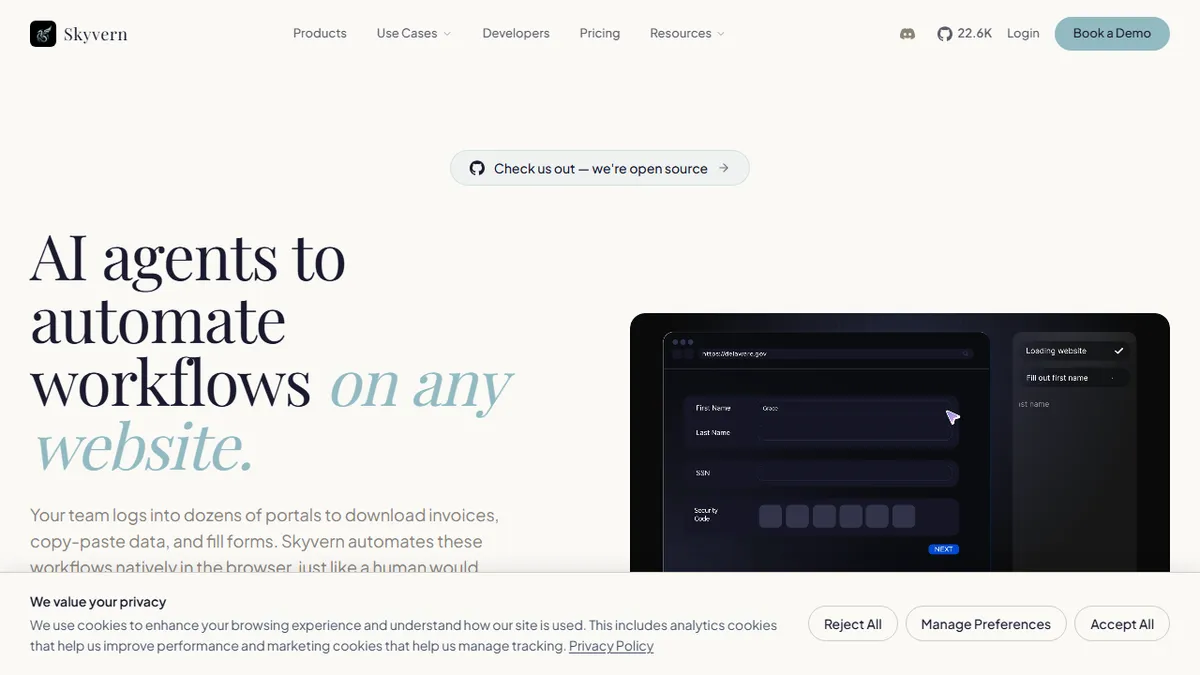
Skyvern automates browser-based workflows using LLMs and computer vision. Skyvern automates workflows natively in the browser, mimicking human interaction.
Skyvern solves CAPTCHAs natively to keep automations running without interruption. Skyvern handles the full two-factor authentication flow for accounts requiring 2FA and TOTP. Skyvern extracts data from workflows in any schema of the user's choice, including CSV or JSON formats.
Developers can trigger workflows via Python and TypeScript SDKs or run the system on-premise with Docker containers. Skyvern Cloud is a managed version that allows users to run the tool without managing infrastructure.
Skyvern offers Hobby, Pro, and Enterprise plans with varying credit limits and features such as team workspaces and self-hosted deployment. The self-hosted option provides full source code access and allows users to bring their own LLM.
According to Skyvern: Skyvern automates browser-based workflows using LLMs and computer vision. Its pages list this strength: Skyvern solves CAPTCHAs natively without needing third-party services.
— The AI Tool Bible editorial team
Pros
- ✅ Skyvern solves CAPTCHAs natively without needing third-party services.
- ✅ Skyvern handles full 2FA and TOTP authentication flows.
- ✅ Skyvern is self-hostable with full source code access and support for bringing your own LLM.
- ✅ Skyvern provides a Playwright-compatible SDK that adds AI capabilities to standard browser automation.
- ✅ Skyvern is Model Context Protocol (MCP) ready for integration with AI coding assistants.
Pricing (captured )
| Tier | Monthly | Key features |
|---|---|---|
| Hobby | $29/month |
|
| Pro | $149/month |
|
| Enterprise | Custom |
|
Prices change; we show the grid as captured on Nov 21, 2026. Check current pricing on the vendor's site →
Facts
- Platforms
- web
- API available
- Yes
- Free trial
- Yes
- Open source
- Yes (license: AGPL-3.0)
- GitHub stars
- 23,402 (checked Nov 13, 2026) (not source-checked)
- Last GitHub push
- Nov 13, 2026 (not source-checked)
- First commit
- Feb 2024 (not source-checked)
- Model used
- Multi-model (OpenAI, Anthropic, Gemini, Ollama) (not source-checked)
- Vendor pages
- Changelog
- Docs pages indexed
- 224 pages we found in the docs (not source-checked)
- Package downloads (30 d)
- 8,042 · pypi skyvern · checked Nov 21, 2026 (not source-checked)
- Hacker News
- 4 stories · top 150 points · last Oct 24, 2026 · checked Nov 21, 2026
- Earliest Wayback capture
- 2024-02-23 (earliest archived capture of the site, not a launch date)
Where this tool sits
Use cases
Recent updates from Skyvern
Frequently asked
- How much does Skyvern cost?
- Skyvern offers a free plan, a Hobby plan at $29/month, and a Pro plan at $149/month. Enterprise plans are also available with varying credit limits and features like team workspaces.
- Which AI models does Skyvern use?
- Skyvern uses a multi-model approach, supporting OpenAI, Anthropic, Gemini, and Ollama. Self-hosted users can also bring their own LLM for full control over the underlying AI infrastructure.
- Can Skyvern handle security checks like CAPTCHAs and 2FA?
- Yes, Skyvern solves CAPTCHAs natively to keep automations running without interruption. It also handles the full two-factor authentication flow for accounts requiring 2FA and TOTP.
- How can I integrate Skyvern into my development workflow?
- Developers can trigger workflows via Python and TypeScript SDKs. You can also run the system on-premise using Docker containers or use Skyvern Cloud for a managed experience without infrastructure management.
- What data formats can Skyvern extract?
- Skyvern extracts data from workflows in any schema of the user's choice. This includes common formats such as CSV or JSON, allowing for flexible data handling and integration.