
SISIF
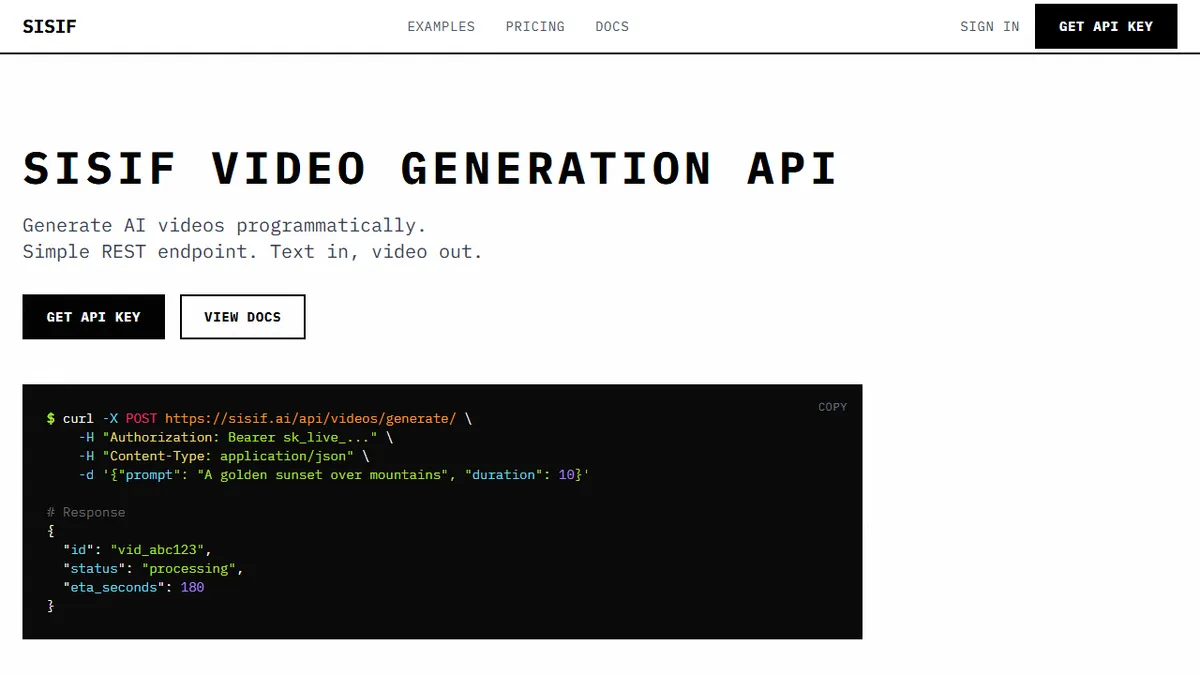
REST API for programmatic text-to-video generation, optimized for short vertical social clips.
In short
SISIF provides a developer-facing REST API that converts text prompts into short vertical videos in 2-5 minutes. It is best for solo creators and marketers who need to integrate generative video into backend or n8n workflows without a subscription.
Pick SISIF if you need to wire text-to-video into a backend or n8n workflow for short vertical social clips without a subscription commitment.
Skip it if you need horizontal/cinematic video, transparent model provenance, or high-volume guaranteed throughput.
SISIF is a developer-facing text-to-video API that turns text prompts into short vertical videos in roughly 2-5 minutes. It exposes a simple REST endpoint with bearer-token auth, a polling status route, and webhook callbacks, plus a built-in n8n integration for non-code workflow automation. Output is fixed to vertical aspect ratios at 540x960 or 720x1280, clearly aimed at TikTok, Reels, and Shorts pipelines rather than cinematic horizontal video.
Pricing is credit-based with no subscription: 4 credits/sec at the high tier and 6 credits/sec at the ultra tier, with 35 free credits on signup and no card required. That makes it a reasonable pick for solo creators, marketers, and small automation shops who want to wire generative video into their existing stack without negotiating with enterprise sales. Rate limits (10/min, 100/hour, 1000/day by default) are generous enough to script but signal this is a shared API, not a dedicated GPU lease.
The page does not disclose the underlying model, which is the main caveat: you can't independently judge quality, motion fidelity, or prompt adherence without burning credits. There is also no public showcase of motion-heavy benchmarks, and the lack of horizontal output rules out broader use cases. For teams who just need to drop programmatic short-form video into an n8n or backend workflow, the API surface is refreshingly minimal.
A pragmatic, API-first video generator that gets out of the way: credits, a REST call, webhooks, done. The hard-coded vertical formats and undisclosed model mean you should spend the free 35 credits before committing, but as a glue component for automated short-form pipelines it fills a niche the big labs ignore.
— The AI Tool Bible editorial team
Pros
- ✅ Clean REST API with bearer auth, polling, and webhooks
- ✅ Native n8n integration for no-code workflow chaining
- ✅ Pay-as-you-go credits with a free tier and no card required
- ✅ Commercial rights to generated videos included
Cons
- ⚠️ Underlying model is undisclosed, so quality is unknown until tested
- ⚠️ Vertical-only output (540x960 / 720x1280); no horizontal formats
- ⚠️ Default rate limits constrain bulk generation workloads
Use cases
Frequently asked
- What video formats does SISIF support?
- SISIF outputs fixed vertical aspect ratios at 540x960 or 720x1280. It is designed for short-form social platforms like TikTok, Reels, and Shorts, and does not support horizontal formats.
- How is SISIF priced?
- Pricing is credit-based with no subscription required. Users can start with 35 free credits without a card, or purchase packs ranging from $10 to $200. Credits are consumed based on video duration and quality tier.
- Can SISIF be integrated into existing workflows?
- Yes, SISIF exposes a simple REST endpoint with bearer-token auth, polling status routes, and webhook callbacks. It also includes a built-in n8n integration for non-code workflow automation.
- Is the underlying AI model disclosed?
- No, the underlying model is not disclosed. Users must test the service using credits to independently judge quality, motion fidelity, and prompt adherence.
- What are the default rate limits for the API?
- Default rate limits are 10 requests per minute, 100 per hour, and 1000 per day. These limits are suitable for scripting but may constrain bulk generation workloads.
Explore related
Compare with similar tools
All in Video →Runway
FeaturedPro-grade AI video editor and Gen-4 generation.
Sora
FeaturedOpenAI's flagship text-to-video model.
Luma Dream Machine
Fast, accessible text-to-video with strong camera control.
HeyGen
Avatar video + lip-sync translation at scale.
Google Veo
Google DeepMind's flagship text-to-video model with native audio generation and cinematic camera control.
Higgsfield
AI video and image generation suite that aggregates 30+ frontier models under one workflow.