Sharper
AI office assistant that turns your documents and connected apps into a cited, agentic knowledge base
Small to mid-size marketing, research and operations teams that want a single assistant able to search across their docs and SaaS tools, draft artifacts, and run scheduled reports with visible citations.
Engineering teams that need an API-first agent framework, or regulated enterprises that require published model, data-residency and SOC 2 documentation before granting access to Gmail, Drive and Slack.
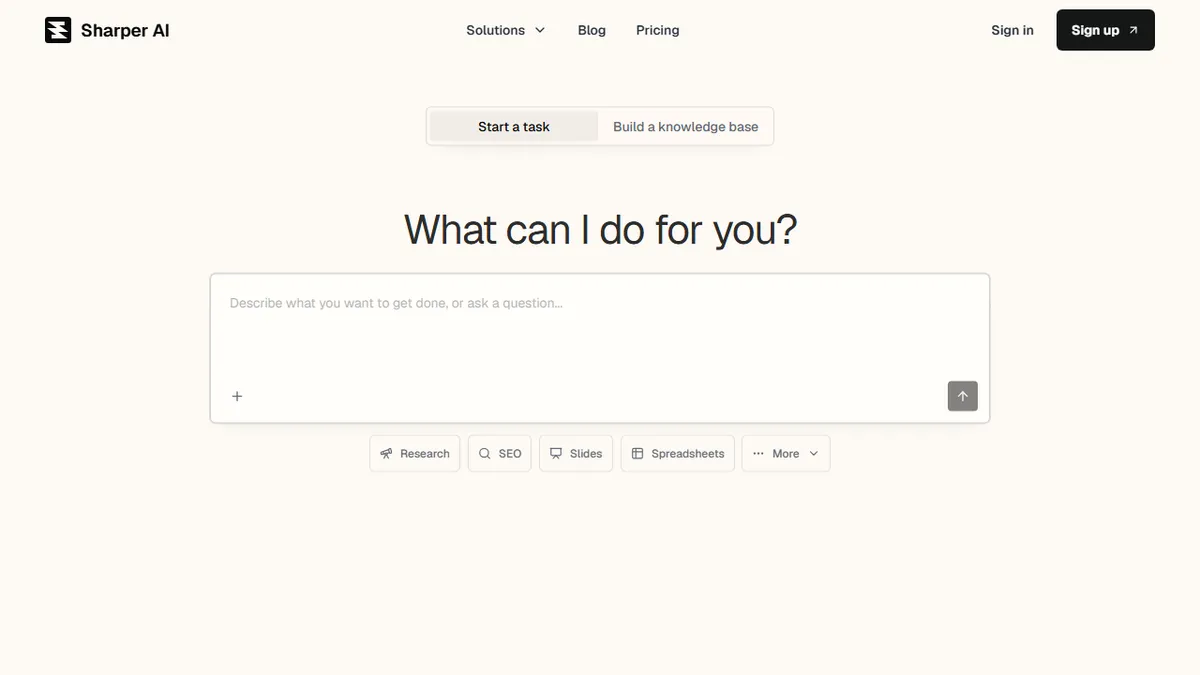
Sharper (sharper-ai.co) is an AI office assistant that turns a team's documents and connected SaaS apps into a searchable, agentic knowledge base for day-to-day knowledge work. It ingests content from Notion, Slack, Google Drive, Gmail, Outlook, Calendar and similar tools into what it calls a Context Field, then lets users ask questions, draft communications, run research, build decks, and manage recurring workflows on top of that unified store. The product exposes four operating modes: Research (synthesises answers with source citations), Review (checks and critiques drafts and documents), Build (produces artifacts such as briefs, slides and emails) and Run (schedules recurring jobs like a daily brief, weekly digest or standing report). Two design choices differentiate it from a generic chat wrapper. The Execution Chain surfaces every tool call, retrieval step and intermediate reasoning stage that produced an answer, so users can inspect and edit the workflow rather than treat the model as a black box. The Proof Ledger anchors each factual claim in the response back to a specific passage and source document, giving reviewers a citation trail suitable for regulated or evidence-sensitive work. Sharper positions itself at three audiences: marketing teams using it for research, campaign drafting and content refresh; research and analyst functions using it for literature scans, comparative studies and briefing packs; and operations teams using scheduled runs to automate recurring reporting and monitoring. Typical workflows include asking a natural-language question across a corpus of internal decks and PDFs, drafting a stakeholder email that pulls the latest figures from a connected sheet, generating a weekly competitor digest that lands in Slack every Monday, or building a first-draft slide deck from a research folder. The underlying model family is not publicly disclosed on the marketing site.
Sharper's Proof Ledger and Execution Chain are the interesting bits: making citations and tool steps first-class is exactly what serious knowledge work needs, and it puts the product a step above chat-only office assistants. That said, the site is coy about the model, the pricing and the security posture, and the connector list overlaps directly with Glean and Copilot, so it will need clearer differentiation to win larger buyers.
— The AI Tool Bible editorial team
Pros
- ✅ Connects to common workplace sources (Notion, Slack, Google Drive, Gmail, Outlook, Calendar) so answers draw on real internal context instead of just the open web
- ✅ Proof Ledger cites the exact passages behind each claim, making outputs auditable for research and compliance-sensitive teams
- ✅ Execution Chain exposes the intermediate tool calls and steps, so users can inspect and adjust the workflow rather than trust a black-box answer
- ✅ Four explicit modes (Research, Review, Build, Run) map cleanly to common knowledge-work jobs instead of forcing everything through a chat box
- ✅ Scheduled Operations turn one-off prompts into recurring briefs, digests and reports without extra automation tooling
- ✅ Free tier lets individuals and small teams pilot the office-assistant workflow before committing
Cons
- ⚠️ Underlying model family is not disclosed, so buyers cannot compare reasoning quality or data-handling assumptions against competitors
- ⚠️ Pricing tiers load dynamically and were not visible at review time, making budget planning and procurement conversations harder
- ⚠️ No public documentation of an API or developer surface, so it is difficult to embed Sharper into custom products or pipelines
- ⚠️ Broad connector access to email, chat and drive creates a wide data-exposure surface that will need security review at most companies
- ⚠️ Marketing positioning overlaps heavily with Glean, Notion AI, Microsoft Copilot and ChatGPT connectors, and the site does not spell out concrete differentiators on evaluation benchmarks
Use cases
Explore related
Compare with similar tools
All in Agents →LangGraph
FeaturedStateful, graph-based agent orchestration from LangChain.
CrewAI
FeaturedPython framework for multi-agent orchestration.
Ernie Bot
Baidu's Mandarin-first ChatGPT rival, powered by the ERNIE model family
Moveworks
The enterprise AI assistant that searches, answers, and takes action across your business systems
AWS Bedrock
Build and scale generative AI applications with foundation models
Claude Agent SDK
Anthropic's official SDK for building autonomous Claude agents.