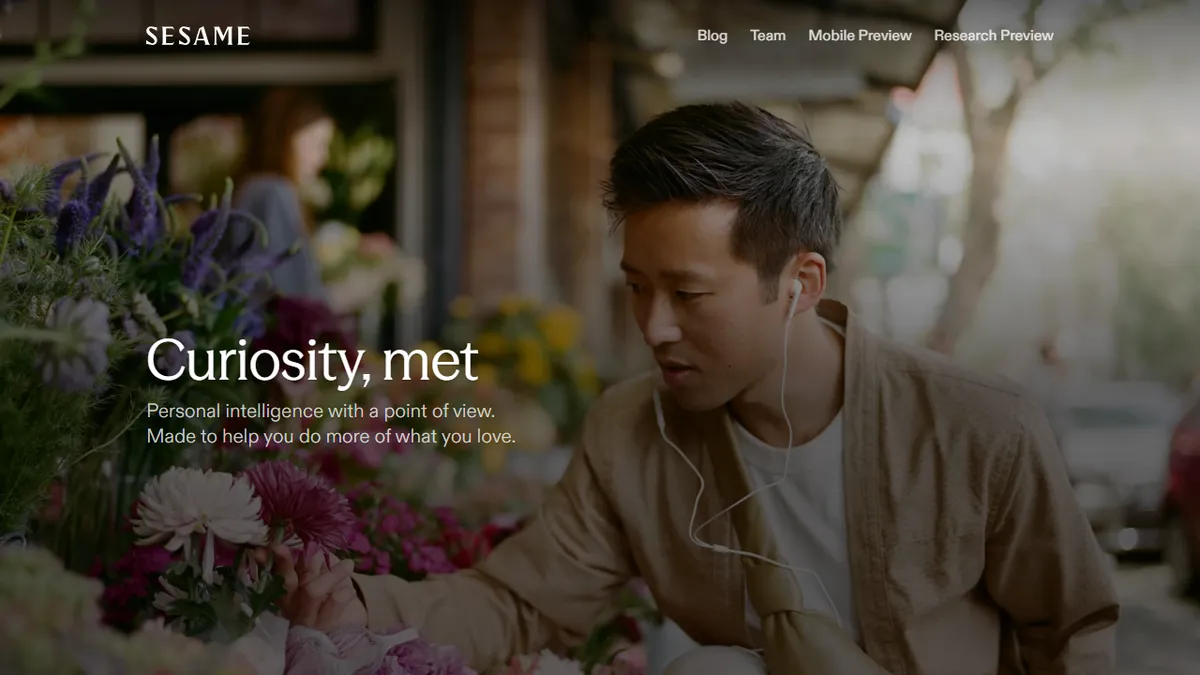

Sesame
Not yet source-checkedConversational voice AI aiming to cross the uncanny valley with context-aware, emotionally aware speech.
Machine-drafted from the vendor's site · not yet source-checkedProfile updated Link checked How we rate
In short
Sesame offers open-weight conversational speech models (CSM) for realistic, context-aware voice agents. It is a free research preview for self-hosting, not a hosted API.
Pick Sesame if you want state-of-the-art open-weight conversational speech and are willing to self-host CSM for voice agents or research.
Skip it if you need a turnkey hosted TTS API with SLAs, multilingual coverage, or enterprise support today.
Sesame is an AI voice research company building conversational agents that sound like real people rather than the flat, robotic assistants that most TTS systems still produce. Its centerpiece is the Conversational Speech Model (CSM), a multimodal transformer that jointly processes text and audio tokens through a semantic backbone and an acoustic decoder operating on RVQ codes. The team has released three sizes (1B, 3B, and 8B backbone parameters) and made key components available under Apache 2.0 on GitHub, alongside a research preview at app.sesame.com and a mobile signup for a broader consumer product.
The pitch is 'voice presence' - agents you can think out loud with, that pick up context and respond with human-like prosody. Sesame is aiming this at everyday users rather than call-center automation, and it has a longer-term hardware bet in the form of AI eyewear slated for 2027. Pricing isn't published; the research preview is free and the mobile app is invite-first.
For developers, the interesting part is the open weights and the paper on how CSM is trained (compute amortization on 1/16th of frames, homograph and pronunciation-consistency benchmarks). There is no public commercial API yet - if you want to build on Sesame today you're working from the open-source release, not a hosted endpoint.
Sesame's demos are the first voice AI in a while that made us do a double take - the prosody and back-channel timing feel genuinely alive. It's early, and there's no billable API yet, but the open-source CSM release makes it one of the more credible bets in the voice-agent space.
— The AI Tool Bible editorial team
Pros
- ✅ Open-source weights under Apache 2.0 for the CSM speech model
- ✅ Distinctly natural, context-aware prosody compared to typical TTS
- ✅ Backed by serious original research with published benchmarks
- ✅ Free research preview available at app.sesame.com
Cons
- ⚠️ No public commercial API - you self-host the open weights
- ⚠️ Pricing and productisation still vague; consumer app is invite-only
- ⚠️ Hardware (AI glasses) not shipping until 2027
- ⚠️ Small model catalogue focused on English voice quality
Facts
- Platforms
- web
- Open source
- Yes
- Model used
- Sesame CSM (1B / 3B / 8B)
- Hacker News
- 7 stories · top 402 points · last Oct 6, 2026 · checked Nov 20, 2026
Where this tool sits
Use cases
Frequently asked
- How much does Sesame cost?
- The research preview is free. Consumer product pricing has not been announced yet. There is no public commercial API pricing because no hosted endpoint is currently available for developers.
- Is there a hosted API for Sesame?
- No, there is no public commercial API yet. Developers must work from the open-source release and self-host the CSM models. It is not a turnkey hosted TTS service with SLAs.
- What models are available in Sesame?
- Sesame offers the Conversational Speech Model (CSM) in three sizes: 1B, 3B, and 8B backbone parameters. Key components are available under Apache 2.0 on GitHub for self-hosting and research.
- Who is Sesame best for?
- It is best for developers wanting state-of-the-art open-weight conversational speech who are willing to self-host. It is not suitable for those needing turnkey hosted APIs, multilingual coverage, or enterprise support today.
- Does Sesame support multilingual speech?
- The documentation does not specify multilingual coverage. In fact, it advises skipping Sesame if you need multilingual coverage today, implying it may not currently support broad language options.