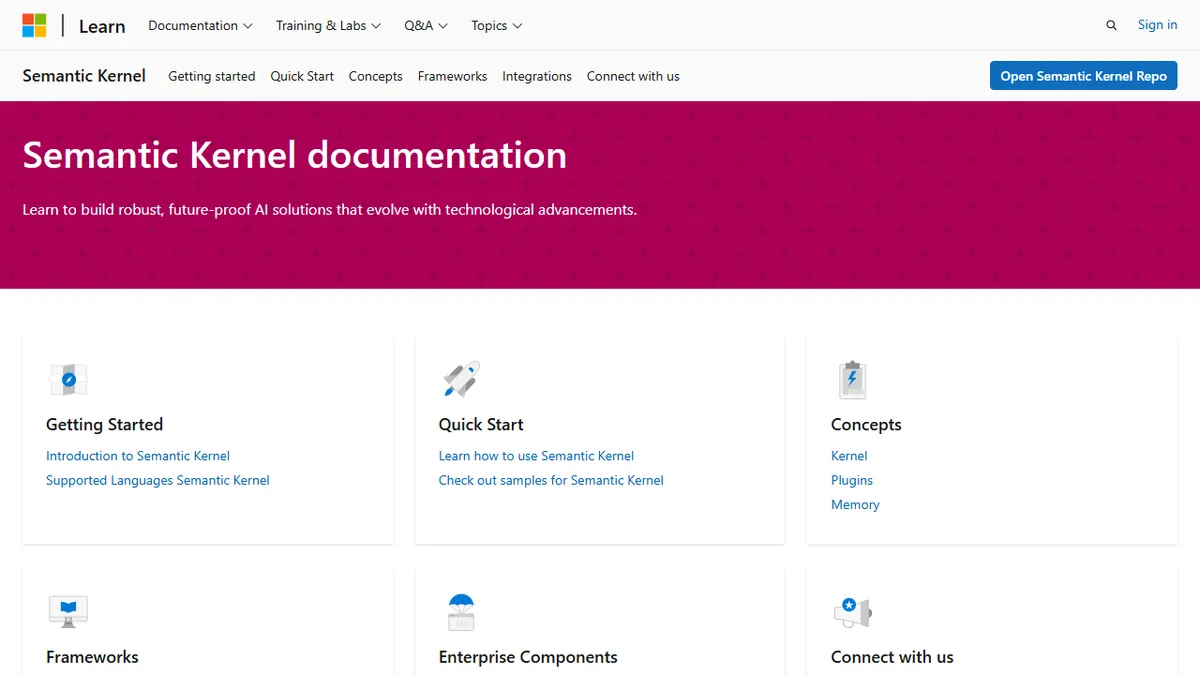

Semantic Kernel
✓ Editorially verifiedMicrosoft's open-source SDK for wiring LLMs, plugins, and agents into enterprise .NET, Python, and Java apps.
In short
Semantic Kernel is an orchestration SDK for embedding LLMs and agents into production applications. It is best for enterprise teams using .NET, Java, or Azure who need Microsoft-supported observability and security hooks.
Pick Semantic Kernel if you're shipping LLM agents inside a .NET, Java, or Azure-heavy enterprise stack and want Microsoft-supported plumbing.
Skip it if you want a minimal Python-only prompting library or you're not on Azure and don't need multi-language SDKs.
Semantic Kernel is Microsoft's open-source orchestration SDK for building AI agents and LLM-powered features inside production applications. It gives you a Kernel object that binds prompts, plugins (native code or OpenAPI tools), memory/vector stores, and model connectors together, plus higher-level Agent and Process frameworks for multi-step, multi-agent workflows. SDKs ship for C#, Python, and Java, which makes it one of the few serious agent frameworks that treats the .NET/JVM enterprise stack as a first-class citizen rather than a Python afterthought.
It's aimed at engineers who need to embed LLMs into existing enterprise systems and want Microsoft-grade observability, filters, and security hooks rather than a bare LangChain-style toolkit. Semantic Kernel itself is free and MIT-licensed; the cost is whatever model API you point it at (Azure OpenAI, OpenAI, Hugging Face, local models, etc.). Compared to LangChain it's leaner and more opinionated about dependency injection and typed contracts, and compared to AutoGen it's more focused on shipping into real apps than on research-y agent choreography.
Strong Azure integration is both the selling point and the trap: connectors for Azure AI Search, Azure OpenAI, and Cosmos DB are excellent, but non-Microsoft ecosystems can feel like second-class citizens. The Agent Framework and Process Framework are still evolving, and API churn between versions has bitten early adopters. For teams already committed to .NET or Azure it's close to a default choice.
The most credible enterprise agent SDK outside LangChain, and the only serious option for .NET and Java shops. It's not the flashiest framework, but it's the one you actually reach for when the code has to live in production behind a load balancer. Expect version churn while the Agent Framework stabilizes.
— The AI Tool Bible editorial team
Pros
- ✅ First-class C#, Python, and Java SDKs, rare among agent frameworks
- ✅ Open source (MIT) and backed by Microsoft with active roadmap
- ✅ Deep Azure OpenAI, Azure AI Search, and Cosmos DB integrations
- ✅ Built-in filters, telemetry, and DI patterns suited to enterprise apps
- ✅ Plugin model works with native functions and OpenAPI-described tools
Cons
- ⚠️ APIs have churned across versions; upgrades can be painful
- ⚠️ Agent and Process frameworks still maturing vs. established rivals
- ⚠️ Best-in-class only if you're already in the Microsoft ecosystem
- ⚠️ Steeper learning curve than lightweight prompt libraries
Use cases
Frequently asked
- What programming languages does Semantic Kernel support?
- The SDK ships for C#, Python, and Java, making it a first-class option for .NET and JVM enterprise stacks.
- Is Semantic Kernel free to use?
- Yes, it is a free, MIT-licensed open-source SDK, though you pay for the underlying model APIs you connect to it.
- How does Semantic Kernel compare to LangChain?
- It is leaner and more opinionated about dependency injection and typed contracts, focusing on shipping into real apps rather than research-y agent choreography.
- What are the main drawbacks of using Semantic Kernel?
- APIs have churned across versions, the Agent and Process frameworks are still maturing, and it is best-in-class only if you are already in the Microsoft ecosystem.
Explore related
Compare with similar tools
All in Agents →LangGraph
FeaturedStateful, graph-based agent orchestration from LangChain.
CrewAI
FeaturedPython framework for multi-agent orchestration.
Ernie Bot
Baidu's Mandarin-first ChatGPT rival, powered by the ERNIE model family
Moveworks
The enterprise AI assistant that searches, answers, and takes action across your business systems
AWS Bedrock
Build and scale generative AI applications with foundation models
Claude Agent SDK
Anthropic's official SDK for building autonomous Claude agents.