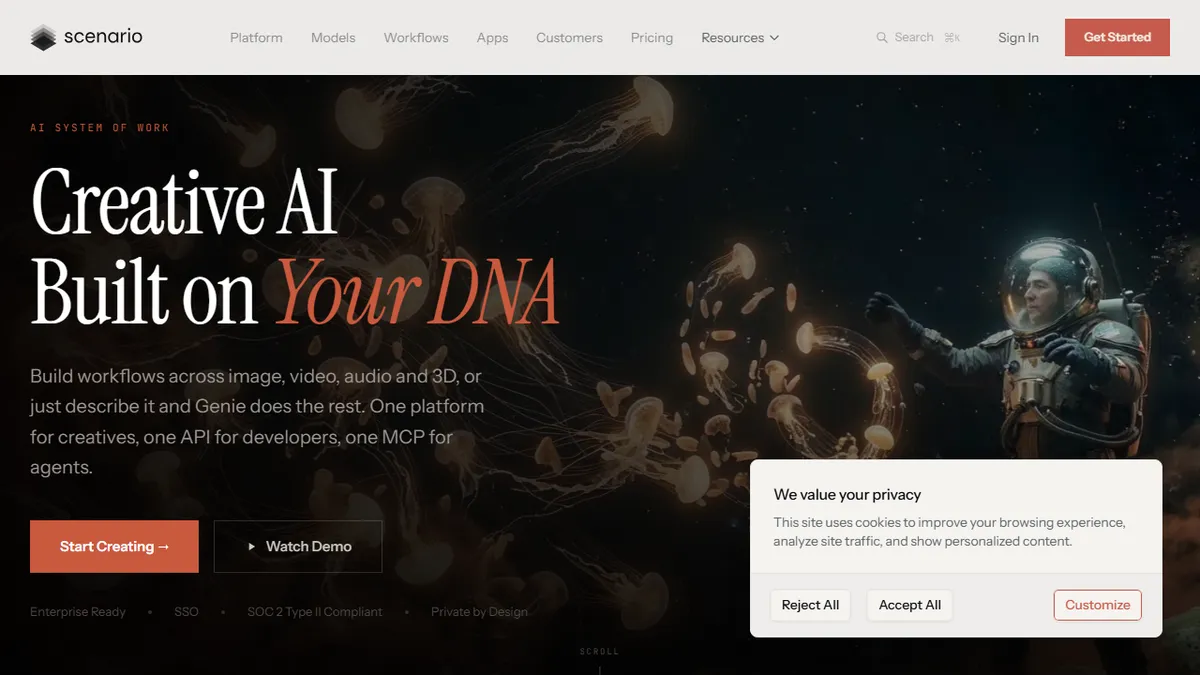

Scenario
Custom-trained generative AI platform for studios that need on-brand image, video, 3D, and audio assets at scale.
In short
Scenario provides custom LoRA training and a unified library of 550+ models for game, ad, and e-commerce studios. It is best for teams needing brand-consistent assets integrated into existing production pipelines via API or Unity plugin.
Pick Scenario if you're a game, ad, or e-commerce studio that needs brand-consistent generative assets wired into a real production pipeline.
Skip it if you just want to play with text-to-image prompts or you need open weights you can self-host.
Scenario is a creative AI infrastructure platform built for teams that can't ship raw Stable Diffusion or Midjourney output. The core pitch is custom model training: upload 5-100 reference images, train a LoRA, and produce assets that actually match your IP, character, or brand style. Around that sits a unified library of 550+ third-party models (FLUX, Seedance, Kling, LTX, Hunyuan, Tripo, ElevenLabs, OpenAI, Gemini and others), a node-based workflow editor, and an App Gallery of pre-built pipelines for characters, video, and 3D.
It's aimed squarely at game studios, ad agencies, e-commerce, and fashion teams - Unity, Ubisoft, and Lacoste are name-checked among 15,000+ customers - rather than hobbyists. Pricing is credit-based: free tier with 50 daily credits, Starter $10/mo, Pro $30/mo, Max $50/mo (annual), plus custom enterprise with SOC 2 Type II, SSO/SAML. The free tier is enough to evaluate; serious production use will push you into Pro or Enterprise quickly.
Where Scenario differentiates is the API-first posture: documented REST API, webhooks, SDKs, MCP support, a Node Agent for orchestration, and a Unity plugin for in-engine asset generation. If you're trying to wire generative assets into an existing production pipeline rather than babysit a chat UI, that's the relevant feature set.
Scenario is one of the few generative platforms built with actual production teams in mind rather than prompt tourists. The custom-LoRA plus multi-model plus API combo is genuinely useful for studios shipping at volume - though the credit math gets serious once you move past stills into video and 3D.
— The AI Tool Bible editorial team
Pros
- ✅ Custom LoRA training on small reference sets keeps output on-brand
- ✅ Aggregates 550+ models across image, video, 3D, and audio in one workspace
- ✅ Strong API, webhooks, MCP, and Unity plugin for pipeline integration
- ✅ Enterprise-grade security (SOC 2 Type II, SSO/SAML) for studio use
- ✅ Free tier with 50 daily credits and no credit card to evaluate
Cons
- ⚠️ Credit-based pricing gets expensive fast for heavy video or 3D workloads
- ⚠️ Closed-source and you don't own the trained model weights
- ⚠️ Workflow editor has a learning curve compared to a simple prompt box
Use cases
Frequently asked
- How does Scenario ensure generated assets match a specific brand style?
- Users can upload 5-100 reference images to train a custom LoRA model. This allows the platform to produce assets that match specific IP, character, or brand styles rather than using generic outputs.
- What types of generative models are available in the Scenario platform?
- The platform aggregates over 550 third-party models across image, video, 3D, and audio. Supported models include FLUX, Seedance, Kling, LTX, Hunyuan, Tripo, ElevenLabs, OpenAI, and Gemini.
- Can Scenario be integrated into existing development pipelines?
- Yes, Scenario offers a documented REST API, webhooks, SDKs, MCP support, a Node Agent for orchestration, and a Unity plugin for in-engine asset generation.
- What are the pricing options for Scenario?
- Pricing is credit-based with a free tier offering 50 daily credits. Paid plans include Starter at $15/mo, Pro at $45/mo, Max at $75/mo, and custom Enterprise pricing.
- Is Scenario suitable for hobbyists or individual creators?
- Scenario is aimed at game studios, ad agencies, and e-commerce teams rather than hobbyists. It is not recommended for users who only want to experiment with text-to-image prompts or require open weights for self-hosting.
Explore related
Compare with similar tools
All in Image Generation →Midjourney
FeaturedThe gold standard for aesthetic AI image generation.
Flux
FeaturedBlack Forest Labs' open-weights image model — rivals Midjourney quality.
Stable Diffusion
Open-source image generation — run anywhere, fine-tune anything.
Nano Banana (Gemini Image)
Google DeepMind's Gemini-powered image generation and conversational editing model family
DALL·E 3
OpenAI's image model — strong on prompt adherence and text-in-image.
Canva Magic Studio
Canva's all-in-one AI creative suite for design, image, video, copy, and presentations