Scalattice
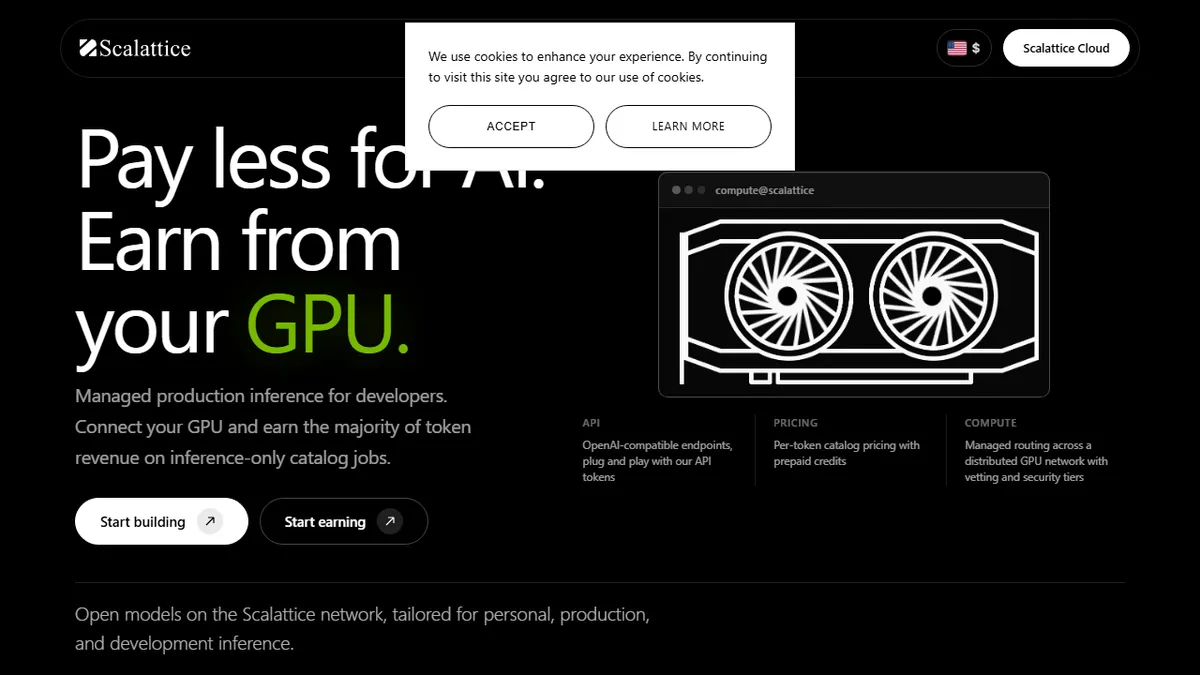
Pay less for AI, earn from your GPU.
In short
Scalattice connects developers with low-cost, per-token inference on open-weight models like Qwen and Llama 3.3 through an OpenAI-compatible API. It is best for cost-sensitive teams building agents or RAG apps who need regional data residency controls and hard spend ceilings via prepaid credits.
Cost-sensitive developers and indie AI teams building agents, RAG apps or coding copilots on open-weight models who want an OpenAI-compatible API without paying frontier-lab prices, plus GPU owners looking to monetise idle capacity.
Teams that need frontier closed models (GPT-4o, Claude, Gemini), enterprises with strict single-tenant inference SLAs, or anyone whose workflow depends on fine-tuning rather than plain inference.
Scalattice is a distributed GPU inference marketplace that exposes a curated catalog of open-weight LLMs (Qwen, Llama 3.3, DeepSeek R1, Gemma and a handful of others) behind an OpenAI-compatible API. It sits in the same competitive space as OpenRouter, Together AI and Fireworks, but its distinguishing bet is a two-sided network: on one side, developers get cheap per-token inference; on the other, GPU owners (individual rigs, small clusters, homelab operators) run an open-source agent to sell idle capacity and get paid per token served. The platform handles routing, health checks, security tiering and regional policy enforcement so that requests can be constrained to specific residency zones, which matters for teams that cannot ship prompts to arbitrary anonymous hardware. Because the API surface mimics OpenAI, integration is usually a base_url swap in an existing SDK — LangChain, LlamaIndex, LiteLLM, Vercel AI SDK and anything that speaks the OpenAI schema work with no code changes. Typical workflows include powering agent loops on cheaper open models, running background summarisation and classification at scale, prototyping RAG stacks without committing to a frontier-lab bill, and giving coding copilots a cheap Qwen-Coder backend. For hardware providers, the agent is designed to be idle-friendly: it accepts work when the GPU is free and steps aside for local jobs. Prepaid credits and live usage dashboards give developers a hard spend ceiling, and payout tracking gives providers a transparent view of earnings. The trade-off is model breadth (a small curated list rather than everything on Hugging Face) and the operational reality that distributed marketplaces tend to have more variable latency than a single-provider inference API.
Scalattice is the interesting kind of infra play — cheap inference for devs on one side, a way for GPU owners to earn on the other, tied together by an OpenAI-shaped API. Worth a slot in your model router next to OpenRouter or Together, especially for background jobs on Qwen and Llama where latency variance is acceptable. Do not stake production-critical low-latency paths on it until you have benchmarked your specific route.
— The AI Tool Bible editorial team
Pros
- ✅ OpenAI-compatible endpoints make migration a base_url change for most SDKs
- ✅ Genuinely cheap per-token rates on popular open models like Llama 3.3 70B and Qwen-2.5-Coder
- ✅ Regional and security-tier routing lets teams keep prompts inside chosen jurisdictions
- ✅ Two-sided model means idle GPU owners can offset hardware costs at zero platform fee
- ✅ Prepaid credits give a hard ceiling on spend without needing budget alerts
- ✅ Curated model list avoids the maintenance burden of self-hosting Llama or DeepSeek
Cons
- ⚠️ Small curated catalog compared to OpenRouter or Hugging Face Inference Endpoints
- ⚠️ Distributed provider pool can mean more variable latency than single-tenant APIs
- ⚠️ No frontier closed models (GPT-4o, Claude, Gemini) — open weights only
- ⚠️ Younger platform without the multi-year uptime history of established inference providers
- ⚠️ Provider-side earnings depend on request flow the network can actually route to your hardware
Use cases
Frequently asked
- What models does Scalattice support?
- The platform offers a curated catalog of open-weight LLMs, including Qwen-2.5-Coder-7B, Llama-3.3-70B, DeepSeek R1, and Gemma. It does not provide access to frontier closed models like GPT-4o or Claude.
- How does Scalattice handle data residency?
- The platform enforces regional policy constraints, allowing requests to be routed to specific residency zones. This feature helps teams keep prompts within chosen jurisdictions rather than sending them to arbitrary anonymous hardware.
- Is integration with existing SDKs difficult?
- Integration is designed to be simple, requiring only a base_url swap in existing OpenAI-compatible SDKs like LangChain, LlamaIndex, LiteLLM, and Vercel AI SDK without code changes.
- What are the pricing details for developers?
- Scalattice uses per-token pay-as-you-go pricing on prepaid credits with no platform fee. Example rates include $0.029 input and $0.077 output for Qwen-2.5-Coder-7B, and $0.098 input and $0.306 output for Llama-3.3-70B.
Explore related
Compare with similar tools
All in Agents →LangGraph
FeaturedStateful, graph-based agent orchestration from LangChain.
CrewAI
FeaturedPython framework for multi-agent orchestration.
Ernie Bot
Baidu's Mandarin-first ChatGPT rival, powered by the ERNIE model family
Moveworks
The enterprise AI assistant that searches, answers, and takes action across your business systems
AWS Bedrock
Build and scale generative AI applications with foundation models
Claude Agent SDK
Anthropic's official SDK for building autonomous Claude agents.