Same.new
Not yet source-checkedPrompt-first AI web app builder that turns a URL or description into a live, hosted full-stack app.
Machine-drafted from the vendor's site · not yet source-checkedProfile updated Link checked How we rate
In short
Same.new turns prompts, URLs, or screenshots into live full-stack web apps with auth and database support, ideal for rapid prototyping without manual coding.
Founders, indie hackers and product designers who need to turn an idea, a reference site, or a screenshot into a live, shareable full-stack web app in an afternoon without wiring a Next.js project by hand.
Teams shipping regulated production software, engineers who want deterministic per-seat pricing, or anyone whose workflow involves dozens of rebuild iterations per day (token metering will bite).
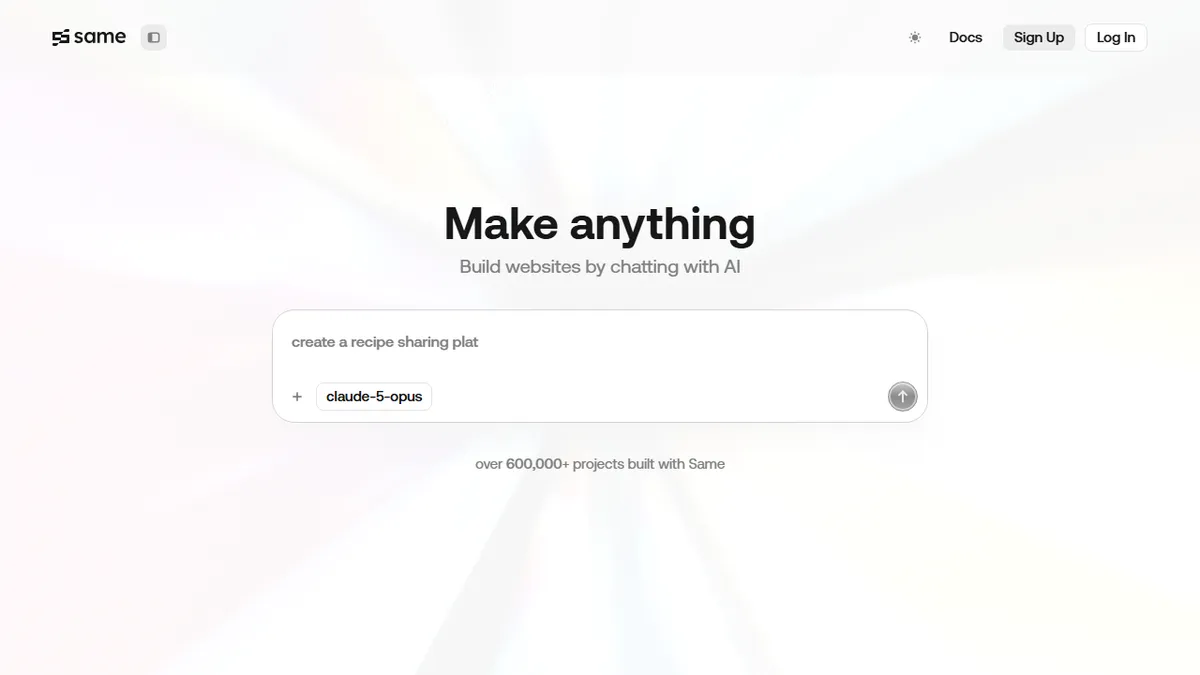
Same.new (formerly branded as same.dev) is a prompt-first AI web app builder aimed at the same territory occupied by Lovable, v0 and Bolt: you type a description, paste a URL, or upload a screenshot, and it produces a working full-stack web application that you can preview, edit and publish to a live URL in minutes. It's positioned for founders, designers and developers who want to move from concept to a shareable demo without hand-writing a Next.js project, wiring Tailwind, and configuring a database.
The workflow is conversational. You describe the app you want (type, target user, required pages, tone, visual direction, must-have behavior) or point Same at an existing site to clone the UI, then iterate by chatting with the agent. It generates a real codebase you can download, remix or push to GitHub, and it connects to the usual full-stack building blocks including Supabase, Neon and Clerk so the generated apps can persist data and authenticate users rather than being pure static mockups. A hosted preview URL is produced automatically, which is where the product earns its ".new" domain — it optimises for the demo-loop of client reviews, landing pages, and early user tests.
Pricing is metered in tokens rather than seats or projects, which rewards short, well-scoped prompts and punishes heavy iteration. The free tier is generous enough to evaluate the product; the paid tiers ($10–$100/mo) unlock premium models, project downloads and remixing, with an overage rate on the top plan. Common workflows include cloning a competitor's marketing page as a starting point, spinning up a quick internal tool or calculator, prototyping a SaaS onboarding flow before committing to real engineering, and rebuilding an old site with a modern stack.
Same.new is a credible entrant in the crowded prompt-to-app space, and the URL-cloning entry point plus real Supabase/Clerk hookups give it a slightly more full-stack feel than pure UI generators. The token-metered pricing is honest but unforgiving on heavy iteration — treat the paid tiers as prototyping budgets, not seat licences, and always download the code so you can graduate off the platform when the project gets serious.
— The AI Tool Bible editorial team
Pros
- ✅ Fast path from prompt or URL to a live hosted preview URL, ideal for client demos and stakeholder reviews
- ✅ Can clone existing sites from a URL or screenshot as a starting point rather than starting from a blank canvas
- ✅ Real full-stack integrations (Supabase, Neon, Clerk, GitHub) instead of throwaway static output
- ✅ Generous free tier (500K tokens/mo) makes evaluation genuinely possible without a card
- ✅ Project download and GitHub push means you own the code and can graduate off the platform
- ✅ Remix capability on paid tiers is useful for iterating on multiple variants of the same app
Cons
- ⚠️ Token-metered pricing gets expensive quickly on heavy iteration or multi-contributor projects, and unused tokens expire monthly
- ⚠️ Generated code quality is variable — production hardening, accessibility, and test coverage still need a human pass
- ⚠️ Cloning existing sites from a URL raises obvious IP and design-attribution questions the product does not police for you
- ⚠️ Less mature ecosystem than incumbents like Lovable, v0 or Bolt — fewer templates, integrations and community examples
- ⚠️ Underlying model choice is opaque; 'premium models' behind paid tiers are not clearly named on the pricing page
Facts
- Free trial
- Yes
- Model used
- Undisclosed premium frontier models (paid tiers)
- Earliest Wayback capture
- 2025-03-17 (earliest archived capture of the site, not a launch date)
Where this tool sits
Use cases
Frequently asked
- How much does Same.new cost?
- Same.new offers a free tier with 500K tokens monthly. Paid plans range from $10 to $100 per month, offering between 2M and 20M tokens. Tokens do not roll over, and overage fees apply on the top plan.
- What technologies does Same.new use?
- It generates real codebases compatible with Next.js, Tailwind, and GitHub. It integrates with Supabase, Neon, and Clerk to enable data persistence and user authentication, moving beyond static mockups to functional full-stack applications.
- Who is Same.new best for?
- It is best for founders, indie hackers, and product designers who need to turn ideas or reference sites into live, shareable demos quickly. It is not recommended for teams shipping regulated production software or those needing deterministic per-seat pricing.
- Can I download or export the code?
- Yes, paid tiers unlock project downloads and remixing. You can download the generated codebase, remix it, or push it directly to GitHub, allowing you to take ownership of the full-stack application you build.
- How does the token-based pricing work?
- Pricing is metered in tokens rather than seats. This model rewards short, well-scoped prompts but can be costly for heavy iteration. The free tier allows evaluation, while paid tiers unlock premium models and higher token limits.