Relevance AI
✓ Editorially verifiedBuild and deploy an AI workforce of specialized agents across your business tools
In short
Relevance AI allows non-engineers to build and deploy specialized AI agents for business workflows. It is best for mid-market and enterprise teams needing governed automation across their SaaS stack without custom code.
RevOps, sales, CS, and operations teams inside mid-market and enterprise companies who want to deploy governed multi-step AI agents against their CRM and SaaS stack without building bespoke orchestration.
Solo developers, hobbyists, or engineering teams that want an open-source, self-hosted agent framework they can fully own and extend in code (LangGraph, CrewAI, or in-house builds fit better).
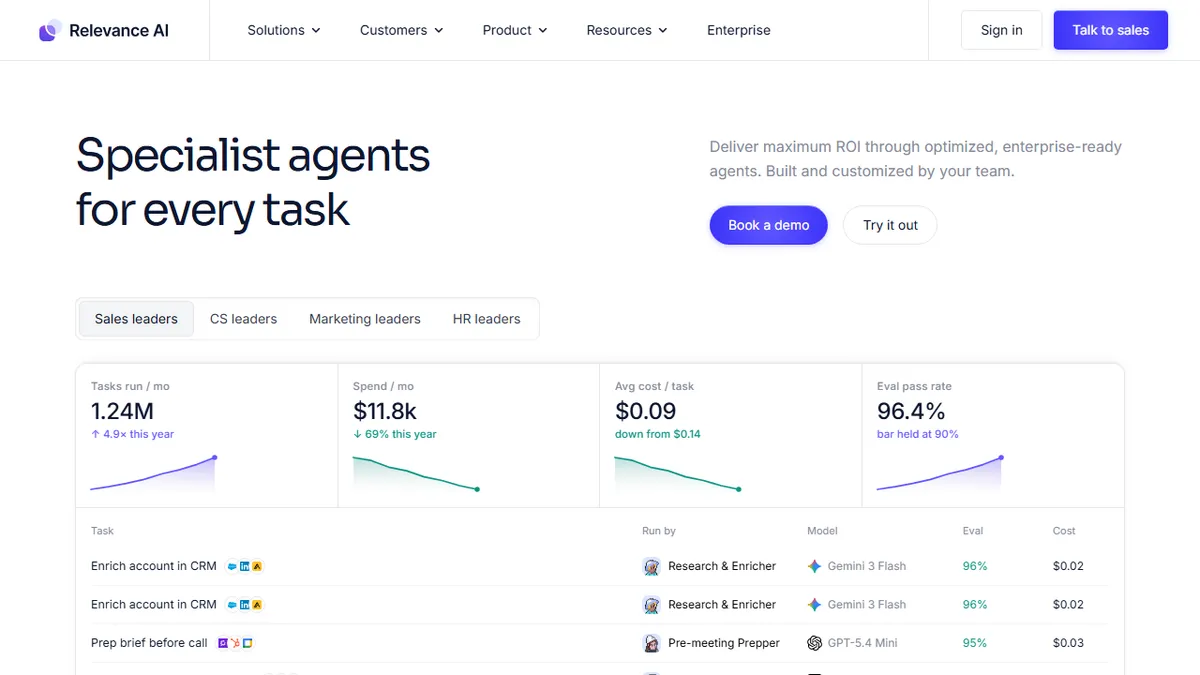
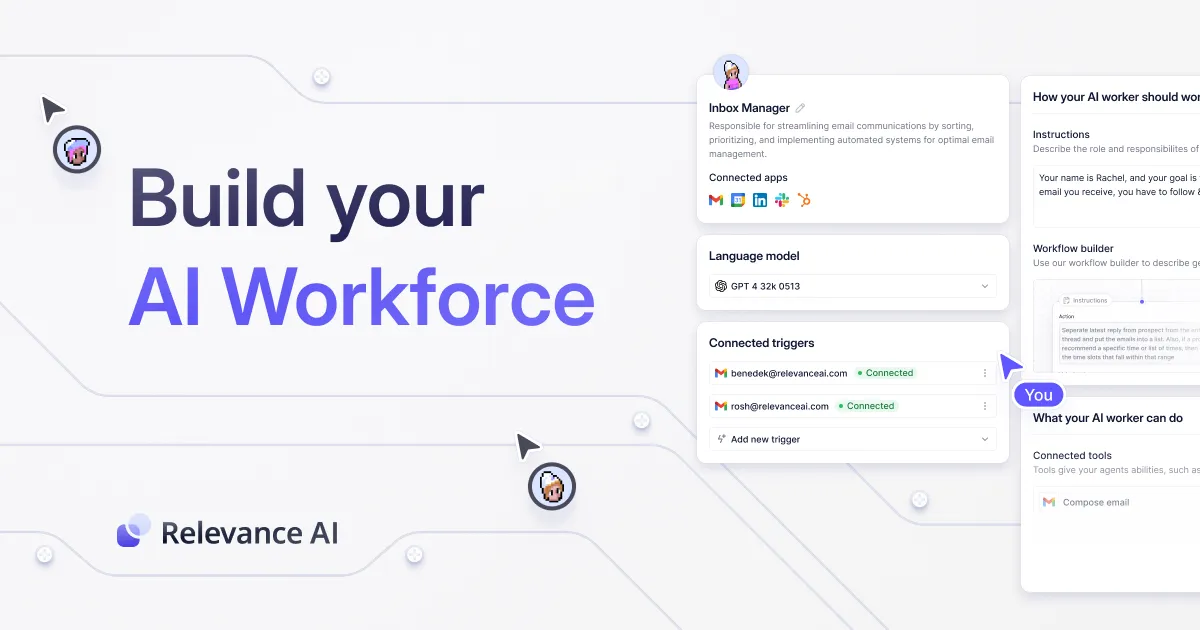
Relevance AI is a no-code platform for designing, deploying, and governing teams of specialized AI agents that automate business workflows across sales, customer success, marketing, HR, and operations. Instead of shipping a single generalist chatbot, users assemble departmental 'AI workforces' — for example a BDR agent that researches prospects and drafts outbound, a CS agent that summarises calls and files follow-ups, or an ops agent that reconciles data across systems. Each agent is built visually from tools (API calls, database lookups, prompt steps, sub-agents) with human-in-the-loop approvals where needed. The platform is model-agnostic and routes tasks across Claude (Opus/Sonnet/Haiku), OpenAI GPT, Google Gemini, and open-weight options like Kimi K2 and GLM, letting teams trade cost for quality per step. It ships with 1,000+ integrations (Salesforce, HubSpot, Slack, Gmail, Notion, etc.), an evaluation framework for regression-testing agent behaviour, cost analytics, RBAC, audit logs, and SOC 2 / GDPR / data-residency controls that enterprises actually ask for in procurement. Common workflows include prospect enrichment and outbound personalisation, meeting prep and CRM hygiene, deal-review copilots, ticket triage and knowledge-base RAG, applicant screening, competitive-intel briefings, and internal-tool orchestration. The builder is aimed at operators and RevOps rather than engineers — you can ship a working agent in an afternoon — but there is enough depth (custom actions, code steps, sub-agents, webhooks) that platform teams can extend it as first-class infrastructure.
One of the more grown-up agent platforms — the evaluation harness, model routing, and enterprise controls are the things most 'agent builders' skip, and they are exactly what stops a demo agent from becoming a liability in production. The trade-off is that it is unmistakably an enterprise product: opaque pricing, GTM-flavoured templates, and a sales motion to match.
— The AI Tool Bible editorial team
Pros
- ✅ No-code visual builder gets non-engineers shipping usable agents quickly
- ✅ Model-agnostic routing across Claude, GPT, Gemini and open-weight models lets you optimise cost vs. quality per step
- ✅ Very large integration catalogue (1,000+ apps) including Salesforce, HubSpot, Slack, Gmail
- ✅ Built-in evaluation and cost-monitoring framework — rare in this category and important for production use
- ✅ Enterprise controls (SOC 2, GDPR, data residency, audit logs, RBAC) are actually present, not roadmap items
- ✅ Strong library of pre-built agent templates for sales, CS, and ops workflows
- ✅ Sub-agent and tool-composition model supports non-trivial multi-step automations
Cons
- ⚠️ Pricing is opaque and sales-gated; hard to budget without a demo call
- ⚠️ Positioning and templates lean heavily toward GTM/enterprise use cases — less obvious value for solo devs or hobbyists
- ⚠️ Deep customisation still benefits from a technical operator; fully non-technical users hit ceilings on complex flows
- ⚠️ Runtime cost can escalate quickly if agents fan out across expensive frontier models without careful routing
- ⚠️ As a hosted platform, you cede orchestration and observability to a third party rather than owning the stack
Use cases
Frequently asked
- Who is Relevance AI designed for?
- It is aimed at RevOps, sales, customer success, and operations teams in mid-market and enterprise companies. It is not intended for solo developers or hobbyists seeking open-source frameworks.
- Which AI models does Relevance AI support?
- The platform is model-agnostic, routing tasks across Claude, OpenAI GPT, Google Gemini, and open-weight options like Kimi K2 and GLM to optimize cost and quality.
- What kind of workflows can be automated?
- Common use cases include prospect research, CRM hygiene, ticket triage, applicant screening, and competitive intelligence. Agents can be built for sales, customer success, marketing, HR, and operations.
- Does Relevance AI offer enterprise security controls?
- Yes, the platform includes SOC 2 and GDPR compliance, data-residency controls, audit logs, and role-based access control (RBAC) to meet enterprise procurement requirements.
- How is Relevance AI priced?
- Pricing is quote-based for enterprise tiers, which include custom actions and unlimited agents. A free trial is available, but there is no fixed public tier pricing.
Explore related
Compare with similar tools
All in Agents →LangGraph
FeaturedStateful, graph-based agent orchestration from LangChain.
CrewAI
FeaturedPython framework for multi-agent orchestration.
Ernie Bot
Baidu's Mandarin-first ChatGPT rival, powered by the ERNIE model family
Moveworks
The enterprise AI assistant that searches, answers, and takes action across your business systems
AWS Bedrock
Build and scale generative AI applications with foundation models
Claude Agent SDK
Anthropic's official SDK for building autonomous Claude agents.