Reducto
✓ Editorially verifiedEnterprise-grade document parsing and extraction with citation-grounded structured output
Engineering teams building production RAG, agent, or automation pipelines over messy real-world documents - contracts, filings, medical records, invoices, insurance forms - where citation-grounded extraction and enterprise privacy controls actually matter.
Hobbyists, prototypes over clean born-digital PDFs, or cost-sensitive projects where an open-source parser like Unstructured, Docling, or a direct GPT-4o/Gemini call is good enough.
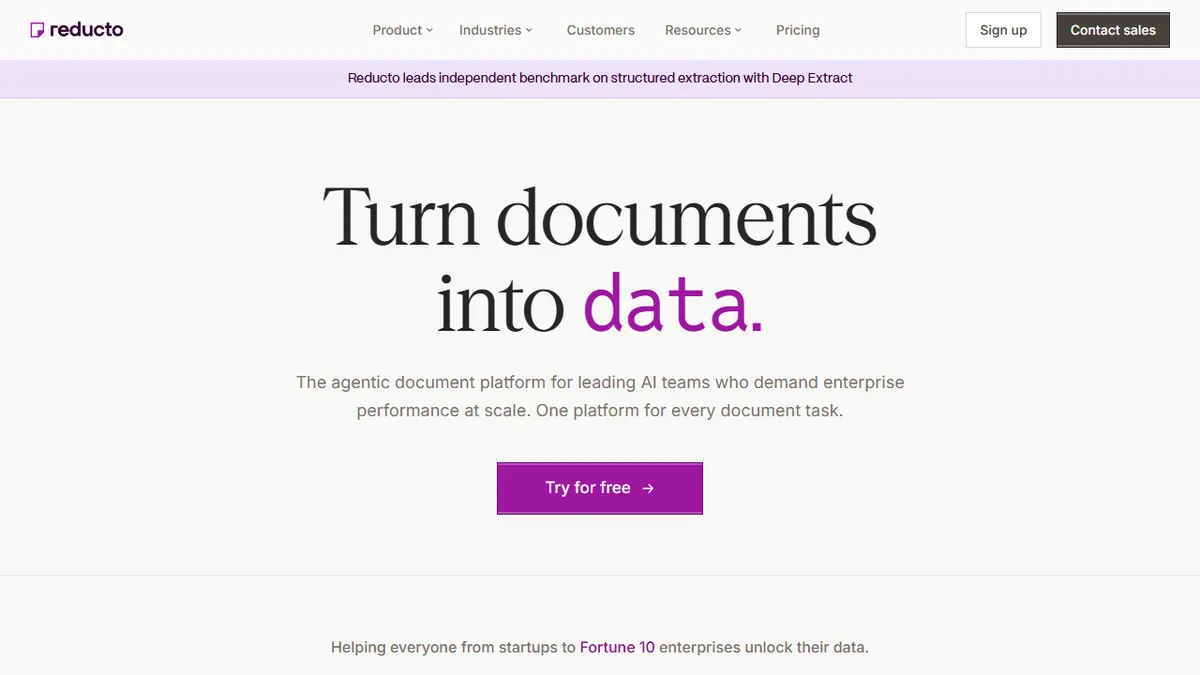
Reducto is a document processing platform aimed at engineering teams building RAG pipelines, agents, or back-office automations that need to reliably turn messy PDFs, scans, spreadsheets, slides, and forms into structured, citation-ready data. It combines in-house vision models with frontier LLMs to handle the parts of document ingestion that generic OCR and off-the-shelf model calls typically break on: complex tables that span pages, embedded charts, handwriting, multi-column layouts, checkboxes, and stamped or low-quality scans. The core operations are parse (document to structured JSON or markdown with per-element citations), extract (typed field extraction against a user-supplied schema, again with citations back to the source region), split (segment long documents into semantically meaningful chunks or sub-documents), classify (route documents through a taxonomy), and edit/regenerate (write changes back out to PDF or DOCX). Access is through a REST API with Python and Node SDKs, a pip-installable CLI, and an MCP server that lets AI agents call the parser as a tool. A hosted Studio UI is available for prototyping schemas and inspecting outputs before wiring them into production. Reducto supports 30+ file types with no per-document page cap, and offers zero-data-retention, BAA, on-prem/VPC deployment, and EU/AU data residency on higher tiers - features that matter for legal, healthcare, insurance, and financial services teams that cannot ship documents to a general-purpose model provider. Typical workflows include feeding cleaner chunks into a vector store for retrieval, extracting structured fields from contracts or invoices, and pre-processing filings before agent-driven analysis.
Reducto is one of the few document-parsing APIs I would actually trust in front of a RAG index for regulated data. The citation-per-element output and no-page-limit policy make it a genuine upgrade over rolling your own OCR-plus-LLM stack, and the MCP server is a nice touch for agent builders. The catch is pricing opacity and the fact that anything beyond the pay-as-you-go tier requires a sales call - budget accordingly.
— The AI Tool Bible editorial team
Pros
- ✅ Handles hard document elements (nested tables, charts, handwriting, scans) far better than default OCR + LLM pipelines
- ✅ Every parsed element and extracted field ships with citations back to the source region, which is critical for RAG grounding and audit trails
- ✅ REST API plus Python/Node SDKs, CLI, and an MCP server for agent tool-use - easy to integrate into existing stacks
- ✅ 30+ file types and no per-document page limit on the standard tier
- ✅ Enterprise-grade privacy options: zero data retention, BAA, VPC/on-prem, EU/AU residency, SSO/SAML
- ✅ 20% batch discount for non-urgent async jobs (12-hour completion) makes large backfills more affordable
- ✅ Studio UI lets non-engineers prototype extraction schemas without touching code
Cons
- ⚠️ Credit-based pricing at $0.015/credit is opaque until you benchmark against your own document mix - hard to estimate monthly spend up front
- ⚠️ Best-in-class privacy features (ZDR, BAA, on-prem, residency) are gated to the sales-quoted Growth and Enterprise tiers
- ⚠️ Closed source and hosted-only on the entry plan - you cannot self-host to inspect or fine-tune the underlying models without an enterprise contract
- ⚠️ Overkill and expensive if your corpus is just clean, born-digital PDFs where open-source parsers like Unstructured, Docling, or pdfplumber suffice
- ⚠️ Specific model names and version cadence are not publicly disclosed, which complicates reproducibility for regulated evaluations
Use cases
Explore related
Compare with similar tools
All in RAG →Pinecone
FeaturedManaged vector database for production-scale similarity search.
LlamaIndex
FeaturedData framework for connecting LLMs to your data.
Elasticsearch Vector Search
Hybrid vector + keyword search in the enterprise-grade Elasticsearch engine
Snowflake Cortex
Generative AI and RAG built into the Snowflake data cloud
DataStax Astra DB
Serverless vector and document database for production RAG and AI agents
MongoDB Atlas Vector Search
Vector search built into the operational database you're already using.