PyTorch Lightning
The deep learning framework for professional AI researchers and ML engineers
PyTorch researchers and ML engineers who need to scale training from a single GPU to multi-node clusters without rewriting their training loop, and who value reproducibility and integration with the standard MLOps stack.
Non-coders, no-code AutoML users, or teams working purely in TensorFlow/JAX. Also overkill for a five-line prototype that has no plans to scale beyond one GPU.
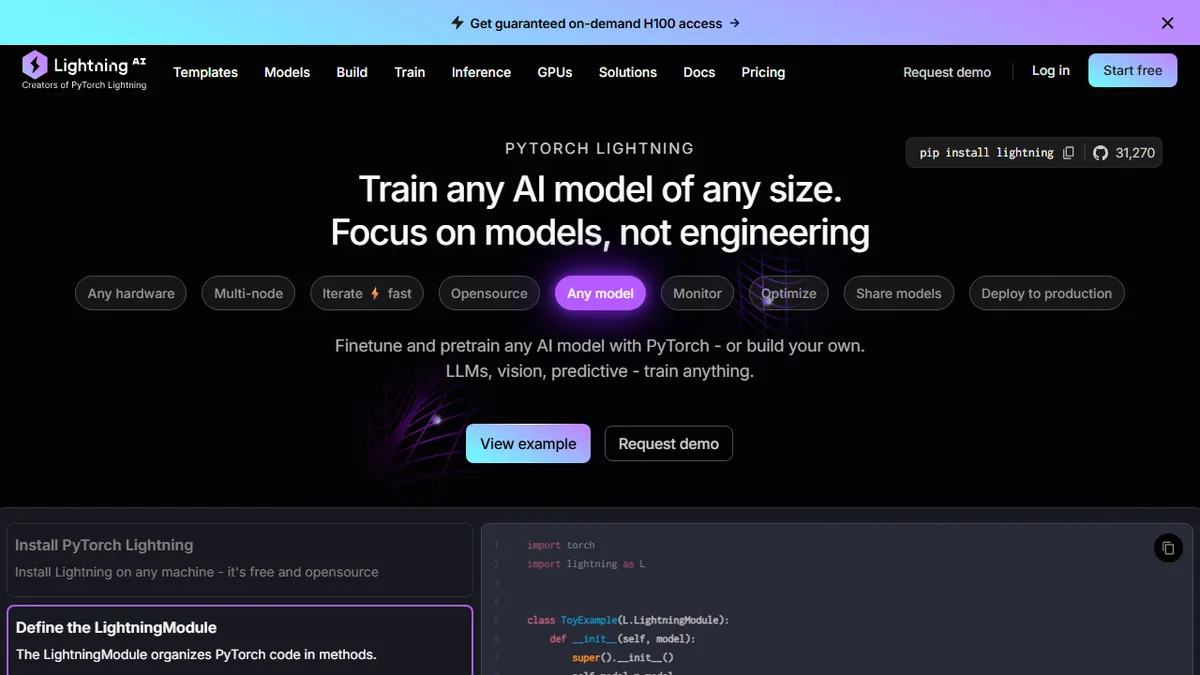
PyTorch Lightning is an open-source, high-level wrapper around PyTorch that structures deep learning code into a standardised, hardware-agnostic format. Instead of writing bespoke training loops for every project, engineers implement a LightningModule (model + optimiser + step logic) and hand it to a Trainer object that handles device placement, distributed training, mixed precision, gradient accumulation, checkpointing, logging and early stopping. The same code runs unchanged on a laptop CPU, a single GPU, multi-GPU nodes, TPUs, or thousands-of-GPU clusters using DDP, FSDP or DeepSpeed strategies. It is aimed squarely at professional researchers and ML engineers who want reproducibility and scale without giving up the flexibility of raw PyTorch, since any hook can be overridden and any custom CUDA or PyTorch call still works. Typical workflows include training and fine-tuning transformers for NLP, computer-vision models such as ViTs and diffusion nets, reinforcement-learning agents, contrastive/self-supervised pretraining, meta-learning, and long-running production training pipelines. It integrates natively with TorchMetrics, Weights & Biases, MLflow, TensorBoard, Comet and Neptune, and pairs with sibling libraries in the Lightning ecosystem (Fabric for a lower-level opt-in API, LitGPT for LLM training, LitServe for model serving, LitData for streaming datasets). Maintained by Lightning AI and a large open-source community, it is one of the most widely adopted training frameworks in academic ML, alongside Hugging Face Accelerate and raw PyTorch.
Lightning has become the de-facto structured training loop for PyTorch, and for good reason: it turns the messiest part of a research codebase into something reviewable. The trade-off is real abstraction tax and version churn, so pin a version early. If Lightning feels too opinionated, drop down to Fabric before abandoning the ecosystem.
— The AI Tool Bible editorial team
Pros
- ✅ Removes boilerplate training-loop code while keeping full PyTorch flexibility and access to every low-level hook
- ✅ Same LightningModule scales from laptop to multi-node clusters via DDP, FSDP, DeepSpeed and TPU strategies with a config flag
- ✅ Built-in mixed precision, gradient accumulation, checkpointing, early stopping and profiling out of the box
- ✅ First-class integrations with TorchMetrics, W&B, MLflow, TensorBoard and Hugging Face models/datasets
- ✅ Fully open source under Apache 2.0 with a large ecosystem (Fabric, LitGPT, LitServe, LitData) and active community
- ✅ Excellent reproducibility story: seeded runs, deterministic mode, structured configs via LightningCLI
Cons
- ⚠️ Extra abstraction layer means debugging can require understanding both PyTorch and Lightning's internal callback/hook order
- ⚠️ Frequent breaking API changes across major versions can force refactors of older training scripts
- ⚠️ For very custom or exotic training loops the framework can feel restrictive, pushing users to Fabric or raw PyTorch anyway
- ⚠️ Documentation sprawls across pytorch-lightning, Fabric and Lightning AI Studio, making it easy to land on the wrong version
- ⚠️ Not an end-user AI tool — requires solid Python and PyTorch skills before it is productive
Use cases
Explore related
Compare with similar tools
All in Fine-tuning →Together AI
FeaturedFine-tune & serve open-weight models (Llama, Mistral, DeepSeek).
Modal
Serverless GPUs and infra for training & serving ML.
Replicate
One-API platform for running and fine-tuning open-source models.
OpenAI Fine-tuning
Fine-tune GPT-4o-mini and friends on your own data.
Llama
Meta's open-weight LLM family covering 1B mobile models up to 405B frontier and natively multimodal 10M-context Llama 4 variants.
RunPod
On-demand GPU cloud and serverless inference platform built specifically for AI workloads.