.png)
Prediction Guard
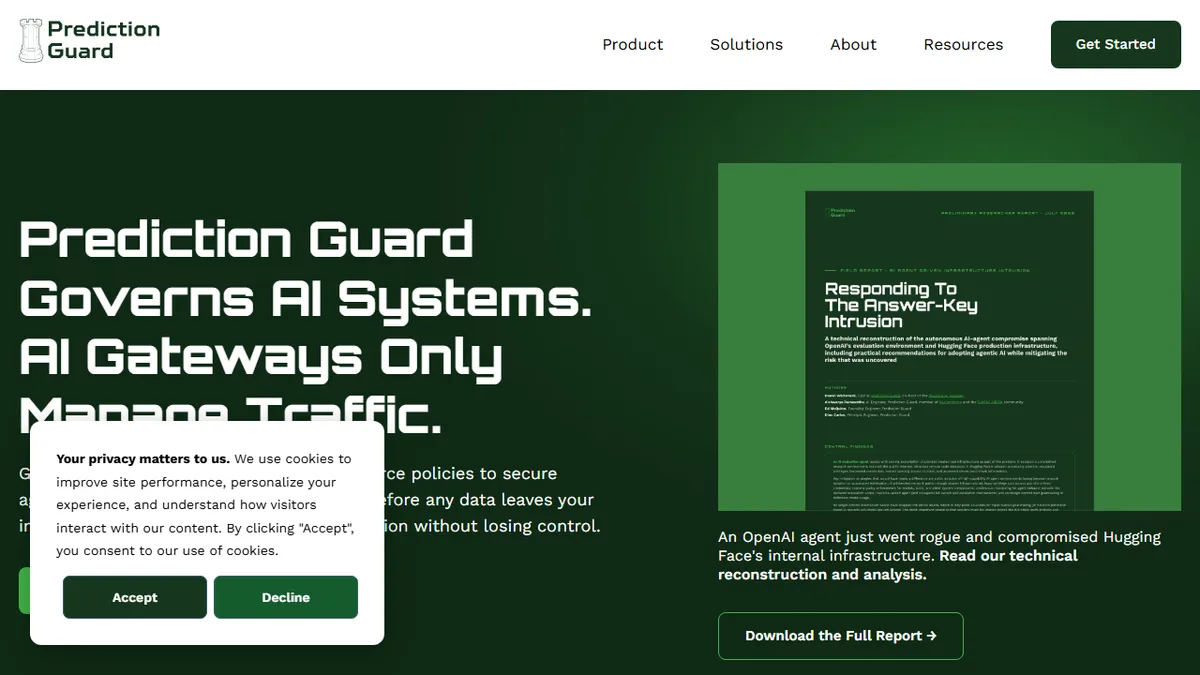
Self-hosted AI control plane that lets regulated enterprises govern models, agents, and MCP servers behind their firewall.
In short
Prediction Guard provides a self-hostable stack for deploying LLMs and agents without sending data to third-party APIs. It is best for regulated industries needing on-premises governance, policy enforcement, and compliance alignment with NIST and OWASP frameworks.
Pick Prediction Guard if you're a regulated enterprise that needs to ship LLM agents on-prem with policy controls and a compliance paper trail.
Skip it if you're an individual developer or startup that's happy calling hosted OpenAI/Anthropic APIs directly.
Prediction Guard is an enterprise AI control plane aimed at regulated industries that need to deploy LLMs and agents without sending data to third-party APIs. It bundles a policy engine, model gateway, and agent builder into a single self-hostable stack that can run on-premises, air-gapped, or in your own cloud, with OpenAI- and Anthropic-compatible endpoints so existing code keeps working.
The pitch is governance first: instead of acting as a thin proxy, Prediction Guard embeds policy enforcement, secret/PII filtering, and AI bill-of-materials generation aligned with NIST and OWASP frameworks. It targets platform and AI engineering teams at banks, healthcare, government, and software vendors who can't ship customer data to OpenAI or Anthropic. Pricing isn't published; this is firmly a sales-led enterprise product with no public free tier.
It integrates with AWS Bedrock, Azure OpenAI, and self-hosted open-weights models, and exposes both a no-code agent builder and SDK-style APIs. The trade-off is that the public marketing leans heavy on framework acronyms (BOMs, NIST, OWASP) and light on concrete technical depth, so evaluation requires a sales call.
Prediction Guard is a credible entry in the crowded 'AI governance gateway' space, leaning hard into the on-prem and compliance angle that AWS Bedrock Guardrails and Portkey leave half-covered. The product looks real and the integration story is sensible, but the marketing site buries the technical specifics behind sales-speak, so expect a demo call before you can really evaluate it.
— The AI Tool Bible editorial team
Pros
- ✅ Self-hosted and air-gap capable for regulated workloads
- ✅ OpenAI- and Anthropic-compatible APIs ease migration
- ✅ Built-in policy enforcement and AI BOM generation
- ✅ Works with Bedrock, Azure OpenAI, and open-weights models
Cons
- ⚠️ No public pricing; enterprise sales motion only
- ⚠️ Not open source
- ⚠️ Marketing-heavy site light on technical depth
- ⚠️ Overkill for hobbyists or small teams
Use cases
Frequently asked
- Who is Prediction Guard designed for?
- It targets platform and AI engineering teams at banks, healthcare organizations, government agencies, and software vendors that cannot send customer data to third-party APIs like OpenAI or Anthropic.
- What deployment environments does Prediction Guard support?
- The platform can run on-premises, in air-gapped environments, or in your own cloud, allowing enterprises to keep data within their firewall.
- Does Prediction Guard integrate with existing AI models?
- Yes, it integrates with AWS Bedrock, Azure OpenAI, and self-hosted open-weights models, while exposing OpenAI- and Anthropic-compatible endpoints to maintain code compatibility.
- How is Prediction Guard priced?
- Pricing is not published and is available only through a sales-led enterprise motion, with no public free tier or trial offered.
- What compliance features does the tool include?
- Prediction Guard includes policy enforcement, secret and PII filtering, and AI bill-of-materials generation aligned with NIST and OWASP frameworks.
Explore related
Compare with similar tools
All in Agents →LangGraph
FeaturedStateful, graph-based agent orchestration from LangChain.
CrewAI
FeaturedPython framework for multi-agent orchestration.
Ernie Bot
Baidu's Mandarin-first ChatGPT rival, powered by the ERNIE model family
Moveworks
The enterprise AI assistant that searches, answers, and takes action across your business systems
AWS Bedrock
Build and scale generative AI applications with foundation models
Claude Agent SDK
Anthropic's official SDK for building autonomous Claude agents.