
PostgresML
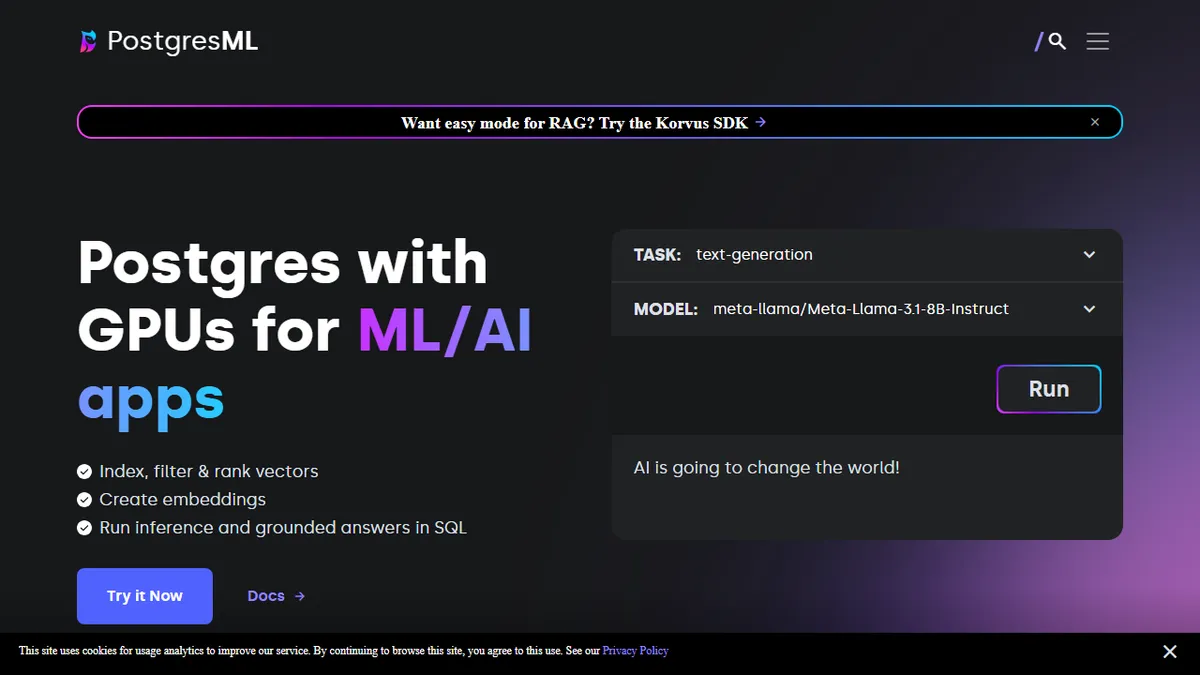
PostgreSQL extension that runs embeddings, vector search, and LLM inference inside your database.
In short
PostgresML adds AI capabilities like embeddings, vector search, and LLM inference directly to PostgreSQL, allowing you to run complex RAG pipelines within a single database query path.
Pick PostgresML if you already run Postgres and want RAG, embeddings, and LLM calls collapsed into one query path instead of four services.
Skip it if your stack isn't Postgres-centric or you need bleeding-edge proprietary models like GPT-4 or Claude.
PostgresML turns Postgres into an AI application stack. The PGML extension lets you generate embeddings, run vector similarity search, call open-source LLMs (Llama, Mistral, and friends), do supervised ML (regression, classification, clustering), and even fine-tune models, all from SQL. The companion Korvus SDK exposes the same primitives to Python and JavaScript so application code never has to leave the database boundary.
It's pitched at engineering teams who are tired of stitching a vector DB, an embedding service, an inference API, and a feature store together. By co-locating data and compute, PostgresML avoids the round-trips that dominate RAG latency budgets, and the team benchmarks it as roughly 10x faster than typical retrieval pipelines and ~42% cheaper than Pinecone for vector workloads. You can self-host the open-source extension or use their managed cloud (with VPC options) and $100 in starter credits.
Used in production by Instacart, OneSignal, Alibaba, and VMware. The trade-off is operational: you're now running GPUs and large models next to your OLTP database, which is great for unified architectures but uncomfortable if your DBA team likes Postgres boring.
The cleanest answer to 'why is my RAG pipeline five services and 400ms of latency?' Co-locating vectors and inference with the source data is genuinely the right architecture for a lot of teams, and PostgresML is the most credible implementation of that thesis. Just be honest about the ops cost of mixing GPU workloads with OLTP.
— The AI Tool Bible editorial team
Pros
- ✅ Embeddings, vector search, and LLM inference in one Postgres extension
- ✅ Eliminates network hops between app, vector DB, and inference service
- ✅ Open source (PGML, Korvus, PgCat) with SQL/Python/JS SDKs
- ✅ Self-host or managed cloud with VPC option
- ✅ Strong benchmarks vs Pinecone on cost and latency
Cons
- ⚠️ Couples GPU/ML workload to your primary database
- ⚠️ Requires Postgres operational expertise to self-host well
- ⚠️ Smaller model catalog than dedicated inference providers
Use cases
Frequently asked
- How much does PostgresML cost?
- Pricing is freemium. Serverless starts at $7.50 per query hour, Dedicated at $0.60 per instance hour, and Enterprise offers custom pricing. New users receive $100 in starter credits for the managed cloud.
- Which AI models does PostgresML support?
- It supports multi-model capabilities, including open-source LLMs like Llama and Mistral, as well as open-source embeddings. It does not support proprietary models like GPT-4 or Claude.
- Is PostgresML suitable for non-Postgres databases?
- No. You should skip it if your stack isn't Postgres-centric. It is specifically designed for teams already running Postgres who want to collapse RAG, embeddings, and LLM calls into one query path.
- What are the performance benefits of using PostgresML?
- By co-locating data and compute, it avoids round-trips that dominate RAG latency. The team benchmarks it as roughly 10x faster than typical retrieval pipelines and ~42% cheaper than Pinecone for vector workloads.
- Can I use PostgresML from Python or JavaScript?
- Yes. The companion Korvus SDK exposes the same primitives to Python and JavaScript, ensuring application code never has to leave the database boundary for these AI operations.
Explore related
Compare with similar tools
All in RAG →Pinecone
FeaturedManaged vector database for production-scale similarity search.
LlamaIndex
FeaturedData framework for connecting LLMs to your data.
Elasticsearch Vector Search
Hybrid vector + keyword search in the enterprise-grade Elasticsearch engine
Snowflake Cortex
Generative AI and RAG built into the Snowflake data cloud
DataStax Astra DB
Serverless vector and document database for production RAG and AI agents
MongoDB Atlas Vector Search
Vector search built into the operational database you're already using.