Portkey
Production LLM gateway with observability, guardrails, and prompt management for teams shipping AI in anger.
In short
Portkey acts as a control plane between your application and multiple LLM providers, offering a unified API with built-in observability and governance. It is best for teams needing production-grade reliability, cost tracking, and security features without building them from scratch.
Pick Portkey if you're running LLMs in production across multiple providers and need one place for observability, cost control, and guardrails without writing it yourself.
Skip it if you're a solo developer shipping a hobby project against a single model — the abstraction is overkill and the raw provider SDK is simpler.
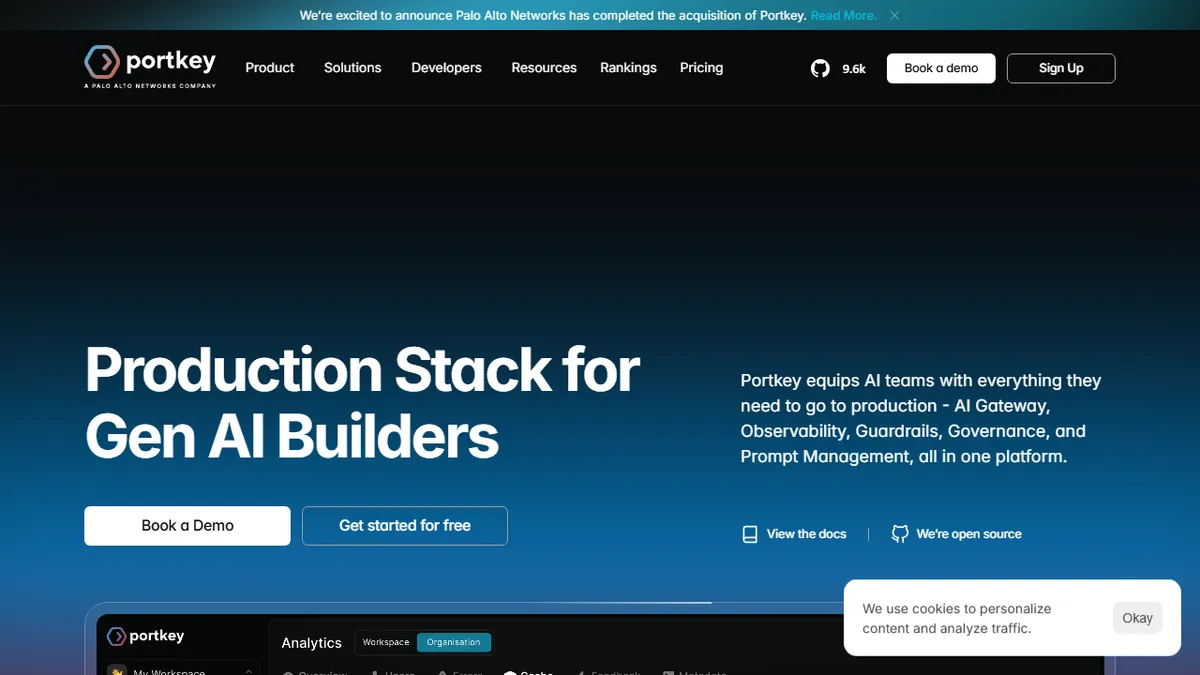
Portkey is an AI gateway and control plane that sits between your application and 1,600+ LLMs, giving you a single API, plus the observability, governance, and reliability layers you'd otherwise have to build yourself. Drop-in compatible with the OpenAI SDK (Node and Python), it adds intelligent caching, automatic retries and fallbacks, semantic routing, cost tracking, prompt versioning, and PII guardrails over whatever model you point it at.
It's aimed at teams who've outgrown raw provider SDKs and need real production hygiene: per-team budgets, RBAC, audit logs, SSO, and an MCP gateway for governing tool servers. Pricing is freemium with a paid Production tier around $59/month and enterprise plans for on-prem and hybrid deployments. The platform was acquired by Palo Alto Networks in 2026, which signals an even heavier enterprise/security posture going forward.
The core gateway is open-source on GitHub (10K+ stars) and self-hostable, with hosted SaaS and enterprise options layered on top. Integrations span OpenAI, Anthropic, Bedrock, Vertex, Azure, plus orchestration frameworks like LangChain, LlamaIndex, and CrewAI.
Portkey is one of the more mature LLM gateways in the market, and the Palo Alto Networks acquisition makes it a safer enterprise bet than scrappier competitors. The open-source core is a real differentiator versus closed observability vendors. If you've ever spent a sprint reinventing fallbacks and cost dashboards, this is the buy-not-build call.
— The AI Tool Bible editorial team
Pros
- ✅ Unified API for 1,600+ models with OpenAI-SDK drop-in compatibility
- ✅ Real observability: traces, costs, latency, errors per request
- ✅ Built-in guardrails, fallbacks, retries, and semantic caching
- ✅ Open-source core gateway, self-hostable for data-sensitive teams
- ✅ Enterprise features (SSO, RBAC, budgets, MCP gateway) out of the box
Cons
- ⚠️ Adds a hop in the request path; latency-sensitive workloads need tuning
- ⚠️ Pricing tiers beyond the headline number are vague until you talk to sales
- ⚠️ Some advanced governance features gated behind enterprise plans
Use cases
Frequently asked
- What is the primary function of Portkey?
- Portkey is an AI gateway and control plane that sits between applications and over 1,600 LLMs. It provides a single API along with observability, governance, and reliability layers such as caching, retries, and cost tracking.
- Is Portkey compatible with existing development tools?
- Yes, it is drop-in compatible with the OpenAI SDK for Node and Python. It also integrates with orchestration frameworks like LangChain, LlamaIndex, and CrewAI, as well as providers like Anthropic, Bedrock, and Azure.
- Can Portkey be self-hosted?
- The core gateway is open-source on GitHub and self-hostable, which is suitable for data-sensitive teams. Hosted SaaS and enterprise options are also available for on-prem and hybrid deployments.
- What enterprise security features does Portkey offer?
- Portkey includes per-team budgets, RBAC, audit logs, SSO, and an MCP gateway for governing tool servers. These features are part of its enterprise plans, which also support on-prem and hybrid deployments.
- Who should avoid using Portkey?
- Solo developers shipping hobby projects against a single model should skip it, as the abstraction may be overkill compared to using the raw provider SDK directly.
Explore related
Compare with similar tools
All in Agents →LangGraph
FeaturedStateful, graph-based agent orchestration from LangChain.
CrewAI
FeaturedPython framework for multi-agent orchestration.
Ernie Bot
Baidu's Mandarin-first ChatGPT rival, powered by the ERNIE model family
Moveworks
The enterprise AI assistant that searches, answers, and takes action across your business systems
AWS Bedrock
Build and scale generative AI applications with foundation models
Claude Agent SDK
Anthropic's official SDK for building autonomous Claude agents.