Poolside
✓ Editorially verifiedFrontier open-weight foundation models purpose-built for agentic software engineering.
In short
Poolside provides frontier-class open-weight foundation models specifically tuned for agentic software engineering. It is best for enterprise and government teams requiring self-hosted, air-gapped coding agents within their own VPCs.
Enterprise and government engineering teams that need a frontier-class coding model they can run inside their own VPC or on-prem, and platform teams building bespoke coding agents on top of open-weight foundations.
Solo developers or small teams who just want a working IDE autocomplete or chat assistant — there is no consumer plan, no first-party editor plugin, and the enterprise stack is overkill.
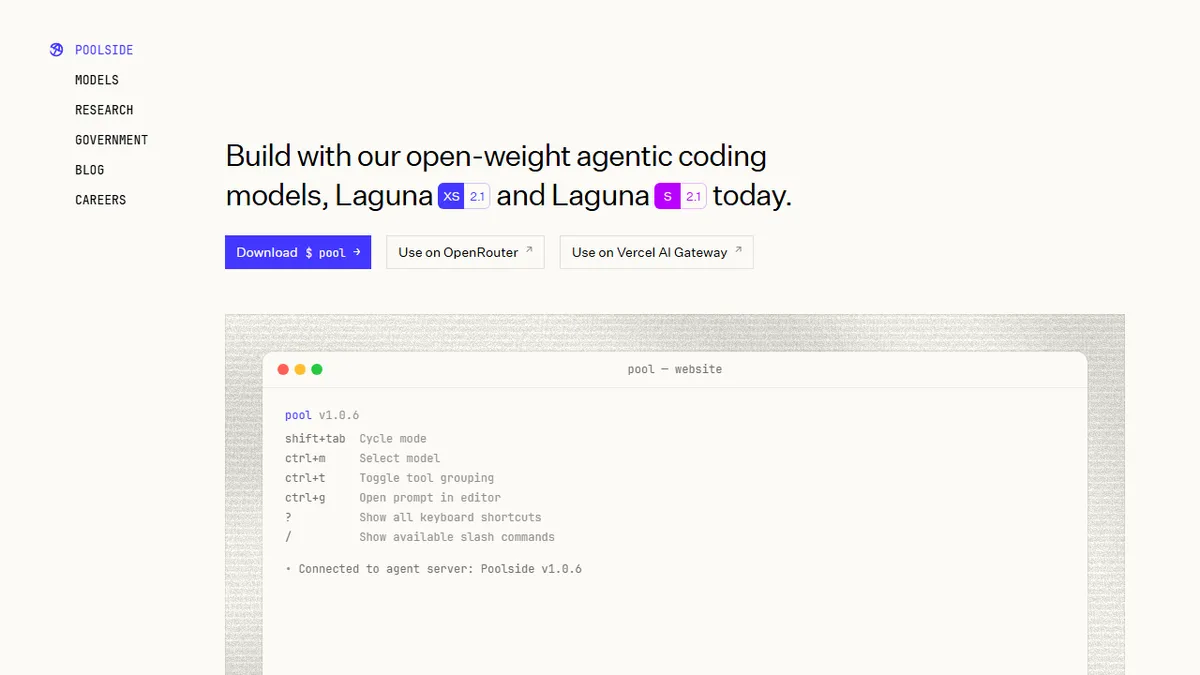
Poolside is a foundation-model company building large language models tuned specifically for agentic software engineering rather than general chat. Its flagship Laguna 2.1 family (Laguna S at 118B total / 8B active parameters and Laguna XS at 33B total / 3B active) uses a Mixture-of-Experts architecture with selective activation, giving frontier-class reasoning at mid-tier serving cost, plus extended 1M and 256K token context windows for large-codebase reasoning. The models are released open-weight, so teams can self-host, fine-tune, or route to them through gateways like OpenRouter and the Vercel AI Gateway; documentation lives at docs.poolside.ai. Alongside the weights, Poolside sells an enterprise stack that pairs the models with an agent runtime, training pipeline built around reinforcement learning from code execution (RLCE), and deployment options that reach on-device and air-gapped environments — a combination aimed at regulated buyers such as banks, defense primes, and government agencies who cannot ship code or telemetry to a public API. Typical workflows include running long-horizon coding agents inside a customer VPC, generating and refactoring large PRs against private monorepos, plugging Laguna into existing IDE/CLI coding agents as a swap-in model, and continuously improving a private model with the customer's own execution traces. It is not a plug-and-play Copilot-style IDE plugin; buyers get raw model access and infrastructure and are expected to bring their own agent scaffolding or platform integration.
Poolside is one of the more credible non-hyperscaler bets in the coding-model space: open-weight Laguna 2.1 gives you a real escape hatch from OpenAI/Anthropic pricing and data policy, and the RLCE + agent-runtime story is aimed squarely at buyers who need to keep code on-prem. It is emphatically infrastructure, not a Copilot replacement, and you feel the youth of the tooling — but for regulated shops building their own coding agents, it deserves a bake-off slot.
— The AI Tool Bible editorial team
Pros
- ✅ Open-weight release means you can self-host, quantise, or fine-tune Laguna S/XS without vendor lock-in.
- ✅ MoE design (8B or 3B active) delivers frontier-tier reasoning while keeping inference cost closer to mid-tier models.
- ✅ 1M / 256K context windows are large enough to reason over sizeable monorepo slices in a single call.
- ✅ Explicit on-device and air-gapped deployment story fits regulated, government, and defense buyers.
- ✅ Available through OpenRouter and Vercel AI Gateway, so teams can try the models without an enterprise contract.
- ✅ Training pipeline built around reinforcement learning from code execution, which is a strong signal for coding-agent quality.
- ✅ Model + agent runtime + training stack are offered together, so enterprise customers can keep improving a private model with their own execution traces.
Cons
- ⚠️ No public pricing and no obvious self-serve signup for the enterprise platform — direct access is sales-led.
- ⚠️ Not a turnkey IDE assistant; you supply the agent scaffolding, editor integration, and evaluation harness.
- ⚠️ Ecosystem, community, and third-party benchmark coverage are still thin compared with GPT, Claude, Gemini, and Qwen-Coder.
- ⚠️ Open-weight, not fully open-source — training data, RLCE recipe, and code are not published.
- ⚠️ Very large parameter counts mean serious GPU capacity is required to self-host Laguna S at useful throughput.
- ⚠️ Product surface (docs, dashboards, tooling) is younger and less polished than incumbent coding-model vendors.
Use cases
Frequently asked
- What models does Poolside offer?
- Poolside offers the Laguna 2.1 family, including Laguna S (118B total/8B active) and Laguna XS (33B total/3B active). Both use a Mixture-of-Experts architecture with extended context windows of 1M and 256K tokens.
- Can I self-host Poolside models?
- Yes, the Laguna 2.1 models are released as open-weight, allowing teams to self-host, fine-tune, or quantize them. This supports deployment in on-device and air-gapped environments for regulated industries.
- Is Poolside a plug-and-play IDE plugin?
- No, Poolside is not a turnkey IDE assistant. It provides raw model access and infrastructure, requiring buyers to supply their own agent scaffolding, editor integration, and evaluation harness.
- How can I access Poolside models without an enterprise contract?
- The Laguna 2.1 open-weight models can be consumed pay-per-token via third-party gateways such as OpenRouter and the Vercel AI Gateway at their published rates.
- Who is Poolside best suited for?
- It is best for enterprise and government engineering teams that need frontier-class coding models they can run inside their own VPC or on-prem, as well as platform teams building bespoke coding agents.
Explore related
Compare with similar tools
All in Coding →Cursor
FeaturedAI-first VS Code fork — chat, edit, and agentic coding in one IDE.
GitHub Copilot
FeaturedThe original AI pair programmer, now with chat and agents.
Replit Agent
FeaturedBuild & deploy a full app from a single prompt.
Warp
The agentic development environment, from the terminal up
Cline
Open-source agentic coding assistant that plans, edits, and runs code inside your IDE
Aider
Terminal-based AI pair programmer that writes commits.