Ponytail
Opinionated ruleset that forces AI coding agents to write less code by reusing what already exists.
In short
Ponytail is a free, MIT-licensed ruleset that forces AI coding agents to write minimal code by reusing existing solutions. It reduces code volume and token usage for teams using agentic tools.
Pick Ponytail if your AI coding agent keeps writing fifty lines for a one-line job and you want a drop-in ruleset to rein it in.
Skip it if you don't already use an agentic coding tool, or if you want a hosted product rather than a configuration overlay.
Ponytail is a plugin ruleset that sits on top of AI coding agents like Claude Code, Cursor, and Windsurf, pushing them toward the minimal-code, pragmatic style of a senior engineer. Instead of generating bespoke solutions, the agent runs through a seven-step decision ladder asking whether the code is necessary at all, whether it already exists in the repo, whether stdlib or the platform handles it, whether a dependency covers it, and whether it can collapse to a one-liner. Three intensity modes (Lite, Full, Ultra) let teams dial in how aggressively the YAGNI principle gets enforced.
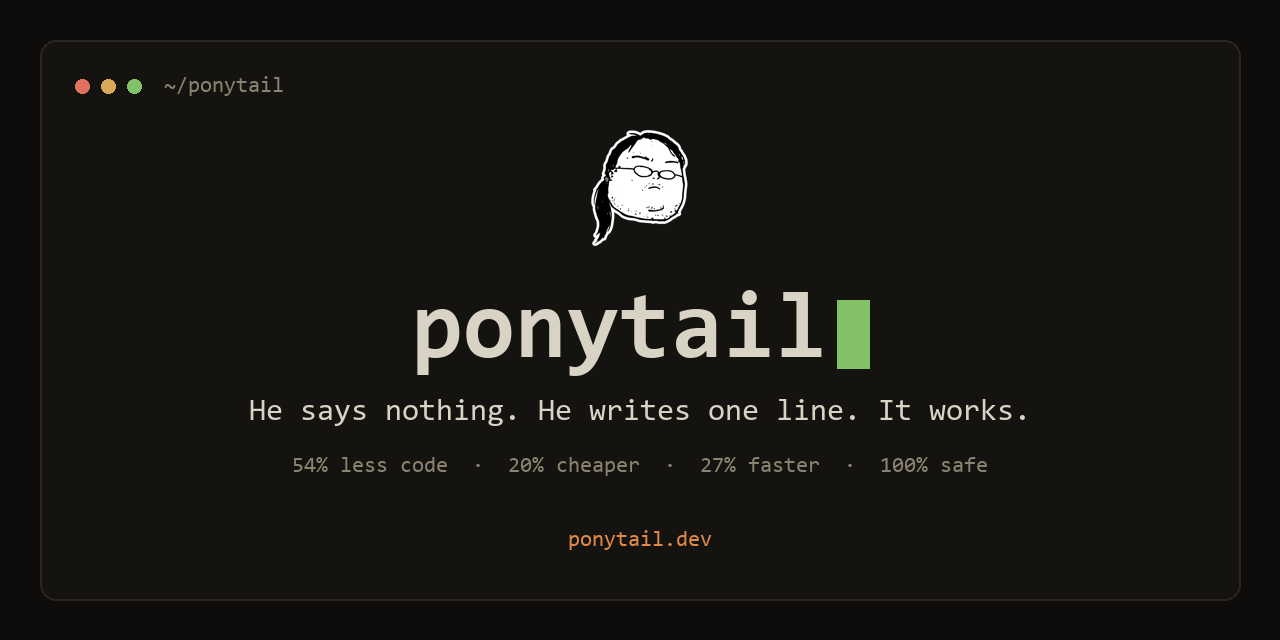
The project ships a small command surface: /ponytail-review hunts for overengineering in a diff, /ponytail-audit scans an entire repo for bloat, and /ponytail-debt tracks shortcuts the agent took. Reported benchmarks claim 54% less code and 22% fewer tokens, which also translates to lower API spend on agentic workflows. It's MIT-licensed and distributed via plugin marketplaces for 14+ agents, so adoption is a copy-paste rather than a service signup.
This is not a standalone model or IDE; it's a behavioural overlay. That makes it useful mainly to teams already paying for an agentic coding tool who feel their agents are generating too much speculative scaffolding, and less useful to people who want a turnkey product or who like exploratory, verbose code generation.
Ponytail solves a real and growing problem: agents generate too much code, and that costs both tokens and review time. As an MIT ruleset rather than a SaaS, the risk of trying it is zero, and the audit/debt commands are a clever addition. We'd treat the headline benchmarks with mild skepticism until reproduced externally.
— The AI Tool Bible editorial team
Pros
- ✅ Free and MIT-licensed, no signup
- ✅ Works across 14+ coding agents (Claude Code, Cursor, Windsurf, etc.)
- ✅ Concrete commands for review, audit, and tech-debt tracking
- ✅ Targets real pain: agentic over-generation and token waste
- ✅ Tunable intensity (Lite/Full/Ultra) for team taste
Cons
- ⚠️ Only as good as the host agent it overlays
- ⚠️ Benchmark claims (54% less code, 22% fewer tokens) are self-reported
- ⚠️ No standalone product, model, or API of its own
- ⚠️ Risk of suppressing legitimate scaffolding if Ultra mode is left on
Use cases
Frequently asked
- How much does Ponytail cost?
- Ponytail is completely free and open-source under the MIT license. It is distributed via plugin marketplaces, so adoption is a simple copy-paste process rather than a paid service signup.
- Which AI coding agents does Ponytail support?
- It works as an overlay for 14+ agentic coding tools, including Claude Code, Cursor, and Windsurf. It is not a standalone IDE or model but a configuration layer that sits on top of existing agents.
- How does Ponytail reduce code generation?
- It uses a seven-step decision ladder to check if code is necessary, if it exists in the repo, or if stdlib handles it. This enforces a minimal-code style, reportedly reducing code by 54% and tokens by 22%.
- Is Ponytail suitable for beginners?
- It is best for teams already using agentic coding tools who want to reduce speculative scaffolding. It is less useful for those wanting a turnkey product or who prefer verbose, exploratory code generation styles.
- What commands does Ponytail provide?
- It includes /ponytail-review to find overengineering in diffs, /ponytail-audit to scan repos for bloat, and /ponytail-debt to track shortcuts. Three intensity modes (Lite, Full, Ultra) let you adjust enforcement levels.
Explore related
Compare with similar tools
All in Coding →Cursor
FeaturedAI-first VS Code fork — chat, edit, and agentic coding in one IDE.
GitHub Copilot
FeaturedThe original AI pair programmer, now with chat and agents.
Replit Agent
FeaturedBuild & deploy a full app from a single prompt.
Warp
The agentic development environment, from the terminal up
Cline
Open-source agentic coding assistant that plans, edits, and runs code inside your IDE
Aider
Terminal-based AI pair programmer that writes commits.