Perplexity AI
Conversational answer engine that cites its sources by default.
In short
Perplexity AI is a search-first answer engine that provides cited, paragraph-style responses using live web data and multiple frontier models for research and analysis.
Pick Perplexity AI if you want an answer engine that shows its work, with cited sources for every claim and a fast Pro tier across multiple frontier models.
Skip it if your workflow is mostly long-form writing, coding agents, or anything where live web grounding adds noise rather than value.
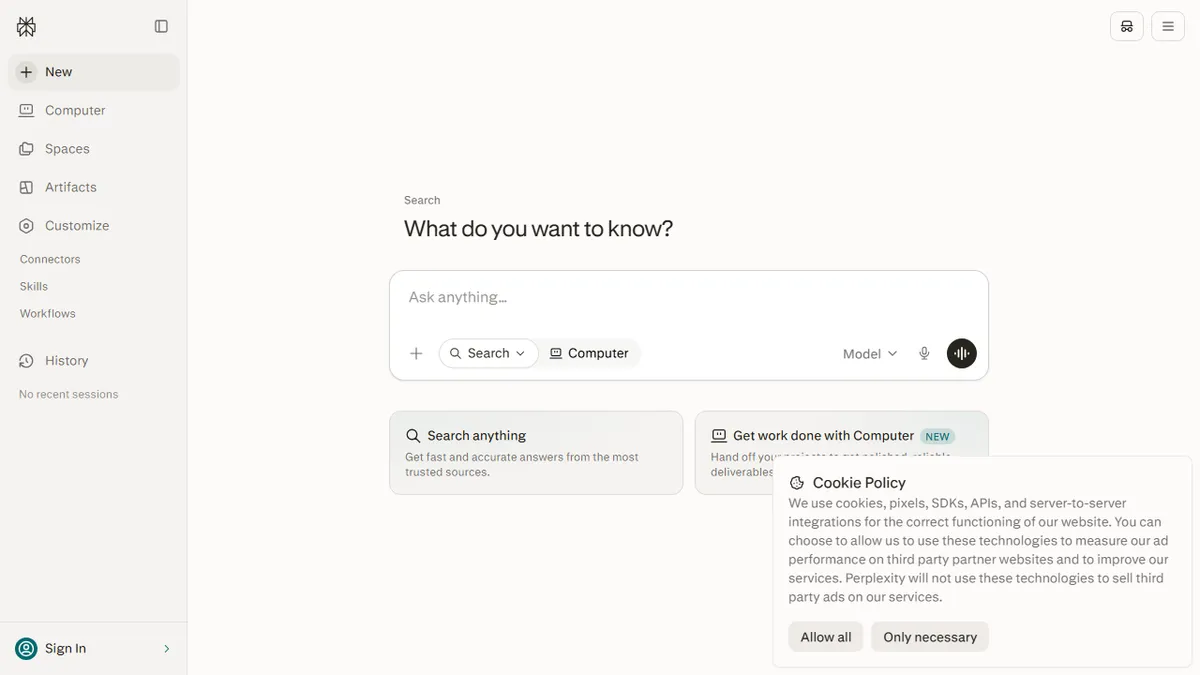
Perplexity is an AI-powered answer engine that combines live web search with large language models to return cited, paragraph-style responses instead of a list of blue links. You ask a question, it retrieves relevant pages, synthesizes an answer, and footnotes each claim back to the source — closer to a research assistant than a chatbot. It supports follow-up questions, threaded conversations, image generation, file uploads, and a 'Spaces' feature for organizing project-specific research.
The differentiator versus ChatGPT or Claude is the search-first architecture and inline citations, which makes it the default for journalists, analysts, and anyone who needs to trace where an answer came from. The free tier covers unlimited basic searches; Perplexity Pro ($20/mo) unlocks 'Pro Search' (multi-step reasoning), file uploads, image generation, and a model picker that includes GPT-4-class models, Claude, and their in-house Sonar models. There's also Perplexity Enterprise for teams and a separate API ('Sonar API') for developers who want grounded-search-as-a-service.
Caveats: answers can still hallucinate or misread sources — citations help but don't eliminate the need to spot-check — and the free tier's default model is noticeably weaker than Pro Search. The browser ('Comet') and mobile apps are solid, and the Sonar API has become a popular RAG shortcut for builders who don't want to run their own web-search-plus-LLM pipeline.
Perplexity is the AI tool we reach for when the question is 'what is currently true' rather than 'help me write something'. The citation-first UX raises the bar for trustworthy AI answers, and the Sonar API has quietly become one of the cleanest ways to bolt grounded search onto your own app. Just don't trust footnotes blindly.
— The AI Tool Bible editorial team
Pros
- ✅ Inline citations on every answer make fact-checking fast
- ✅ Live web grounding by default — won't go stale like a static LLM
- ✅ Model picker on Pro covers GPT, Claude, Gemini, and Sonar
- ✅ Sonar API gives developers grounded search-plus-answer in one call
- ✅ Spaces and file upload turn it into a real research workspace
Cons
- ⚠️ Citations don't guarantee accuracy — sources can still be misread
- ⚠️ Free-tier default model is meaningfully weaker than Pro Search
- ⚠️ Less useful for long-form writing or creative work than ChatGPT/Claude
Use cases
Frequently asked
- How much does Perplexity AI cost?
- Perplexity offers a freemium model. The Basic tier is $10, Pro is $30, and Enterprise requires contacting sales. The free tier covers unlimited basic searches, while Pro unlocks advanced features like file uploads and image generation.
- Which AI models does Perplexity use?
- Perplexity utilizes a multi-model approach, including their in-house Sonar models, GPT-4 class models, Claude, and Gemini. Pro users can select from these frontier models via a model picker to suit different research needs.
- Is Perplexity better than ChatGPT for research?
- Perplexity is designed for research with a search-first architecture and inline citations, making it ideal for tracing sources. ChatGPT and Claude are better for long-form writing or coding where live web grounding might add noise.
- Can developers use Perplexity for RAG applications?
- Yes, the Sonar API provides grounded-search-as-a-service. It is a popular RAG shortcut for builders who want to integrate web-search-plus-LLM pipelines without running their own infrastructure.
- Does Perplexity guarantee accurate answers?
- No, answers can still hallucinate or misread sources. While citations help trace claims, the documentation notes that users must still spot-check information. The free tier's default model is also noticeably weaker than Pro Search.
Explore related
Compare with similar tools
All in RAG →Pinecone
FeaturedManaged vector database for production-scale similarity search.
LlamaIndex
FeaturedData framework for connecting LLMs to your data.
Elasticsearch Vector Search
Hybrid vector + keyword search in the enterprise-grade Elasticsearch engine
Snowflake Cortex
Generative AI and RAG built into the Snowflake data cloud
DataStax Astra DB
Serverless vector and document database for production RAG and AI agents
MongoDB Atlas Vector Search
Vector search built into the operational database you're already using.