Pathway
Live data framework for production RAG and streaming ETL pipelines in Python.
In short
Pathway is a Python framework for building real-time data pipelines with a focus on production-grade Retrieval-Augmented Generation. It is best for teams needing live indexing from changing sources like SharePoint or Kafka without rebuild jobs. The tool uses a Rust core with a Python API to continuously parse, embed, and serve data to LLMs.
Pick Pathway if you're building production RAG over constantly changing sources (Drive, SharePoint, Kafka) and need freshness without rebuild jobs.
Skip it if you just want a quick prototype RAG over static PDFs - LlamaIndex or a hosted vector DB will get you there faster.
Pathway is a Python-first framework for building real-time data pipelines, with a strong focus on production-grade Retrieval-Augmented Generation. Instead of stitching together a vector store, ingestion job, and orchestration glue, you describe the pipeline once and Pathway keeps it live: documents flowing in from S3, SharePoint, Google Drive, Kafka, or Postgres are continuously parsed, embedded, indexed, and served to your LLM with low-latency freshness.
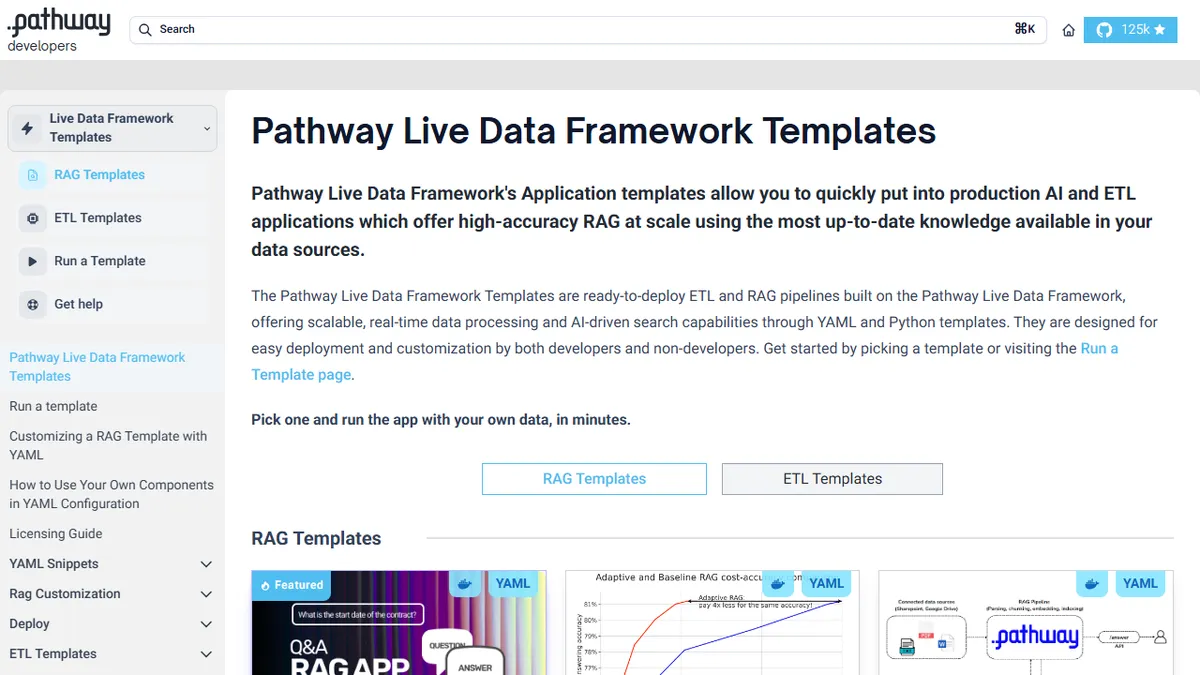
The Templates library is the practical entry point. It ships ready-made YAML and Python recipes for question-answering RAG, multimodal RAG over PDFs and images, adaptive RAG, private RAG with Ollama, and various ETL/anomaly-detection patterns. The engine itself is a Rust core with a Python API, licensed under BSL 1.1 for self-hosting, which makes it genuinely usable for teams who can't ship data to a hosted vector DB. Pricing scales from a free Community tier (8 GB RAM, 4 cores) through Scale and Enterprise tiers with managed deployment.
Pathway sits closer to the data-engineering end of the RAG stack than tools like LlamaIndex or LangChain. Native connectors cover Kafka, Delta Lake, Airbyte, Postgres, and most major object stores, and the same pipeline handles batch and streaming without rewrites. The trade-off is a learning curve: you're writing dataflow code, not stringing together prompt chains.
Pathway is one of the few RAG frameworks that takes streaming seriously, and the live-indexing story is the real differentiator versus rebuild-on-cron setups. The BSL license and Python API make it a reasonable bet for teams who want to own their stack. Expect to write dataflow code, not glue.
— The AI Tool Bible editorial team
Pros
- ✅ Genuinely live indexing - documents update without rebuild jobs
- ✅ Self-hosted under BSL 1.1, no data leaves your infra
- ✅ Rich connector library (Kafka, S3, SharePoint, Postgres, Delta Lake)
- ✅ Same pipeline handles batch and streaming
- ✅ 20+ production-ready templates including multimodal and adaptive RAG
Cons
- ⚠️ Steeper learning curve than prompt-chain frameworks
- ⚠️ BSL is not OSI-approved - commercial restrictions apply at scale
- ⚠️ Smaller community than LangChain/LlamaIndex
- ⚠️ Pricing for Scale/Enterprise tiers not transparent
Use cases
Frequently asked
- What is the primary use case for Pathway?
- Pathway is designed for building production RAG over constantly changing sources such as Google Drive, SharePoint, and Kafka. It ensures data freshness without requiring manual rebuild jobs.
- How does Pathway handle data ingestion and processing?
- The framework continuously parses, embeds, indexes, and serves documents from sources like S3, Kafka, and Postgres. It handles both batch and streaming data within the same pipeline without requiring rewrites.
- What licensing model does Pathway use?
- Pathway is licensed under BSL 1.1 for self-hosting, which allows data to remain within your infrastructure. It offers a free Community tier with 8GB RAM and 4 cores, along with Scale and Enterprise tiers.
- Is Pathway suitable for quick RAG prototyping?
- It is not recommended for quick prototypes over static PDFs, as tools like LlamaIndex may be faster for that purpose. Pathway involves a steeper learning curve because you write dataflow code rather than stringing together prompt chains.
- What templates are available in the Pathway library?
- The Templates library includes ready-made YAML and Python recipes for question-answering RAG, multimodal RAG over PDFs and images, adaptive RAG, private RAG with Ollama, and various ETL patterns.
Explore related
Compare with similar tools
All in RAG →Pinecone
FeaturedManaged vector database for production-scale similarity search.
LlamaIndex
FeaturedData framework for connecting LLMs to your data.
Elasticsearch Vector Search
Hybrid vector + keyword search in the enterprise-grade Elasticsearch engine
Snowflake Cortex
Generative AI and RAG built into the Snowflake data cloud
DataStax Astra DB
Serverless vector and document database for production RAG and AI agents
MongoDB Atlas Vector Search
Vector search built into the operational database you're already using.