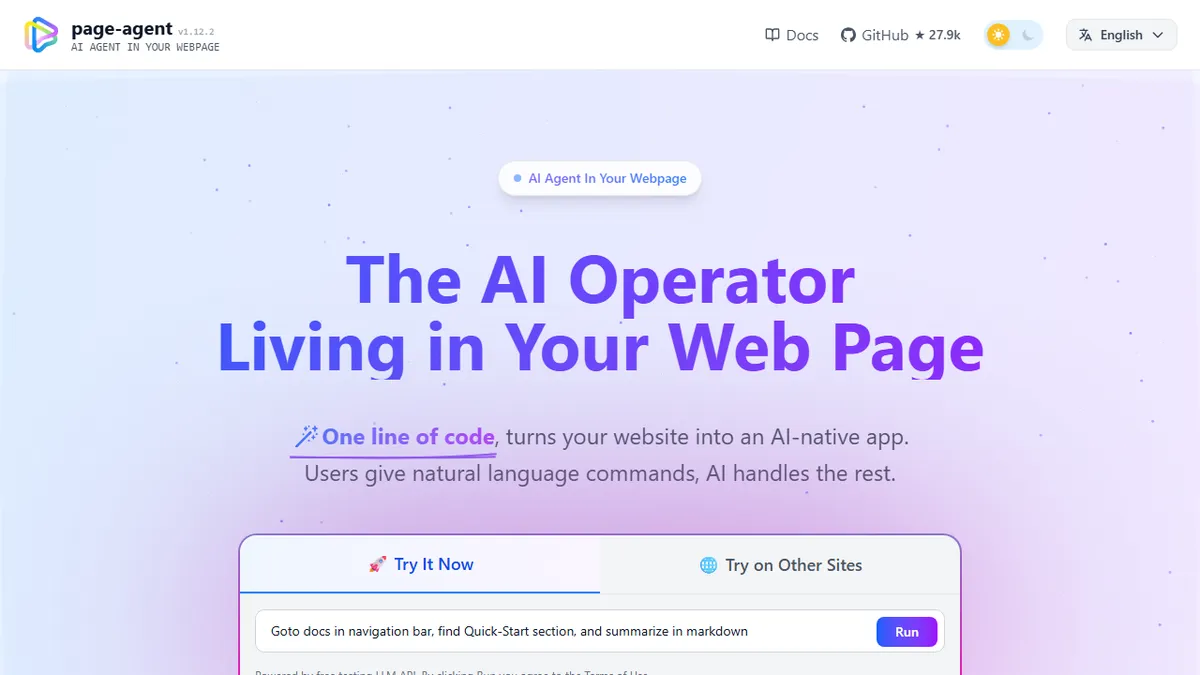

PageAgent
An in-page JavaScript GUI agent that drives web interfaces with natural language, no headless browser required.
In short
PageAgent is a free, MIT-licensed JavaScript library that embeds natural-language GUI agents directly into web pages. It uses your own LLM to drive interfaces without headless browsers.
Pick PageAgent if you're embedding a natural-language copilot into your own web app and want a lightweight, in-page agent rather than an external automation rig.
Skip it if you need a no-code, hosted agent platform or want to automate arbitrary third-party sites without engineering investment.
PageAgent is Alibaba's open-source GUI agent that runs as JavaScript inside the webpage itself, letting users control any web interface through natural-language commands. Unlike Playwright-style automation or screenshot-based vision agents, it reads the DOM as text and dispatches actions in-process, which means no Python runtime, no headless Chromium, and no multimodal model bill. An optional Chrome extension extends it to cross-tab workflows, and there's beta MCP server support.
It's model-agnostic: you bring your own LLM (Qwen, GPT, Claude, or anything you can hit over HTTP), and a free demo endpoint is provided for kicking the tires. The intended audience is engineers embedding copilots into SaaS dashboards, teams automating form-heavy ERP/CRM flows, and accessibility builders who want voice-driven web apps. Because everything runs client-side, latency and cost are largely a function of whichever LLM you wire up.
The project is MIT-licensed with significant traction on GitHub (20k+ stars). It's a library, not a hosted product, so expect to read code and integrate it yourself rather than sign up for a dashboard.
A refreshingly pragmatic take on browser agents: skip the headless Chromium, skip the vision model, just read the DOM as text and let the LLM act through your own JS. It won't replace Playwright for general-purpose scraping, but for embedding a copilot inside the SaaS you already ship, it's the right altitude.
— The AI Tool Bible editorial team
Pros
- ✅ Runs in-page as JS, no headless browser or Python stack needed
- ✅ Text-based DOM approach avoids costly multimodal vision models
- ✅ Model-agnostic — plug in any LLM you already pay for
- ✅ MIT-licensed and actively maintained by Alibaba
- ✅ Optional Chrome extension covers multi-tab workflows
Cons
- ⚠️ A library, not a product — you build the UX around it
- ⚠️ Text-only DOM reading struggles with canvas/WebGL-heavy apps
- ⚠️ Requires engineering work to integrate safely into production
Use cases
Frequently asked
- How much does PageAgent cost?
- PageAgent is free and MIT-licensed. You only pay for the LLM provider you wire in, such as Qwen, GPT, or Claude. A free demo endpoint is available for testing.
- Do I need a specific AI model?
- No, it is model-agnostic. You bring your own LLM, including Qwen, GPT, Claude, or any model accessible via HTTP. You choose the provider based on your latency and cost needs.
- Is PageAgent a hosted service?
- No, it is a library, not a hosted product. You must read the code and integrate it yourself into your web application. It is not a no-code platform.
- How does it differ from Playwright?
- PageAgent runs as JavaScript inside the webpage, reading the DOM as text. It does not require a Python runtime, headless Chromium, or screenshot-based vision models, making it lighter for in-page integration.
- Who is PageAgent best for?
- It is best for engineers embedding copilots into SaaS dashboards, teams automating form-heavy ERP/CRM flows, and accessibility builders. It is not for users needing no-code hosted automation.
Explore related
Compare with similar tools
All in Agents →LangGraph
FeaturedStateful, graph-based agent orchestration from LangChain.
CrewAI
FeaturedPython framework for multi-agent orchestration.
Ernie Bot
Baidu's Mandarin-first ChatGPT rival, powered by the ERNIE model family
Moveworks
The enterprise AI assistant that searches, answers, and takes action across your business systems
AWS Bedrock
Build and scale generative AI applications with foundation models
Claude Agent SDK
Anthropic's official SDK for building autonomous Claude agents.