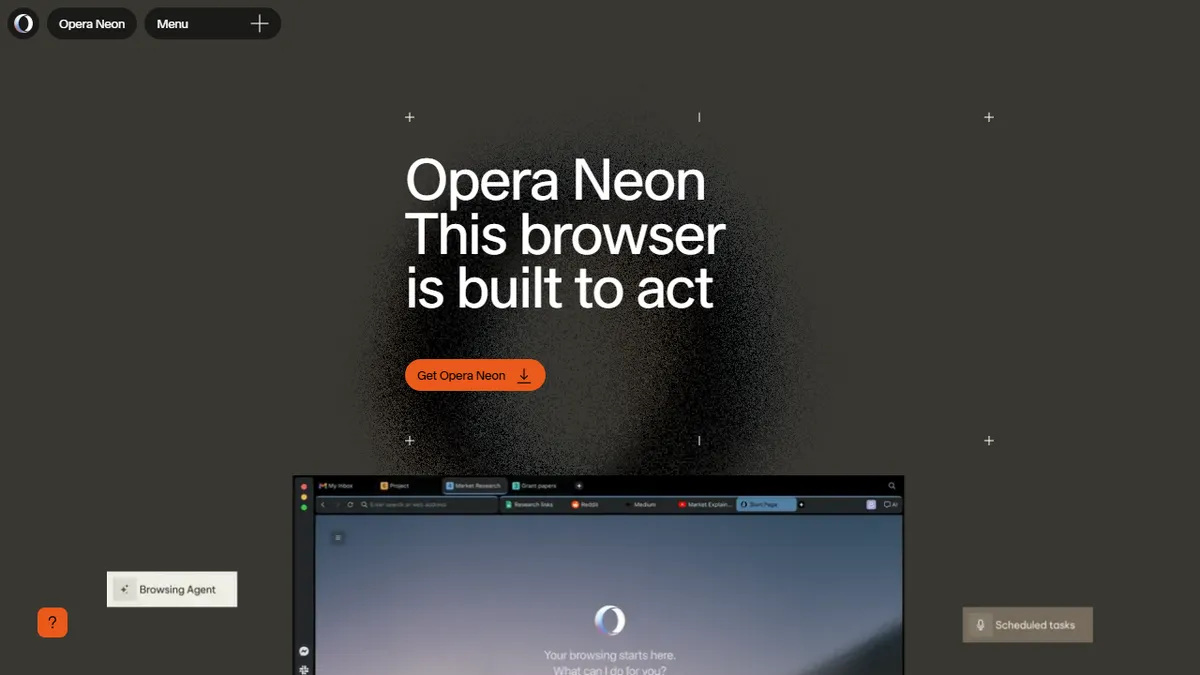

Opera Neon
✓ Editorially verifiedAn agentic browser from Opera built to act on the web, not just render it.
Power users, researchers and knowledge workers who live inside their browser and want AI agents that can act on tabs and produce artifacts, not just chat about them.
Users who want a free browser, teams that need transparent model disclosure and enterprise controls, or anyone unwilling to change default browsers to try an agent layer.
Opera Neon is Opera's agentic AI browser, relaunched in 2025 as a paid subscription product distinct from the free Opera One browser. Rather than bolting a chat sidebar onto a conventional browser, Neon positions AI agents as the primary way you interact with pages: specialised agents can build an agenda from your tabs, run multi-source web research, draft documents from what they read, and hand structured output back to you for review. It keeps the traditional Opera feature set underneath (advanced tab management, workspaces, built-in ad blocker, free VPN, sidebar messengers, snapshots) so it still works as a normal Chromium browser when you want one, but the differentiator is the agent layer that reads pages, maintains context across tabs, compares sources, and produces artifacts. Neon integrates with external tooling via MCP (Model Context Protocol) and CLI paths, which makes it interesting to developers who want the browser to be part of a wider agent stack rather than a walled garden. Typical workflows: sending an agent to compare vendor pricing across ten tabs, spinning up a research brief from a query, turning a cluster of open articles into a summary document, or letting an agent fill out repetitive multi-step web tasks while you supervise. Opera markets it as privacy-first and gives users controls over what agents can see and do, positioning it against Perplexity Comet, Arc's late-stage AI features, Dia, and The Browser Company's follow-ups.
Neon is the most credible agentic-browser attempt from an incumbent so far — Opera has the Chromium chops and the VPN/ad-block hygiene most rivals lack. The two things that keep it from being a slam-dunk right now are the opaque pricing page and the total silence on which model powers the agents. Worth trialling if you already like Opera; wait for third-party reliability tests if you don't.
— The AI Tool Bible editorial team
Pros
- ✅ Agents are first-class citizens: browser is built around them rather than treating chat as a sidebar afterthought.
- ✅ Backed by a 30-year-old browser vendor, so the underlying Chromium base, tab management, ad blocker and VPN are mature.
- ✅ MCP and CLI integration hooks make it composable with wider agent tooling instead of being locked in.
- ✅ Maintains context across tabs, which is genuinely useful for research and comparison tasks.
- ✅ Privacy-first framing with explicit controls over what agents can access.
- ✅ Ships as a full browser, so you do not have to swap tools mid-workflow to use the agent.
Cons
- ⚠️ Paid subscription with pricing not clearly published on the public marketing site, making it hard to evaluate cost upfront.
- ⚠️ Opera does not disclose which underlying LLM powers the agents, so buyers cannot judge model capability or data-handling directly.
- ⚠️ Agentic browsers are still an emerging category — reliability, hallucinated actions, and safety controls are unproven at scale.
- ⚠️ Competing with Perplexity Comet, Dia and Arc-style products means feature parity is a moving target.
- ⚠️ Switching your default browser is a high-friction commitment compared to trying a web app.
Use cases
Explore related
Compare with similar tools
All in Agents →LangGraph
FeaturedStateful, graph-based agent orchestration from LangChain.
CrewAI
FeaturedPython framework for multi-agent orchestration.
Ernie Bot
Baidu's Mandarin-first ChatGPT rival, powered by the ERNIE model family
Moveworks
The enterprise AI assistant that searches, answers, and takes action across your business systems
AWS Bedrock
Build and scale generative AI applications with foundation models
Claude Agent SDK
Anthropic's official SDK for building autonomous Claude agents.