OpenMontage
Open-source, agentic video production studio that plugs into your AI coding assistant.
In short
OpenMontage orchestrates AI coding assistants to handle the full video production pipeline, from research and scripting to asset generation and final render. It is best for technical creators who want a scriptable, provider-agnostic system that produces edited videos from real motion footage rather than single clips.
Technical creators, indie studios, and dev-savvy marketing teams who already live inside Claude Code / Cursor / Copilot and want a scriptable, provider-agnostic video pipeline they can extend and self-host.
Non-technical users who want a click-and-render web app, teams that need a closed-source-friendly licence, or anyone expecting a single "generate video" button without configuring providers or reviewing intermediate stages.
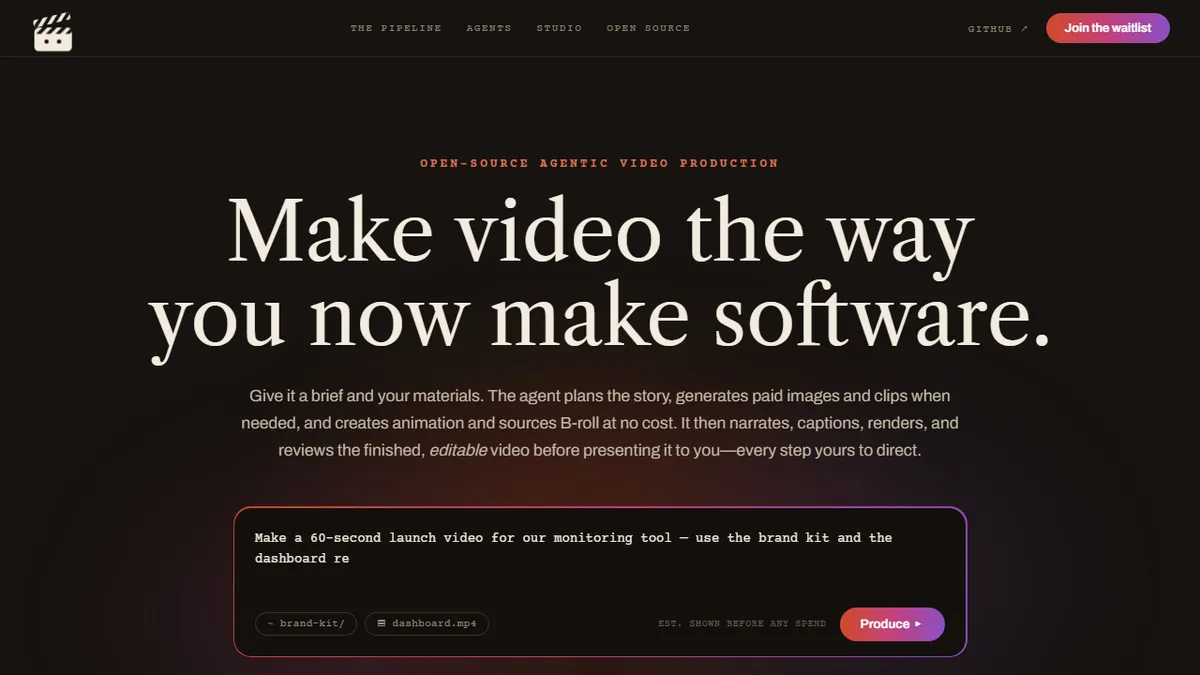
OpenMontage is an open-source, agentic video production system that turns an AI coding assistant (Claude Code, Cursor, Copilot, Windsurf, or Codex) into a full end-to-end video studio. Instead of generating a single clip from a prompt, it orchestrates the entire pipeline: research, scripting, scene planning, asset generation, editing, composition, and post-render QA. The distinguishing move is that it produces actually-edited videos from real motion footage - sourced from Kling, Runway Gen-4, Veo 3, HeyGen, MiniMax, and local GPU models, or from free archives like Pexels, Pixabay, Archive.org and Wikimedia - rather than animating still images.
The project ships 12 specialised pipelines (animated explainer, talking head, documentary montage, cinematic, avatar spokesperson, clip factory, screen demo, podcast repurpose, localisation and dub, hybrid, animation, trailer-style) plus 100+ tools spanning video generation (15 providers), image generation (11 providers including FLUX, Imagen, GPT Image 2, Recraft, Stable Diffusion), text-to-speech (ElevenLabs, Google TTS, OpenAI TTS, Kling, and offline Piper), music (Suno, ElevenLabs Music/SFX), and FFmpeg-based post. Composition is handled by Remotion (React), HyperFrames (HTML/CSS/GSAP), and raw FFmpeg. Around 700+ agent skill and knowledge files guide the coding assistant through each stage, with approval gates at proposal, script, assets, and publish steps, plus post-render self-review (ffprobe checks, frame sampling, slideshow-risk scoring, budget governance).
Typical workflow: you describe a video ("60-second animated explainer about neural networks"), the agent proposes an approach and budget, drafts a script with live web research, plans scenes, generates or fetches assets, assembles the edit, and runs automated QA before final render. Platform profiles for YouTube (including Shorts and 4K), Instagram Reels/Feed, TikTok, LinkedIn, and cinematic formats are built in. API keys are optional - functionality gracefully scales up with whichever providers you configure.
This is the most ambitious open-source video-agent project I've seen: it treats video production as an orchestration problem, not a generation problem, and the approval gates plus ffprobe-based self-review are a genuine step up from the usual "prompt in, mystery clip out" tools. The catch is that you really do need to be comfortable in a coding editor and willing to shop for provider keys - but if you are, the ceiling is far higher than any hosted competitor.
— The AI Tool Bible editorial team
Pros
- ✅ Genuine end-to-end pipeline (research to final render) rather than single-shot clip generation
- ✅ Provider-agnostic - 15 video, 11 image, 5 TTS providers plus free stock sources; scales with what you have keys for
- ✅ Runs at $0 using Piper TTS, Remotion, and free archive footage; paid providers are opt-in per run
- ✅ Multi-point human approval gates and automated post-render QA (ffprobe, slideshow-risk scoring, budget caps)
- ✅ 12 opinionated pipelines cover most common formats (explainer, talking head, documentary, cinematic, shorts)
- ✅ AGPL-3.0 open-source with extensible tool/pipeline modules and ~45k GitHub stars of community traction
- ✅ Built-in platform profiles for YouTube, Reels, TikTok, LinkedIn with correct aspect ratios and specs
- ✅ Works inside your existing coding editor - no separate SaaS dashboard to learn
Cons
- ⚠️ Requires an AI coding assistant subscription (Claude Code, Cursor, Copilot, etc.) - it is not a standalone app
- ⚠️ Local install with Python 3.10+, Node 18+, and FFmpeg prerequisites; not point-and-click for non-technical users
- ⚠️ Higher-quality outputs still depend on paid third-party APIs (Kling, Runway, ElevenLabs, Suno) that bill separately
- ⚠️ AGPL-3.0 copyleft makes it awkward to embed inside closed-source commercial products
- ⚠️ Agentic orchestration means longer runtimes and more moving parts than a single-prompt video generator
- ⚠️ Documentation and pipelines are evolving quickly; edge cases may require reading the source or joining Discussions
Use cases
Frequently asked
- How much does OpenMontage cost to use?
- The software is free and open-source under the AGPL-3.0 license. It can run at $0 using free providers like Piper TTS and archive footage, though optional paid providers typically cost $0.15 to $3 per video.
- Which AI coding assistants are compatible with OpenMontage?
- OpenMontage integrates with Claude Code, Cursor, Copilot, Windsurf, and Codex. It requires an existing subscription to one of these AI coding assistants to function.
- What types of video content can OpenMontage produce?
- It supports 12 specialized pipelines including animated explainers, talking heads, documentary montages, cinematic trailers, and podcast repurposing. It also includes built-in platform profiles for YouTube, Instagram, TikTok, and LinkedIn.
- Is OpenMontage suitable for non-technical users?
- No, it is not designed for non-technical users who want a click-and-render web app. It requires local installation with Python, Node, and FFmpeg, and users must be comfortable working within a coding editor.
Explore related
Compare with similar tools
All in Video →Runway
FeaturedPro-grade AI video editor and Gen-4 generation.
Sora
FeaturedOpenAI's flagship text-to-video model.
Luma Dream Machine
Fast, accessible text-to-video with strong camera control.
HeyGen
Avatar video + lip-sync translation at scale.
Google Veo
Google DeepMind's flagship text-to-video model with native audio generation and cinematic camera control.
Higgsfield
AI video and image generation suite that aggregates 30+ frontier models under one workflow.