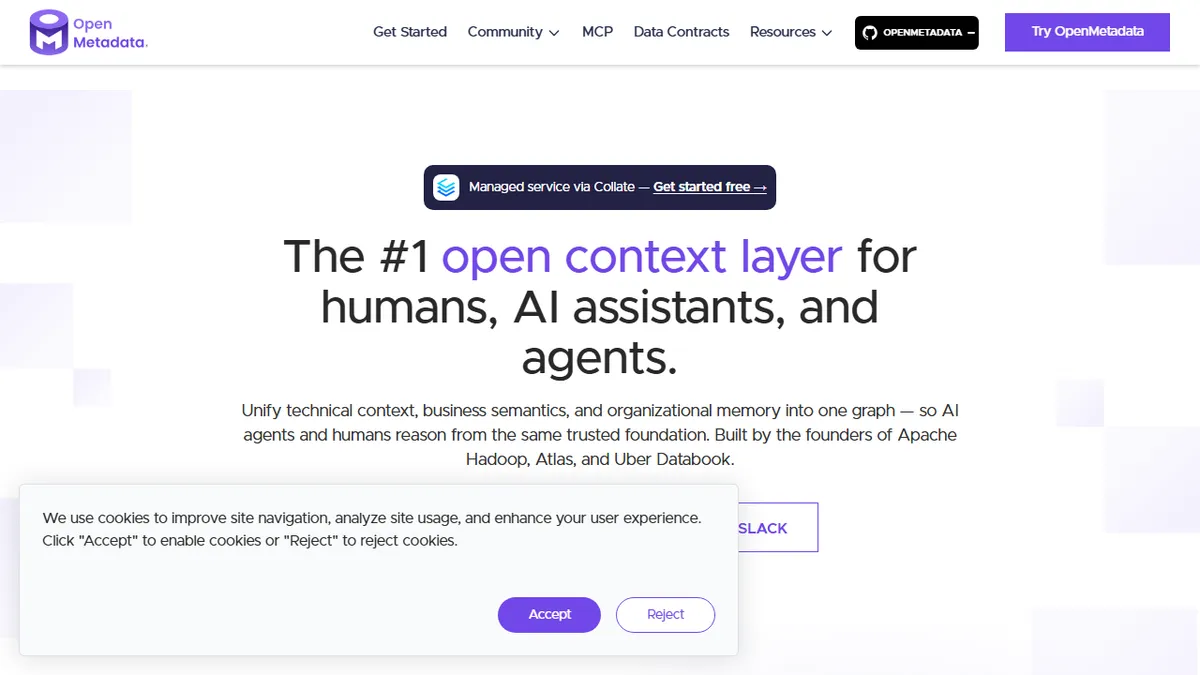

OpenMetadata
Open-source metadata platform that gives AI agents a semantic context graph over your data stack.
In short
OpenMetadata is an open-source data catalog that provides AI agents with a semantic context graph over your data stack. It is best for data platform teams needing to ground internal AI agents in trusted, governed metadata rather than raw schema names.
Pick OpenMetadata if you're a data platform team that needs a real catalog and wants internal AI agents to query governed metadata via MCP.
Skip it if you just want a quick RAG index over docs, or if you have no existing data-catalog problem to solve.
OpenMetadata is an open-source data catalog and governance platform that has repositioned itself around AI agent enablement. The core product handles the usual data-catalog responsibilities — discovery, lineage, classification, quality monitoring, glossaries — across 130+ connectors covering Snowflake, BigQuery, Databricks, Airflow, dbt, Tableau and similar. What makes it interesting in 2026 is the Semantic Context Graph layer and a native Model Context Protocol (MCP) server, which together let LLM agents query trusted, governed metadata about an organization's tables, columns, metrics and business terms instead of guessing from raw schema names.
It's aimed at data platform teams at companies large enough to have a real catalog problem (millions of assets, dozens of sources) but that also want their internal AI agents and copilots to ground answers in something other than a vector dump of Confluence. Self-hosted is free and genuinely usable — 14k+ GitHub stars, 450+ contributors — while Collate, the commercial SaaS run by the same team, offers a managed cloud version with a free tier. There's also a published AI SDK for programmatic agent access.
The trade-off is operational weight: this is enterprise catalog software, not a lightweight RAG indexer. Expect non-trivial deployment, ingestion pipelines per source, and a learning curve around the metadata model. If you don't already need a catalog, bolting one on just to feed an agent is overkill.
OpenMetadata is one of the few catalogs that has genuinely embraced the agent era, not just bolted on a chatbot. The MCP server plus Semantic Context Graph is the right architectural bet for grounding enterprise copilots. Just don't deploy it solely to make an LLM smarter — you need the catalog use case first.
— The AI Tool Bible editorial team
Pros
- ✅ Fully open-source with a large, active contributor base
- ✅ Native MCP server exposes governed metadata to any agent
- ✅ 130+ connectors across databases, BI, pipelines and ML
- ✅ Semantic Context Graph grounds LLM answers in trusted definitions
- ✅ Managed Collate cloud available if you don't want to self-host
Cons
- ⚠️ Heavy to deploy compared to lightweight RAG tools
- ⚠️ Real value only emerges at meaningful data-asset scale
- ⚠️ Agent/MCP layer is newer than the catalog core
- ⚠️ Metadata model has a learning curve for new teams
Use cases
Frequently asked
- How does OpenMetadata support AI agents?
- It features a Semantic Context Graph layer and a native Model Context Protocol (MCP) server. These allow LLM agents to query trusted, governed metadata about tables, columns, metrics, and business terms.
- What data sources does OpenMetadata connect to?
- The platform covers 130+ connectors, including Snowflake, BigQuery, Databricks, Airflow, dbt, and Tableau, handling discovery, lineage, and quality monitoring.
- Is OpenMetadata free to use?
- Yes, the self-hosted version is free open-source software. Additionally, Collate, the managed cloud version, offers a free tier alongside paid plans.
- Who should use OpenMetadata?
- It is aimed at data platform teams at companies with a real catalog problem, such as millions of assets and dozens of sources, who want their AI agents to use governed metadata.
- What are the deployment challenges of OpenMetadata?
- It is enterprise catalog software with non-trivial deployment requirements, including ingestion pipelines per source and a learning curve around the metadata model. It is not a lightweight RAG indexer.
Explore related
Compare with similar tools
All in Agents →LangGraph
FeaturedStateful, graph-based agent orchestration from LangChain.
CrewAI
FeaturedPython framework for multi-agent orchestration.
Ernie Bot
Baidu's Mandarin-first ChatGPT rival, powered by the ERNIE model family
Moveworks
The enterprise AI assistant that searches, answers, and takes action across your business systems
AWS Bedrock
Build and scale generative AI applications with foundation models
Claude Agent SDK
Anthropic's official SDK for building autonomous Claude agents.